
Class Reptilia
Order Squamata
Suborder Sauria
Family Crotaphytidae
Crotaphytus collaris—Eastern Collared Lizard // Gambelia wislizenii—Longnose Leopard Lizard
Synonyms. Iguanidae. The Iguanidae has been split into a number of families in recent years, of which the Crotaphytidae is one.
Two species of these relatively large, active predators are common in region today, and both are represented in our fossil record.
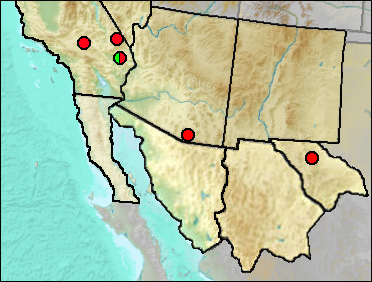
A number of different species of Crotaphytus has been recognized in recent years. Because of this, Czaplewski and Mead et al. (1999) felt that the fossil material from Papago Springs Cave should be left at the generic level pending new data.
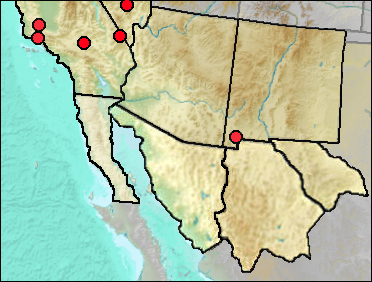
Sites.
Irvingtonian/Rancholabrean: Cadiz (Jefferson 2014: Cf.).
Rancholabrean: Mescal Cave (Jefferson 1991a).
Mid Wisconsin: Papago Springs Cave (Czaplewski and Mead et al. 1999).
Late Wisconsin/Holocene: Fowlkes Cave (Parmley and Bahn 2012); Solar One (Jefferson 1991a).
Literature. Czaplewski and Mead et al. 1999; Jefferson 1991a, 2014; Parmley and Bahn 2012.
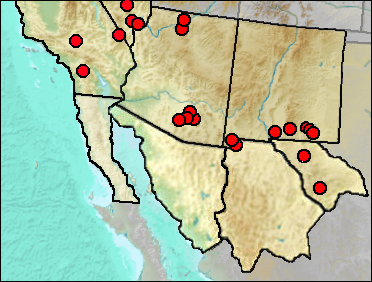
This large lizard is one of the two most common lizards recovered from the eastern portions of the region (the other being Phrynosoma hernandesi). It seemingly occurred throughout the Wisconsin record. It's currently widespread within the region and into southern Colorado except in the highest elevations.
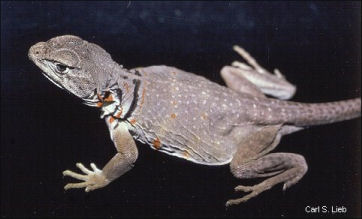
Fig. 1. Crotaphytus collaris. Photograph by Carl S. Lieb.
Applegarth (1979) believed it must have been at its upper altitudinal distributional limit during the full glacial at Dry Cave, with a frequency of lizard remains of 0.03% (after adjustment for relative recoverability). Both rocks and some open areas appear to be requirements, according to Applegarth.
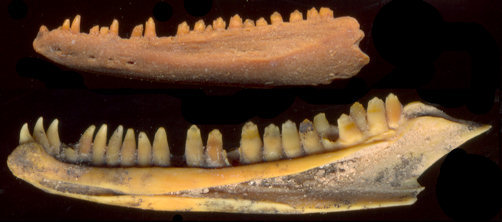
Fig. 2. Fossil dentaries of Crotaphytus collaris from U-Bar Cave. UTEP 5689-4-112 (top, labial view) and UTEP 5689-16.3 (bottom, lingual view).
Sites.
Rancholabrean: Piute Ponds (Jefferson 2014)
Early/Early-Mid Wisconsin: Lost Valley (Harris 1993c); Rm Vanishing Floor (Harris 1993c).
Mid Wisconsin: Pendejo Cave (Harris 2003); U-Bar Cave (Harris 1987).
Mid/Late Wisconsin: Animal Fair (Applegarth 1979); Dark Canyon Cave (Applegarth 1979); Diamond Valley (Spring et al. 2009); Pintwater Cave (Hockett 2000).
Mid Wisconsin-Holocene: Shelter Cave (Brattstrom 1964).
Mid/Late Wisconsin/Holocene: Sierra Diablo Cave (UTEP).
Late Wisconsin: Animal Fair 18-20 ka (Applegarth 1979); Antelope Cave (Reynolds, Reynolds, Bell, and Pitzer 1991); Bison Chamber (Holman 1970); Chuar Valley (Cole and Mead 1981); Desert Almond (Van Devender et al. 1977a); Gypsum Cave (Brattstrom 1954); Pendejo Cave (Harris 2003); Picacho Peak (Van Devender et al. 1991); Shafter Midden (UTEP); Tucson Mountains (Van Devender and Mead 1978); Vulture Cave (Mead and Phillips 1981); TT II (Harris 1993c); U-Bar Cave 14-15 ka (Harris 1989).
Pleistocene/Holocene: Wylde Cave (Brattstrom 1964).
Late Wisconsin/Holocene: Balcony Room (Holman 1970); Burnet Cave (Rickart 1977: cf. gen. et sp.); Deadman Cave (Mead et al. 1984); Howell's Ridge Cave (Van Devender and Worthington 1977); Kokoweef Cave (Reynolds, Reynolds, et al. 1991); Pendejo Cave (Harris 2003); Stanton's Cave (Olsen and Olsen 1984); Wolcott Peak (Van Devender and Mead 1978); Kokoweef Cave (Reynolds, Reynolds, et al. 1991); Wylde Cave (Brattstrom 1964).
Withdrawn. The record by Harris and Findley (1964) from the Isleta Caves apparently is Holocene.
Literature. Applegarth 1979; Brattstrom 1954, 1964; Cole and Mead 1981; Harris 1987, 1989, 1993c, 2003; Harris and Findley 1964; Hockett 2000; Holman 1970; Mead and Phillips 1981; Mead et al. 1984; Olsen and Olsen 1981; Reynolds, Reynolds, et al. 1991; Reynolds, Reynolds, Bell, and Pitzer 1991; Rickart 1977; Springer et al. 2009; Van Devender and Mead 1978; Van Devender and Worthington 1977; Van Devender et al. 1977a; Van Devender et al. 1991.
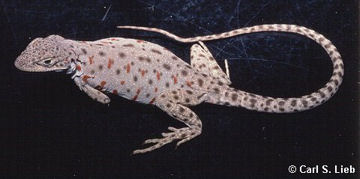
This is a large predatory lizard of open sandy or gravelly, desertscrub habitats (Applegarth 1979; Van Devender and Worthington 1977). Applegarth (1979) particularly emphasized the desirability of low-growing shrubs.
In view of its normal habitat of desertscrub, which is not known until late in New Mexico, the Howell's Ridge Cave likely is part of the Holocene fauna rather than being Late Wisconsin.
Fig. 1. Gambelia wislizenii. Photograph by Carl S. Lieb.
Sites.
Rancholabrean: Cool Water Coal Gasification Solid Waste Site (Jefferson 1991a).
Wisconsin: Carpinteria (Jefferson 1991a).
Mid Wisconsin: McKittrick (Jefferson 1991a).
Mid/Late Wisconsin: Pintwater Cave (Hockett 2000).
Late Wisconsin: Antelope Cave (Reynolds, Reynolds, Bell, and Pitzer 1991).
Late Wisconsin/Holocene: Howell's Ridge Cave (Van Devender and Worthington 1977); Kokoweef Cave (Reynolds, Reynolds, et al. 1991).
Literature. Applegarth 1979; Hockett 2000; Jefferson 1991a; Reynolds, Reynolds, et al. 1991; Reynolds, Reynolds, Bell, and Pitzer 1991; Van Devender and Worthington 1977.
Last Update: 25 May 2015