
Class Amphibia
Order Anura
Family Ranidae
Lithobates sp.—True Frogs // Lithobates catesbeianus—Bullfrog // Lithobates blairi/pipiens—Plains/Northern Leopard Frog // Lithobates pipiens Group—Leopard Frogs // Rana sp.—Brown Frogs // Rana aurora—Northern Red-legged Frog
The genus Rana has been split into two genera (in our region), with Rana (Brown Frogs) now restricted to taxa of the Pacific region and the remaining North American ranids being placed in the genus Lithobates (North American True Frogs). All specimens from our region were published under the name Rana.
Although ranids tend to be fairly easily identified to family from fragmentary remains, the recognition in recent years of a number of species earlier subsumed under the species Rana pipiens leaves many past identifications suspect and greatly complicates specific identification of medium sized "leopard frogs."
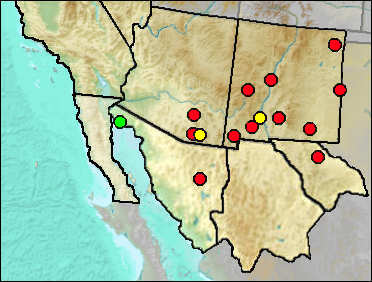
Some specimens have not been identified beyond the genus Lithobates and are listed here.
Synonyms. Rana
Sites.
Late Blancan: California Wash (Lindsay 1984); Kelly Canyon (Morgan et al. 2011).
Irvingtonian: El Golfo (Croxen et al. 2007).
Rancholabrean: Alkali Flat (Morgan and Lucas 2005); Starvation Draw (Morgan and Lucas 2005); Tramperos Creek (Morgan and Lucas 2005).
Wisconsin: White Lake (Harris 1993c).
Mid Wisconsin: Papago Springs Cave (Czaplewski and Mead et al. 1999); Térapa (Mead et al. 2006).
Late Wisconsin: Animal Fair (UTEP); Arroyo de las Tinajas 7A (UTEP); Blackwater Loc. No. 1 (Slaughter 1975); VLA (Morgan and Lucas 2005); TT II (UTEP).
Late Wisconsin/Holocene: Deadman Cave (Mead et al. 1984); Fowlkes Cave (Parmley 1988); Howell's Ridge Cave (UTEP).
Literature. Croxen et al. 2007; Czaplewski and Mead et al. 1999; Harris 1993c; Lindsay 1984; Mead et al. 1984; Mead et al. 2006; Morgan and Lucas 2005; Morgan et al. 2011; Parmley 1988; Slaughter 1975.
 Lithobates catesbeianus (Shaw
1802)—Bullfrog
Lithobates catesbeianus (Shaw
1802)—BullfrogSynonyms. Rana catesbeiana
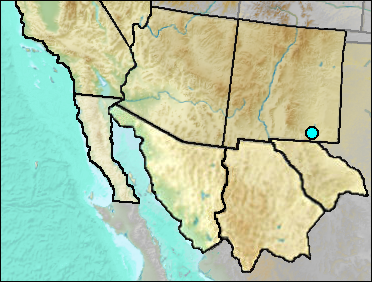
 Wiley (1972) reported this large frog from Dark Canyon Cave, but Applegarth found the
material (two vertebrae) to represent a large Woodhouse's Toad and a somewhat smaller,
unidentifiable toad. Johnson (1987) reported Bullfrog material from Lubbock Lake, in the Panhandle
of Texas east of our area.
Wiley (1972) reported this large frog from Dark Canyon Cave, but Applegarth found the
material (two vertebrae) to represent a large Woodhouse's Toad and a somewhat smaller,
unidentifiable toad. Johnson (1987) reported Bullfrog material from Lubbock Lake, in the Panhandle
of Texas east of our area.
This is an eastern species occurring west into the Great Plains. It has been widely introduced in historic times, including sites in New Mexico and Arizona.
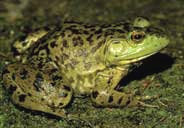
Fig. 1. Photograph of Lithobates catesbeianus, courtesy of the U.S. Geological Survey.
Rejected Sites.
Mid/Late Wisconsin: Dark Canyon Cave (Wiley 1972); misidentified according to Applegarth (1979).
Literature. Applegarth 1979; Johnson 1987; Wiley 1972.
Synonyms. Rana blairi/pipiens
Applegarth (1979) discussed the modern distribution and habitats of leopard frogs in New Mexico. Lithobates berlandieri represents a relatively warm-adapted species now reaching only extreme southeastern New Mexico; it is unknown from the region as a fossil. Lithobates blairi, in the same species group as L. pipiens, is characteristic of open grasslands in eastern New Mexico and isolated populations across southern New Mexico into southeastern Arizona. Lithobates pipiens occurs in the northern and western mountains and down the Rio Grande Valley as far as El Paso, Texas.
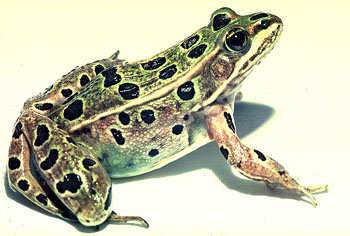
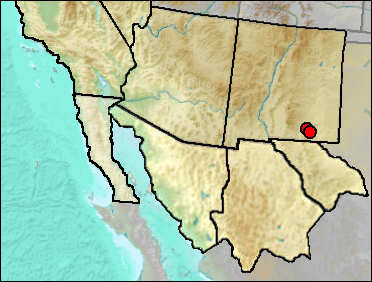
Applegarth (1979) believed some of the Animal Fair ranids represent Lithobates pipiens, but that possibly L. blairi also was present. He also noted that L. pipiens may be represented at Dark Canyon Cave.
Fig. 1. Lithobates pipiens. Image courtesy of USGS Western Ecological Research Center, photograph by Brad Shaffer.
Sites.
Mid/Late Wisconsin: Dark Canyon Cave (Applegarth 1979: cf.).
Late Wisconsin: Animal Fair 18-20 ka (Applegarth 1979); Bison Chamber (Harris 1993c).
Literature. Applegarth 1979; Harris 1993c.
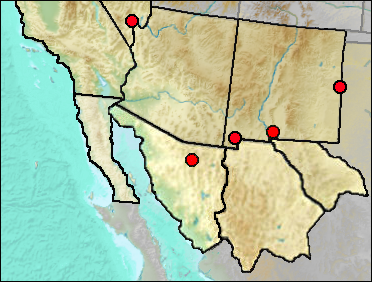
Synonyms. Rana pipiens Group
Most of the records given here were published as Rana pipiens (=Lithobates pipiens), but date from before the full extent of the leopard-frog taxonomic problem was appreciated. Thus they may represent L. pipiens or some other, related species.
Sites.
Sangamon: La Brisca (Van Devender et al. 1985).
Mid Wisconsin-Holocene: Shelter Cave (Brattstrom 1964: cf).
Late Wisconsin: Brown Sand Wedge (Slaughter 1975); Gypsum Cave (Brattstrom 1954).
Late Wisconsin/Holocene: Howell's Ridge Cave (Van Devender and Worthington 1977: cf.).
Literature. Brattstrom 1954; Morgan et al. 2011; Slaughter 1975; Van Devender and Worthington 1977; Van Devender et al. 1985.
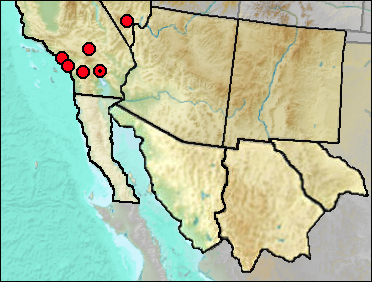
Placement to Rana rather than Lithobates is assumed.
Sites.
Rancholabrean: Bedford Properties (Jefferson 1991a); Tule Springs (Springer et al. 2005).
Rancholabrean/Early Holocene: Metro Rail Universal City Station (Jefferson 2014).
Sangamon: Naval Housing Unit (Jefferson 1991a: ? gen.); San Pedro Lumber Co. (Jefferson 1991a: cf. gen.).
Mid Wisconsin: Pacific City (Wake and Roeder 2009).
Mid/Late Wisconsin: Diamond Valley (Spring et al. 2009).
Late Wisconsin: La Mirada (Jefferson 1991a: cf. gen.).
Late Wisconsin/Holocene: Calico Lakes (Jefferson 1991a).
Literature. Jefferson 1991a, 2014; Springer et al. 2005, 2009; Wake and Roeder 2009.
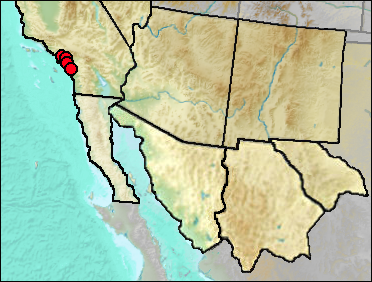
It is unclear whether the fossil taxa should be assigned to this species or to Rana draytonii (California Red-legged Frog). At the time these frogs were identified, R. draytonii was considered a subspecies of the Northern Red-legged Frog. Although it seems more likely that R. draytonii is the taxon involved, since the sites are within its current general range, it is listed here as given by Jefferson (1991a) and Brattstrom (1953).
Sites.
?Late Irvingtonian/Rancholabrean: Emery Borrow Pit (Jefferson 1991a).
Sangamon: Newport Bay Mesa (Jefferson 1991a).
Wisconsin: Costeau Pit (Jefferson 1991a).
Mid/Late Wisconsin: Rancho La Brea (Brattstrom 1953).
Literature. Brattstrom 1953; Jefferson 1991a.
Last Update: 5 Jan 2009