
Class Reptilia
Order Squamata
Suborder Serpentes
Family Dipsadidae
Diadophis punctatus—Ringneck Snake // Heterodon nasicus—Western Hognosed Snake // Hypsiglena—Nightsnakes // Hypsiglena chlorophaea—Desert Nightsnake // Hypsiglena jani—Chihuahuan Night Snake // Hypsiglena ochrorhyncha—Coast Nightsnake // Hypsiglena "torquata"—Nightsnake
In the past, the members of this family have usually been placed in the Colubridae, with Heterodon more recently placed in the Xenodontidae and, as of late 2009, Dipsadidae. These small snakes have enlarged, grooved teeth toward the back of the jaw that are used to introduce venom into their prey. They are generally considered harmless to humans.
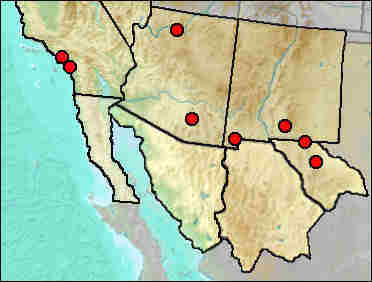
 Ringneck Snakes are widespread in the
Southwest, but mainly limited to woodlands between 1200 and 2200 m, although dispersal
along riparian corridors occurs; desertscrub is a definite barrier (Van Devender and
Worthington 1977).
Ringneck Snakes are widespread in the
Southwest, but mainly limited to woodlands between 1200 and 2200 m, although dispersal
along riparian corridors occurs; desertscrub is a definite barrier (Van Devender and
Worthington 1977).
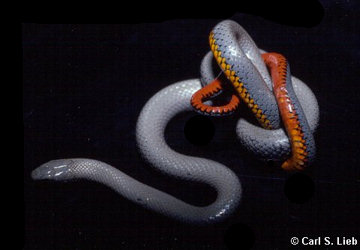
Fig. 1. Ringneck Snake. Carl S. Lieb photograph.
Sites.
Wisconsin: CC:5:5 (Mead et al. 2003).
Mid Wisconsin: Pendejo Cave (Harris 2003); Rancho La Brea (LaDuke 1991).
Late Wisconsin: Upper Sloth Cave (Logan and Black 1979).
Late Wisconsin/Holocene: Fowlkes Cave (Parmley 1990: cf.); Howell's Ridge Cave (Van Devender and Worthington 1977).
Literature. Harris 2003; LaDuke 1991; Logan and Black 1979; Mead et al. 2003; Parmley 1990; Van Devender and Worthington 1977.
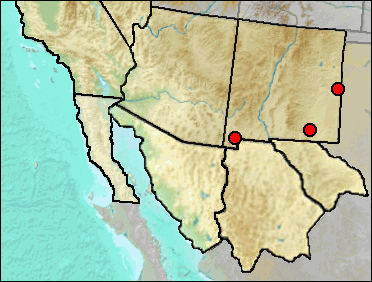
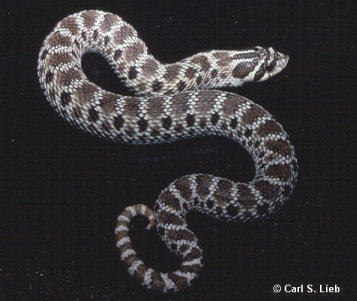 All records are from areas within the
present range of the Western Hognose Snake. Van Devender and Worthington (1977) give
the preferred habitat as grasslands with less common occurrence in desertscrub.
All records are from areas within the
present range of the Western Hognose Snake. Van Devender and Worthington (1977) give
the preferred habitat as grasslands with less common occurrence in desertscrub.
Sites.
Late Wisconsin: Blackwater Draw Fauna (Slaughter 1975: cf.); TT II (UTEP).
Late Wisconsin/Holocene: Howell's Ridge Cave (Van Devender and Worthington 1977).
Literature. Slaughter 1975; Van Devender and Worthington 1977.
Most records of Hypsiglena in our region were reported as H. torquata. However, Mulcahy (2008) recognized a number of species among populations previously recognized as H. torquata. The Pleistocene records have been parceled out according to the modern distribution (with the exception of those from southeastern Arizona, southwestern New Mexico, and northern Sonora—see below). This is deemed by me to be the lesser of two evils (the other evil is just recognizing all to the generic level only).
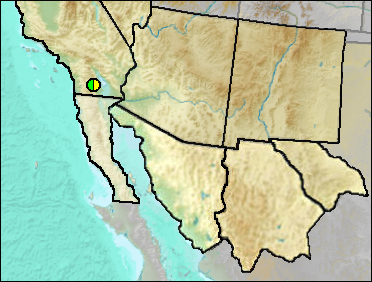
Sites.
Late Blancan/Irvingtonian: Vallecito Creek, Anza-Borrego Desert (Cassiliano 1999).
Literature. Cassiliano 1999.
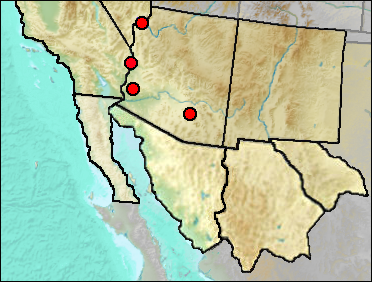
Synonyms. Hypsiglena torquata.
With the breakup of Hypsiglena torquata into several species, literature records of H. torquata have necessarily been listed here solely on the basis of present distribution.
Sites.
Late Wisconsin: New Water Mountains (Van Devender and Mead 1978); Picacho Peak (Van Devender et al. 1991; Red Tail Peak Midden (Jefferson 1991a); Vulture Canyon (Van Devender et al. 1977a); Vulture Cave (Mead and Phillips 1981); Wolcott Peak (Van Devender and Mead 1978).
Late Wisconsin/Holocene: Whipple Mountains Midden (Jefferson 1991a).
Literature. Jefferson 1991a; Mead and Phillips 1981; Van Devender and Mead 1978; Van Devender et al. 1977a; Van Devender et al. 1991.
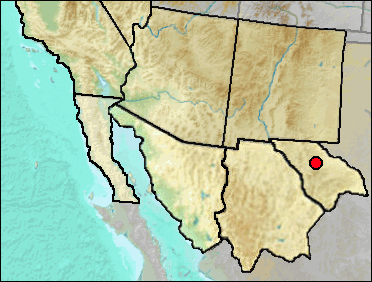
Synonyms. Hypsiglena torquata.
Sites.
Late Wisconsin/Holocene: Fowlkes Cave (Parmley 1990).
Literature. Parmley 1990.
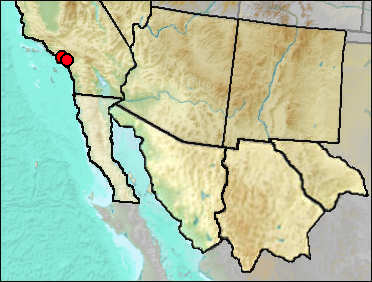
Synonyms. Hypsiglena torquata.
Sites.
?Late Irvingtonian/Rancholabrean: Emery Borrow Pit (Jefferson 1991a).
Mid Wisconsin: Rancho La Brea (LaDuke 1991).
Literature. LaDuke 1991.
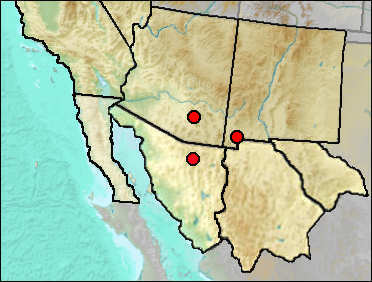
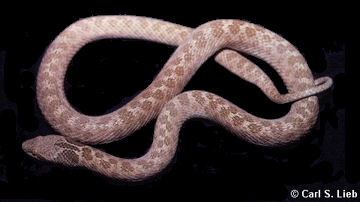
The night snakes pose a problem in identification of fossil material in southeastern Arizona, southwestern New Mexico, and northern Sonora. Mulcahy (2008) divided the species Hypsiglena torquata into a number of species, with three (H. chlorophaea, H. jani, and an unnamed species [Cochise clade]) in the region mentioned. Hypsiglena torquata itself was limited to Mexico. The records given here were identified as H. torquata before the splitting into separate species. Not only are there no known osteological features separating the species, but relatively small shifts in geographic ranges could put any of the three at a given fossil site. Thus I have retained the name H. torquata, but with the specific epithet in quotes.
Fig. 1. Hypsiglena torquata. Photograph courtesy of Carl S Lieb.
Van Devender and Worthington (1977) indicated that H. torquata was probably most common in desertscrub but also occupies elevationally higher habitats into pine forest.
Sites.
Sangamon: La Brisca (Van Devender et al. 1985).
Late Wisconsin/Holocene: Deadman Cave (Mead et al. 1984); Howell's Ridge Cave (Van Devender and Worthington 1977).
Literature. Mead et al. 1984; Mulcahy 2008; Parmley 1990; Van Devender and Worthington 1977; Van Devender et al. 1985.
Last Update: 26 Mar 2014