
Class Reptilia
Order Squamata
Suborder Sauria
Family Scincidae
Plestiodon gilberti—Gilbert's Skink // Plestiodon multivirgatus—Many-lined Skink // Plestiodon multivirgatus size—Size of Many-lined Skink // Plestiodon obsoletus—Great Plains Skink // Plestiodon skiltonianus—Western Skink
The Scincidae is a very large family distributed virtually worldwide except Antarctica. Our regional species recovered as fossils traditionally have been considered members of the genus Eumeces. However, recent taxonomic work (Smith 2005, Brandley et al. 2005) has indicated that the New World Eumeces are distinct from the Old World forms at the generic level. The North American Center for Herpetology has accepted Plestiodon as the correct name for the American taxa.
Literature. Brandley et al. 2005; Smith 2005.
Synonyms. Eumeces sp.
Various species of skinks are widespread in the Southwest.
Sites
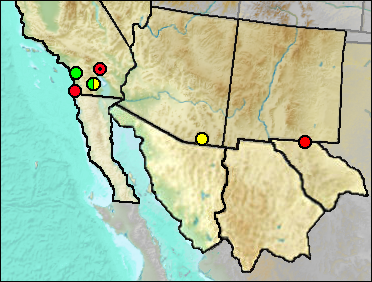
Late Blancan: California Wash (Lindsay 1984).
Late Blancan/Irvingtonian: Vallecito Creek, Anza-Borrego Desert (Cassiliano 1999).
Irvingtonian: Elsinore: Microtus/Mammuthus (Bell 1993).
Rancholabrean: Bedford Properties (Jefferson 1991a).
Wisconsin: Glen Abbey (Majors 1993).
Late Wisconsin: Upper Sloth Cave (Logan and Black 1979).
Literature. Bell 1993; Cassiliano 1999; Jefferson 1991a; Lindsay 1984; Logan and Black 1979; Majors 1993.
Sites
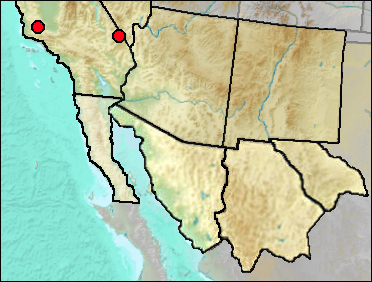
Mid Wisconsin: McKittrick (Jefferson 1991a).
Late Wisconsin: Antelope Cave (Reynolds, Reynolds, Bell, and Pitzer 1991: cf.)
Late Wisconsin/Holocene: Kokoweef Cave (Reynolds, Reynolds, et al. 1991).
Literature. Jefferson 1991a; Reynolds, Reynolds, et al. 1991; Reynolds, Reynolds, Bell, and Pitzer 1991.
Synonyms. Eumeces multivirgatus.
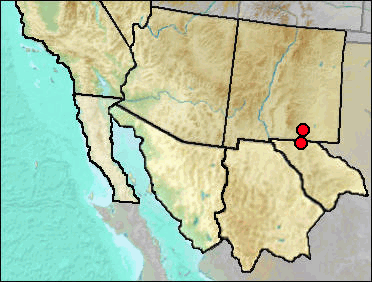
According to Applegarth (1979), P. multivirgatus tends, in the Southwest, to occur in mesic situations near permanent water. He identified the Many-lined Skink from the full-glacial "A" grid of Animal Fair, Dry Cave, on the basis of a frontal and a tibia; nine other items are consistent with this species. More than 18 items representing small Plestiodon were identified from the older, "F" grid. Applegarth suggested on the basis of these records, that permanent water likely was within 5 km of Dry Cave during the pre-pleniglacial and full-pluvial time span.
Sites
Late Wisconsin: Animal Fair 18-20 kya (Applegarth 1979); Animal Fair F2L5 (Applegarth 1979); Upper Sloth Cave (Logan and Black 1979).
Literature. Applegarth 1979; Logan and Black 1979.
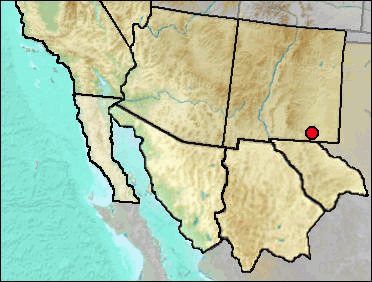
Applegarth (1979) identified one element of a small skink from Dark Canyon Cave. The size is consistent with P. multivirgatus and it probably represents that species.
Sites.
Mid/Late Wisconsin: Dark Canyon Cave.
Literature. Applegarth 1979.
Synonyms. Eumeces obsoletus.
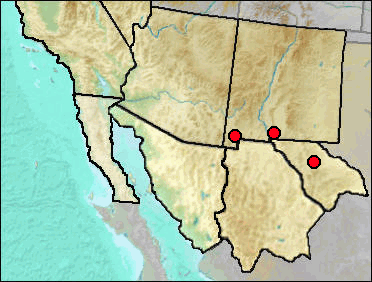
Van Devender and Worthington (1977) described the Great Plains Skink as an inhabitant of mesic canyons that may also extend out from the mountainous areas into riparian situations. Applegarth (1979) noted it as ranging widely in southern New Mexico in woodland and grassland situations, though tending to favor riparian habitat with rocks present.
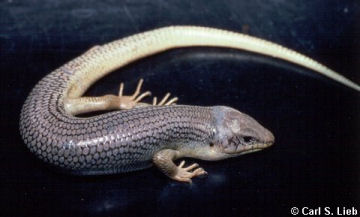
Fig. 1. Great Plains Skink (Plestiodon obsoletus). Photograph by Carl S. Lieb.
Applegarth (1979) ascribed absence from the Dry Cave full glacial as likely due to cool temperatures. The Wylde Cave record very likely is Holocene.
Sites.
Mid Wisconsin-Holocene: Shelter Cave (Brattstrom 1964).
Late Wisconsin/Holocene: Fowlkes Cave (Parmley and Bahn 2012: cf.); Howell's Ridge Cave (Van Devender and Worthington 1977); Wylde Cave (Brattstrom 1964).
Literature. Applegarth 1979; Brattstrom 1964; Parmley and Bahn 2012; Van Devender and Worthington 1977.
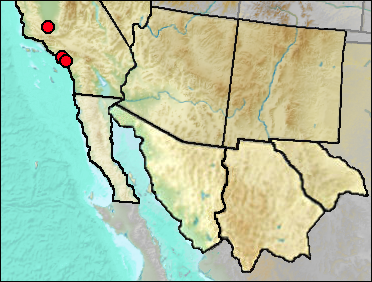
The Western Skink geographic range includes coastal southern California.
Sites.
?Late Irvingtonian/Rancholabrean: Emery Borrow Pit (Jefferson 1991a).
Mid/Late Wisconsin: Rancho La Brea (Brattstrom 1953).
Late Wisconsin: Maricopa (Jefferson 1991a).
Literature. Brattstrom 1953; Jefferson 1991a.
Last Update: 28 May 2014