
Class Mammalia
Order Perissodactyla
Family Equidae
Equidae—Family Equidae // Equidae sp.—Horses // Equus sp. (small)—Small Horse // Equus sp (large)—Large Horse // Equus calobatus—Stilt-legged Onager // Equus conversidens—Mexican Horse // Equus cumminsii—Cummings' Ass // Equus enormis—Enormous Horse // Equus fraternus—Fraternal Horse // Equus giganteus—Giant Horse // Equus occidentalis—Western Horse // Equus pacificus—Pacific Horse // Equus (Plesippus) sp.—American Zebra // Equus (Plesippus) francescana—Francescana Zebra // Equus (Plesippus) simplicidens—American Zebra // Equus Species A—Unidentified Equus // Haringtonhippus francisci—Harington's Stilt-legged Horse
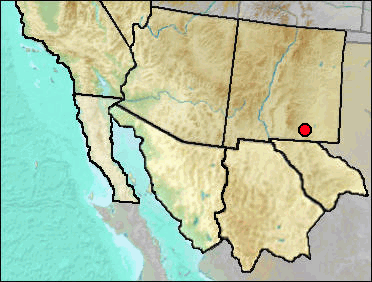
Horse material from the Camel Room site in Dry Cave appears quite different from other Dry Cave horses. Harris and Porter (1980) listed this as Species A. Quoting that publication (p. 61), "The dentition of 25-537 appears to be of a zebrine about the size of Burchell's zebra or somewhat smaller. It has, for example, all the zebrine features noted by McGrew (1944)—the V-shaped metaconid-metastylid groove and the well-developed parastylid and hypostylid on dP3 . As noted by Quinn (1955) in modern zebras, the ectoflexid intrudes well into the metaconid-metastylid column, dividing it into a pre-isthmus and a post-isthmus." The lower incisors lack an infundibulum.
We found no other late Wisconsin horse described that seems to fit the characters observed in the specimen, but preferred to leave this as Equus, Species A.

Fig. 1. Two sectioned lower teeth showing zebrine characters. UTEP 25-537. Scale in mm.
Sites.
Late Wisconsin: Camel Room (Harris and Porter 1980).
Literature.
Harris and Porter 1980; McGrew 1944; Quinn 1955.
Last Update: 13 Apr 2014