
Class Mammalia
Order Rodentia
Family Erethizontidae
Coendou sp. Prehensile-tailed Porcupine // Erethizon sp.—American Porcupines // Erethizon bathygnathum—Extinct Porcupine // Erethizon cascoensis—Casco Porcupine // Erethizon dorsata—American Porcupine
 The ancestor of
the porcupines moved north from South America following the completion of the Central American land
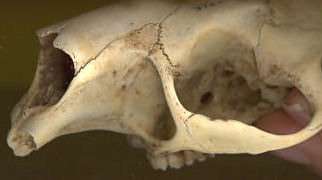
bridge in the Pliocene. In common with many South American rodents, the infraorbital foramen is
huge (Fig. 1).
The ancestor of
the porcupines moved north from South America following the completion of the Central American land
bridge in the Pliocene. In common with many South American rodents, the infraorbital foramen is
huge (Fig. 1).
Fig. 1. The infraorbital foramen is in about the center of the image, separated by a bar of bone from the orbit.
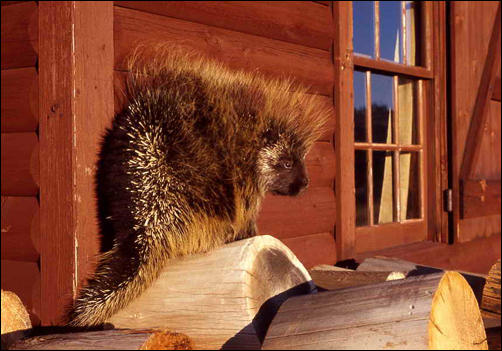
Fig. 2. American Porcupine. Photograph by Mary Meagher, courtesy of the Nation Park
Service.
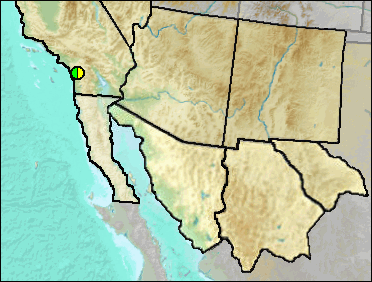
Living species of Coendou occur from about central Mexico south into Central and South America.
Sites.
Late Blancan/Early Irvingtonian: Elsinore: Mimomys (Pajak et al. 1996).
Irvingtonian: El Golfo (Croxen et al. 2007).
Literature.
Croxen et al. 2007; Pajak et al. 1996.
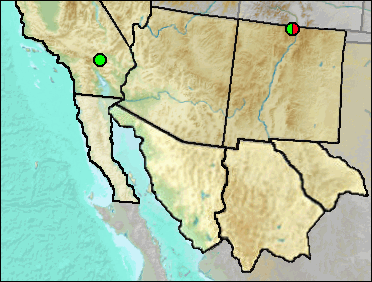
Rogers et al. (2000) recorded without comment Erethizon sp. from both the Irvingtonian and Wisconsin/Holocene deposits.
Sites.
Irvingtonian: SAM Cave (Rogers et al. 2000).
Early Irvingtonian: Gypsum Ridge (Wagner and Prothero 2001).
Wisconsin/Holocene: SAM Cave (Rogers et al. 2000).
Literature. Rogers et al. 2000; Wagner and Prothero 2001.
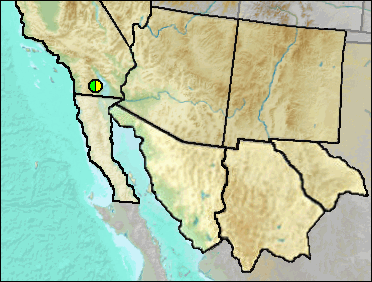
Sites.
Wilson (1935:220-221) described the taxon as having the ramus "deeper and more massive than in Recent species of Erethizon. M1 and M2 in comparison with P4 relatively larger than in the Recent North American porcupines. Size slightly larger than Erethizon epixanthum nigrescens [= E. dorsata]".
Late Blancan/Irvingtonian: Anza-Borrego (Murray 2008).
Literature. Murray 2008.
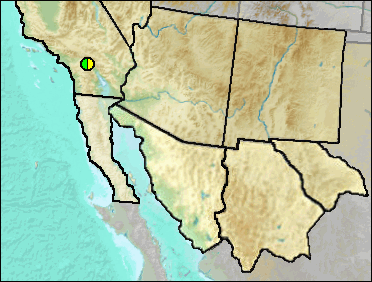
Synonyms. Coendou cascoensis
White (1970:3) gave the diagnosis as "Size near Erethizon, hypoflexus missing on P4 or lost early in tooth wear, upper cheek-tooth rows almost parallel and as close together as in markedly smaller species of Coendou.
The type locality is the San Timoteo formation, Casco local fauna (Albright 2000).
Sites.
Late Blancan: Jack Rabbit Trail, San Timoteo Badlands (Albright 2000: ?).
Early Irvingtonian: El Casco, San Timoteo Badlands (Albright 2000).
Literature. Albright 2000.
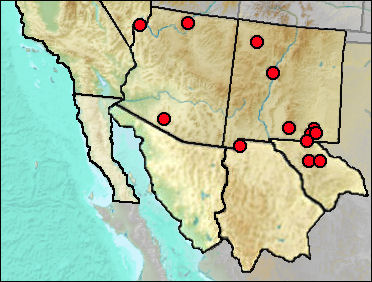
Synonyms. Erethizon epixanthum.
This large rodent is common today in our region. Although generally thought of as a woodland and forest creature, there are a number of records from creosotebush desert. In most of the literature until very recently, the specific portion of the species name was given as "dorsatum".
The cheek teeth of E. dorsata are rooted and the occlusal surfaces unique (Figs. 1 and 2). The only other Pleistocene rodent of our region possibly confusable with the porcupine is Castor canadensis (American Beaver), which has unrooted cheek teeth with complex occlusal surfaces that are quite different in detail from those of Erethizon. In suitable material, the very small infraorbital foramen of the beaver clearly separates it. Another notable difference is that the angular process of the porcupine is strongly inflected, unlike that of the beaver (Fig. 2).
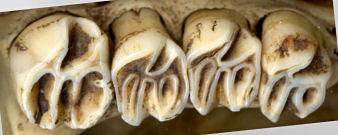
Fig. 1. Upper right toothrow of Erethizon dorsata. Anterior is to the left.
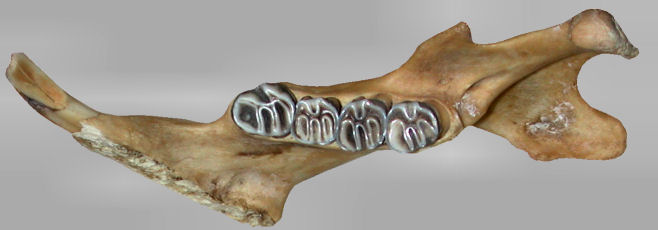
Fig. 2. Right dentary of E. dorsata, showing the character of the teeth and the inflected angular process.
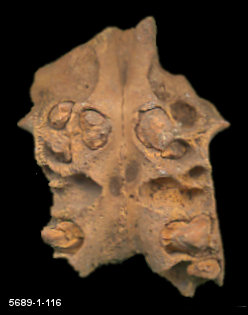
Fig. 3. Mid-Wisconsin palate of Erethizon dorsata (UTEP 5689-1-116) from U-Bar Cave.
Sites.
Wisconsin: Cave NE Dry Cave (Harris 1993c).
Early/Early-Mid Wisconsin: Rm Vanishing Floor (Harris 1993c: cf. gen. et sp.).
Mid Wisconsin: U-Bar Cave (Harris 1993c); Castle Mountains (Mead et al. 2005).
Mid/Late Wisconsin/Holocene: Sierra Diablo Cave (UTEP).
Late Wisconsin: Animal Fair 18-20 ka (Harris 1989); Big Manhole Cave (Harris 1993c); Bison Chamber (Harris 1989); Charlies Parlor (Harris 1989); Harris' Pocket (Harris 1970a); Human Corridor (Harris 1993c); Lower Sloth Cave (Logan 1983); Muskox Cave (Logan 1981); Rick's Cenote (Harris 1993c); Rampart Cave (Van Devender et al. 1977a); Vulture Cave (Mead and Phillips 1981).
Late Wisconsin/Holocene: Balcony Room (UTEP); Boyd's Cave (UTEP); Fowlkes Cave (Dalquest and Stangl 1984b); Isleta Cave No. 1 (Harris 1993c); Pendejo Cave (Harris 2003); Sheep Camp Shelter (Harris 1993c); Stanton's Cave (Olsen and Olsen 1984); Williams Cave (Ayer 1936); Wolcott Peak (Mead et al. 1983).
Literature. Ayer 1936; Dalquest and Stangl 1984b; Harris 1970a, 1989, 1993c, 2003; Logan 1981, 1983; Mead and Phillips 1981; Mead et al. 1983; Mead et al. 2005; Olsen and Olsen 1984; Van Devender et al. 1977a.
Last Update: 17 Jul 2014