
Class Mammalia
Order Carnivora
Family Felidae
Felis sp. (small)—Small Cat // Felis/Lynx—Cat or Bobcat // Felis rexroadensis—Rexroad Cat // Homotherium—Scimitar Cats // Homotherium crenatidens—Robust Scimitar Cat // Homotherium serum—Scimitar Cat // Lynx—Bobcat // Miracinonyx sp.—American Cheetah-like Cats // Miracinonyx inexpectatus—American Cheetah-like Cat // Miracinonyx trumani—American Cheetah-like Cat // Panthera—Roaring Cats // Puma—Cougar // Smilodon—Sabertooth Cats // Xenosmilus—Strange Cats
As a group, the cats are highly carnivorous, taking almost no plant material. This carnivory is revealed in part by the highly sectorial nature of the teeth, lacking the crushing features seen, for example, in the canids. All are relatively short-snouted and with the carnassial teeth close to the jaw articulation; this configuration confers power to both the front of the jaw and to the carnassial region. Tooth reduction has gone further in this family than in other carnivores (to 28 or 30 teeth total).
The living felids (and probably extinct forms as well) are stealth hunters, either stalking their prey or lying in ambush until the prey is close enough for a lunge or for a short chase. In line with these tactics, most modern species have spots or stripes that tend to blend into the background and to break up the outline of the animal. None is adapted for long term cursorial activity. Division of prey among the different modern taxa is largely on the basis of size.
The Felidae has long been abused by taxonomic splitters and lumpers. Some recent workers have recognized as many as 18 modern genera, while others have recognized as few as two. We will follow Wozencraft (2005), with five modern genera occurring within our region in addition to four extinct genera.
Re-examination of the single specimen (a damaged astragalus) of small felid from the Sabertooth Camel Maze site (not mapped) indicates that it is too small for Lynx, so appears to indicate presence of a smaller, unidentified felid.
Sites.
Early/Early Mid-Wisconsin: Sabertooth Camel Maze (Harris 1993c: as Lynx ?).
Literature.
Harris 1993c; Wozencraft 2005.
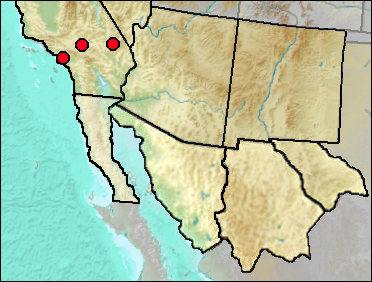
Sites.
Irvingtonian/Rancholabrean: Manix Lake (Jefferson 1991b).
Rancholabrean: San Pedro Lumber Yard (Jefferson 1991a).
Rancholabrean/?Early Holocene: Mitchell Caverns (Jefferson 1991b).
Literature. Jefferson 1991b.
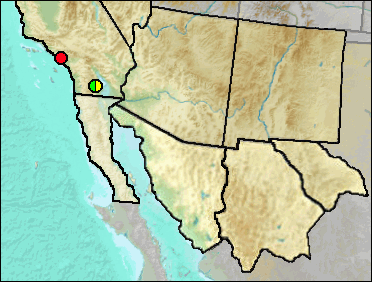
These may or may not belong to the genus Felis—changes in usages of genera within the Felidae make it uncertain as to what genus was meant. The criterion for the Anza-Borrego form is "smaller than Lynx rufus".
Sites.
Late Blancan/Irvingtonian: Anza-Borrego (Murray 2008).
Sangamon: Naval Fuel Reserve Quarry (Jefferson 1991b).
Mid/Late Wisconsin: Rancho La Brea (Stock and Harris 1992).
Literature. Jefferson 1991b; Murray 2008; Stock and Harris 1992).
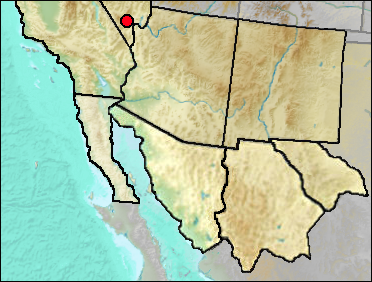
Sites.
Rancholabrean: Tule Springs (Mawby 1967: cf. gen.)
Literature. Mawby 1967.
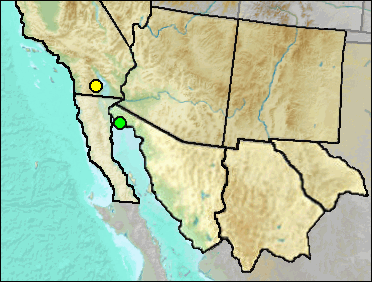
Synonyms. Lynx rexroadensis, Felis lacustris. Kurtén and Anderson (1980) listed this taxon as a synonym of Felis lacustris, but MacFadden and Galiano (1981) note that F. lacustris is enough larger as to best be considered a separate species.
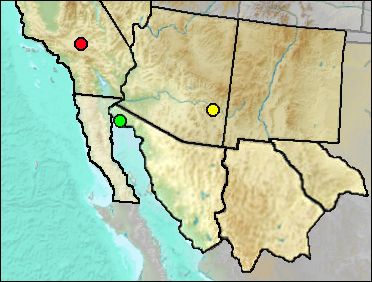
Sites.
Late Blancan: Anza-Borrego (Murray 2008).
Irvingtonian: El Golfo (Croxen et al. 2007).
Literature. Croxen et al. 2007; Kurtén and Anderson 1980; MacFadden and Galiano 1981; Murray 2008.
Kurtén and Anderson (1980:190) describe the dentition as follows:
In this genus, the sabers are relatively short, very flattened and recurved (like a scimitar) and have razor-sharp, serrated edges fore and aft. The other teeth also have serrated edges. The incisors are disposed in a curve. The carnassials are thin slicing blades.
Sites.
Late Blancan: 111 Ranch (Morgan and White 2005).
Irvingtonian: El Golfo (Croxen et al. 2007).
Irvingtonian/Rancholabrean: Manix Lake (Jefferson 1991b).
Literature.
Croxen et al. 2007; Jefferson 1991b; Kurtén and Anderson 1980; Morgan and White 2005.
Sites.
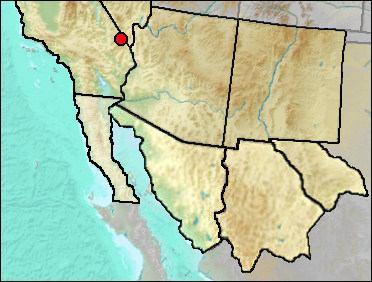
Irvingtonian/Rancholabrean: Lake Manix (Jefferson and Tejada-Fiores 1993)
Literature. Jefferson and Tejada-Fiores 1993).
Sites.
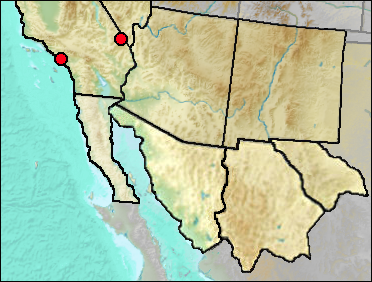
Irvingtonian/Rancholabrean: Lake Manix (Jefferson and Tejada-Fiores 1993: ?)
Mid/Late Wisconsin: Rancho La Brea (Stock and Harris 1992).
Literature. Jefferson and Tejada-Fiores 1993)Stock and Harris 1992).
Synonyms. Acinonyx.
The cheetah-like cats apparently were specialized for a cursorial mode of life, similar to that of the true, African Cheetah (Kurtén and Anderson 1980).
Sites.
Late Blancan: 111 Ranch (Morgan and White 2005).
Literature.
Kurtén and Anderson 1980; Morgan and White 2005.
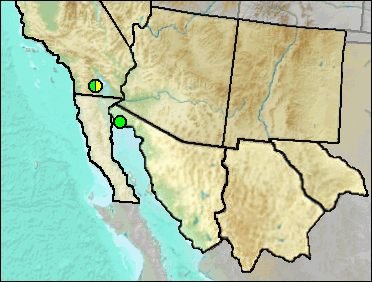
Synonyms. Acinonyx inexpectatus, Acinonyx studeri
This species is somewhat larger than M. trumani and likely was ancestral to that species (Kurtén and Anderson 1980).
Sites.
Late Blancan/Irvingtonian: Anza-Borrego (Murray 2008).
Irvingtonian: El Golfo (Croxen et al. 2007).
Literature.
Croxen et al. 2007; Murray 2008.
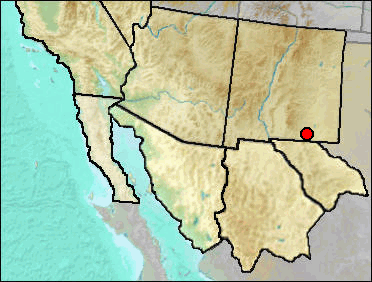
Synonyms. Acinonyx trumani, Felis trumani, Puma trumani.
Orr (1969) described this species on the basis of a late Wisconsin (19,750 ± 650 ka) skull from Crypt Cave, NV, as Felis trumani. Adams (1979) placed the New World cheetah-like cats in the Old World genus Acinonyx, represented by A. jubatus (Cheetah), but in a new subgenus, Miracinonyx. On the basis of new material, Van Valkenburgh et al. (1990) elevated Miracinonyx to the generic level. Ancient DNA data (Barnett et al. 2005) confirms Puma concolor as the sister species of M. trumani rather than A. jubatus.
"[Miracinonyx] is distinguished from other cats mainly by characters related to a highly cursorial mode of predation, most clearly reflected in the extremely elongated and slim limb bones, light body, and small head ...." (Kurtén and Anderson 1980:193).
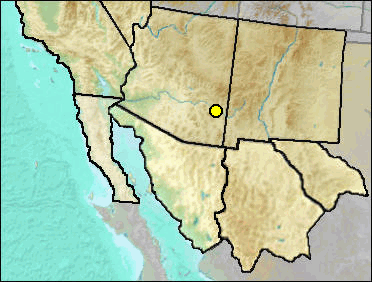
There is one late Wisconsin record of the American Cheetah in our region. The material on which this record is based hasn't been published.
Sites.
Late Wisconsin: Muskox Cave (Logan 1981).
Literature.
Adams 1979; Barnett et al. 2005; Kurtén and Anderson 1980; Logan 1981; Orr 1969; Van Valkenburgh et al. 1990.
Last Update: 12 May 2014