
Class Mammalia
Order Cingulata
Family Glyptodontidae
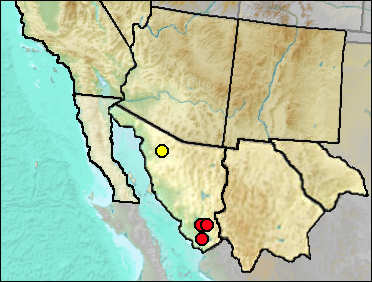
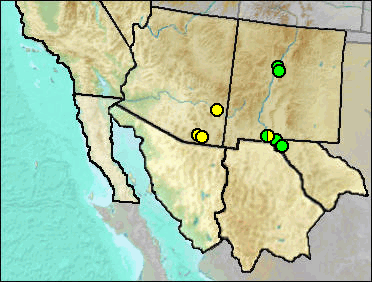
Although Mead et al. (2007) listed Sonoran species as Glyptotherium cylindricum, evidence was not strong and White et al. (2010) reverted the identifications of the Sonoran localities listed below to Glyptotherium sp.
 Glyptodonts are large, armored
relatives of the armadillos.
Glyptodonts are large, armored
relatives of the armadillos.
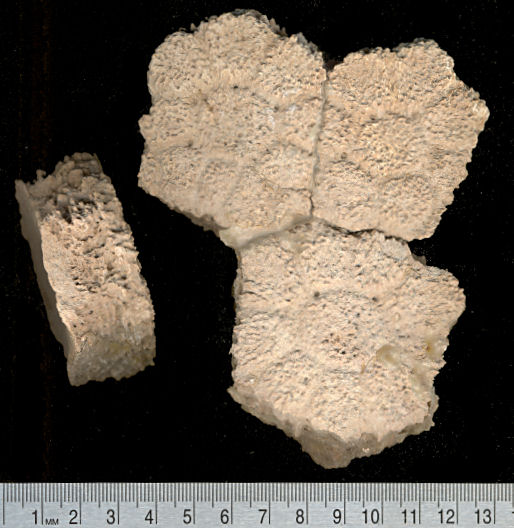
Fig. 1. Three articulated glyptodont scutes and an edgewise view to show thickness. Apparently white glue was used to maintain the contacts; some still obscures junctions. UTEP specimens from the vicinity of Fabens.
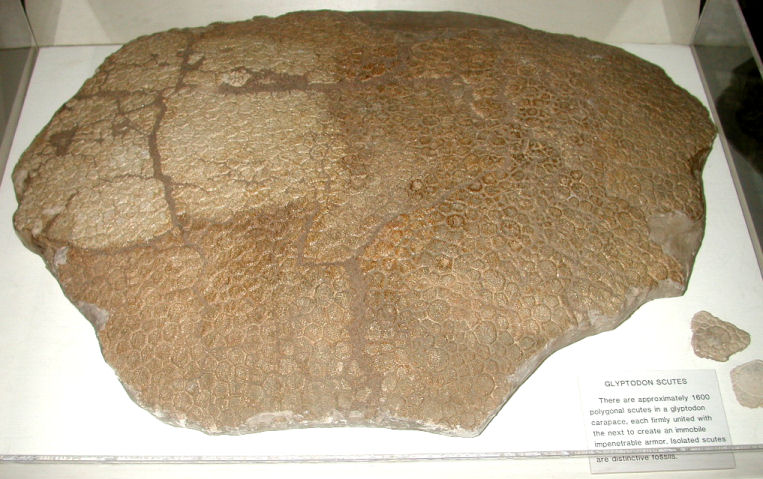
Fig. 2. Part of the carapace of Glyptotherium texanum, from a display in the Centennial Museum, University of Texas at El Paso.
Sites.
Late Blancan: San Simon Fauna (Morgan and White 2005).
Rancholabrean: Chinobampo (White et al. 2010); La Botana (White et al. 2010); Llano Prieto (White et al. 2010).
Literature. Morgan and White 2005; White et al. 2010.
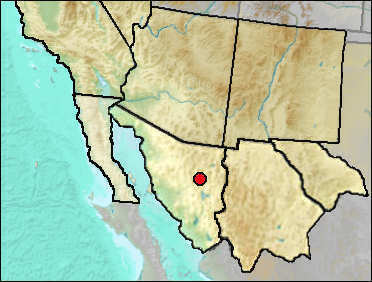
Sites.
Mid Wisconsin: Térapa (Mead et al. 2007).
Literature. Mead et al. 2007.
Synonyms. Glyptotherium arizonae
Kurtén and Anderson (1980) indicated that Glyptotherium texanum was the smallest of the North American glyptodonts and apparently was ancestral to G. arizonae. Morgan and Harris (2015) maintained the separation of G. arizonae and G. texanum, with a cutoff date before the publication of Gillette et al. (2015). In that work, Gillette et al. studied a large sample of Glyptotherium and concluded that G. arizonae is a synonym of G. texanum; thus the latter extends from the early Blancan NALMA to the Irvingtonian.
Sites.
Late Blancan: 111 Ranch (Morgan and White 2005); Caballo (Morgan et al. 2011); California Wash (Morgan and White 2005); Curtis Ranch (Lindsay 1984); La Union (Morgan and Lucas 2003); Virden (Morgan et al. 2008).
Early Irvingtonian: El Paso (UTEP); Adobe Ranch (Morgan and Lucas 2003); Tijeras Arroyo (Morgan and Lucas 2005); Vicinity of Fabens (UTEP); Western Mobile Gravel pit (Morgan and Lucas 2005).
Literature. Gillette and Ray 1981; Gillette et al. 2015; Kurtén and Anderson 1980; Lindsay 1984; Morgan and Harris 2015; Morgan and Lucas 2003, 2005; Morgan and White 2005; Morgan et al. 2008; Morgan et al. 2011.
Last Update: 1 Feb 2016