
Class Mammalia
Order Proboscidea
Family Elephantidae
Elephantidae—Elephant Family // Mammuthus sp.—Mammoth // Mammuthus columbi—Columbian Mammoth // Mammuthus exilis—Pygmy Mammoth // Mammuthus imperator—Imperial Mammoth // Mammuthus meridionalis—Southern Mammoth
The family Elephantidae includes the extinct mammoths and the living species of elephants. The family traces back to Africa, where it split off from the gomphothere line. The Indian Elephant (Elephas maximus) is the most closely related living species to the mammoths, both on the basis of morphology and of what little DNA evidence is available.
Aside from the general proboscidean characters briefly mentioned in the section on the Proboscidea, the most obvious adaptation among the mammoths is in the nature of their cheek teeth. Rather than following the usual mammalian tooth pattern, a tooth consists of a number of plates of enamel-covered dentine held together by cementum. The plates are at right angles to the axis of the tooth. Differential wear between the highly resistant enamel, the somewhat less resistant dentine, and the relatively soft cementum results in teeth adapted to clipping herbage into short segments while also crushing the plant material to break down the cell walls. The great size and depth of the teeth resist wear from the normally abrasive foods utilized.
Mammoths originated in the Old World, migrating into the New at the start of the Irvingtonian Land Mammal Age. Thus their occurrence in a fauna is taken as indicating that the age is either Irvingtonian or Rancholabrean.
A number of taxonomic schemes for Mammuthus have been advanced. One, rather commonly followed, suggests two clades represented in the New World. One is represented by the Woolly Mammoth, Mammuthus primigenius, restricted in northern North America to Canada and a few northern U.S states. The other clade is represented by a series of species in an apparent anagenetic sequence. Under this nomenclature, the latter series (from oldest to most recent) is M. meridionalis, M. imperator, and M. columbi. M. hayi may be equivalent to M. meridionalis. M. jeffersoni has been used for the most recent mammoths in this line (e.g., Kurtén and Anderson 1980); however Agenbroad (2003) instead suggested that M. jeffersonii is conspecific with M. primigenius. The line ended in North America in extinction at the end of the Pleistocene.
An alternative taxonomy has M. imperator as conspecific with M. columbi, with the latter name having precedence. There also has been the suggestion that M. columbi, rather than being descended from M. meridionalis, was derived from the Old World M. trogontherii (e.g., McDaniel 2006). For purposes here, a distinction is made in the accounts between M. imperator and M. columbi without taking a stand on which taxonomic view is correct.
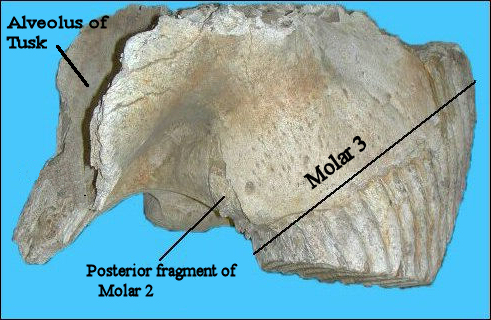
Fig. 1. A partial maxilla and premaxilla of Mammuthus with the posteriormost fragment of M2 and the nearly complete M3 (several plates are missing posteriorly). Note the wear surface of M3; as the anterior portion of the tooth wears away, the tooth rotates anteriorly, shifting the wear surface posteriorly.
 Both by
the structure of the teeth and by analogy with its nearest living relative, the Indian Elephant
(Elephas maximus), it's generally accepted that mammoths were grazers. The massive teeth
are admirably adapted to withstand the highly abrasive diet of grasses. The cheek teeth are so
large that normally no more than portions of two teeth are in place at any one time. The teeth move
forward in the jaws as they wear, pushing the earlier tooth forward. The teeth are angled such that
the anterior end wears first, the tooth rotating into wear as the front end is ground away. Thus,
at any one time, between full eruption of the first tooth of the series of six and the last, the
hinder end of the anterior tooth and the anterior end of the posterior tooth are in wear. In
addition to this "conveyor system" of tooth replacement, the teeth are highly hypsodont, providing a long period of vertical wear
before the tooth become useless. The tendency through time has been to increase the number of
plates of enamel that make up each cheek tooth concomitant with reduction in the thickness of the
enamel.
Both by
the structure of the teeth and by analogy with its nearest living relative, the Indian Elephant
(Elephas maximus), it's generally accepted that mammoths were grazers. The massive teeth
are admirably adapted to withstand the highly abrasive diet of grasses. The cheek teeth are so
large that normally no more than portions of two teeth are in place at any one time. The teeth move
forward in the jaws as they wear, pushing the earlier tooth forward. The teeth are angled such that
the anterior end wears first, the tooth rotating into wear as the front end is ground away. Thus,
at any one time, between full eruption of the first tooth of the series of six and the last, the
hinder end of the anterior tooth and the anterior end of the posterior tooth are in wear. In
addition to this "conveyor system" of tooth replacement, the teeth are highly hypsodont, providing a long period of vertical wear
before the tooth become useless. The tendency through time has been to increase the number of
plates of enamel that make up each cheek tooth concomitant with reduction in the thickness of the
enamel.
Features other than size also facilitate a long period of usefulness. Cheek teeth consist of anteriorly-posteriorly flattened plates joined together by cementum. Each plate consists of a flattened oval of enamel around a core of dentine. This arrangement has several advantages. For one, the enamel resists wear. This not only extends the life of the tooth, but also results in a series of ridges extending beyond the less resistant dentine and the even softer cementum. As uppers and lowers move against one another, plant material is caught between the enamel ridges and neatly clipped.
Morgan and Lucas (2005) suggest that most of the sites listed here, as well as findings noted only as proboscidean, likely represent M. columbi. Mead et al. (2006:165) state: Given these identification problems, we refer essentially all Arizona mammoth remains to Maglio's designation of M. columbi (in part equates to M. jeffersoni of Kurtén and Anderson, 1980)." Records from Mead et al. (2005) are tentatively placed in this species, and they point out that a specimen from Taylor, Arizona, identified as M. imperator lacks published data necessary for sure placement with a species and time interval (Mead et al. 2005). In somewhat of an inconsistency, records by other authors that are not included in Mead et al. or Agenbroad et al. (2013) are given here as Mammuthus sp.
Literature. Agenbroad 2003; Agenbroad et al. 2013; Kurtén and Anderson 1980; McDaniel 2006; Morgan and Lucas 2005; Mead et al. 2005; Mead et al. 2006
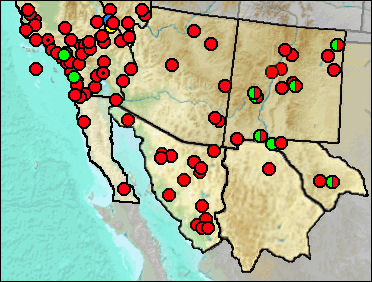
Fragmentary teeth and post-cranial elements often are identifiable as mammoths, but not identifiable to species; also, some specimens likely identifiable have only been reported as Mammuthus (or as mammoth).
Sites.
Pleistocene: Lake Rogers, Death Valley (Jefferson 2014); Winchester (Jefferson 2014).
Irvingtonian/Rancholabrean: Albert (Morgan and Lucas 2005); Datil (Morgan and Lucas 2005); Encino Blowouts (Agogino 1972); Green's Gap (Morgan and Lucas 2005); Haiwee Reservoir (Jefferson 2014); Lazy E Ranch (Morgan and Lucas 2005); Near Marathon (Mallouf 2001); Perico Creek (Morgan and Lucas 2005); Quarai (Hibben 1941); Riverside (Jefferson 1991b).
Late Blancan: Tecopa Lake Beds (Woodburne and Whistler 1991: ? gen.).
Irvingtonian: El Paso (UTEP); Elsinore: Microtus/Mammuthus (Pajak et al. 1996); Eureka Street, Victorville (Jefferson 1991b); Village Drive (Jefferson 2014).
Late Irvingtonian/Early Rancholabrean: Rancho California (Jefferson 1991b: ?); Thorn, Victorville (Jefferson 1991b).
Irvingtonian/Rancholabrean: Manix Lake (Jefferson 1991a).
Rancholabrean: Aconchi (White et al. 2010); Altar (White et al. 2010); Amargosa Desert (Jefferson et al. 2015); Arbogast Ranch (Jefferson 1991b); Athens on the Hill (Jefferson 1991b); Awl Site (Jefferson 1991b); Bachoco (White et al. 2010); Badlands Ranch (Morgan and Lucas 2005); Ballast Point, San Diego (Jefferson 1991b); Ballona Creek Wash (Jefferson 1991b); Bedford Properties (Jefferson 1991b); Big Bear Cutoff (Jefferson 1991b); Bitter Springs Playa (Jefferson 1991b); Bixby Rd. between Atlantic and Orange avenues (Jefferson 1991b: ? gen.); Black Butte (Jefferson 1991b); Bodfish, Lake Isabella (Jefferson 1991b: ?); Bolsa Chica (Jefferson 1991b); Brickyard, 13633 South Central Ave. (Jefferson 1991b); Camarillo, Las Posas Estates (Jefferson 1991b); Campbell Hill (Jefferson 1991b); Carbó (White et al. 2010); Carizzo Plains (Jefferson 1991b); Cedros (White et al. 2010); Centennial Parkway, Las Vegas Valley (Jefferson et al. 2015: cf.); Century Blvd. and Van Ness Ave. (Jefferson 1991b); Champagne, Pomona Valley (Jefferson 2014); Charley Day Spring (Lindsay and Tessman 1974); Cherry Ave. and Spring St., Long Beach (Jefferson 1991b); Ciénega de Cabo (White et al. 2010); Coachella Canal 1 (Jefferson 1991b); Cócorit (White et al. 2010); Compton (Jefferson 1991b); Conejo (Jefferson 1991b); Cool Water Coal Gasification Site (Jefferson 1991b); Costa Mesa (Jefferson 1991b); Cumpas (White et al. 2010); Dacolite Quarry, Walteria (Jefferson 1991b); Dana Point (Jefferson 1991b); Detention Basin, Upper Las Vegas Wash (Jefferson et al. 2015); Dominguez Hills (Jefferson 1991b); Earp (Jefferson 1991b); Edwards Air Force Base (Jefferson 2014: ?); El Mármol (Garay B.); Elephant Hill (Jefferson et al. 2015); Figueroa and Sepulveda boulevards (Jefferson 1991b); Gaffey Street and Agajanian Drive (Jefferson 1991b); General MacArthur Blvd. (Jefferson 1991b); Glendale (Jefferson et al. 2015); Granite Creek (Pasenko and Agenbroad 2012); Harbor Freeway, Athens (Jefferson 1991b); Harbor Freeway and 99th St. (Jefferson 1991b); Hermosillo (White et al. 2010); Hicks Canyon (Jefferson 2014); Hope Ranch (Jefferson 1991b); Huntington Beach (Jefferson 1991b); Jalama State Park (Jefferson 1991b); Keams Canyon (Agenbroad and Mead 1989); Kingston Wash (Jefferson 1991b); La Angostura (White et al. 2010); La Botana (White et al. 2010); La Brea and Venice boulevards (Jefferson 1991b); Laguna Niguel (Jefferson 1991b); Lake San Agustín (Morgan and Lucas 2005); La Puercera (White et al. 2010); Las Vegas Basin, Las Vegas NW (Jefferson et al. 2015); Llano Prieto (White et al. 2010); Lomita (Jefferson 1991b); Los Algodones (Garay B.); Madison and Middlebury, Los Angeles (Jefferson 1991b); Magdalena (White et al. 2010); Mankin (Jefferson 1991b); Mesa and Third streets (Jefferson 1991b); Main and 114th Streets, Los Angeles (Jefferson 1991b); Manchester and Airport boulevards (Jefferson 1991b); Manchester and Vermont boulevards (Jefferson 1991b); Metro Rail Wilshire Western Station (Jefferson 2014); Moapa (Jefferson et al. 2015); Naco (Sonora) (White et al. 2010); National City West (Jefferson 2014); Olympic Boulevard and Alvira Street (Jefferson 1991b); Pendleton (Jefferson 1991b); Pinto Basin (Jefferson 2014); Pixie Ave. and Cover St. (Jefferson 1991b); Quiriego (White et al. 2010); Rancho de Enmedio (White et al. 2010); Rancho La Brisca (White et al. 2010); Rosamond Boulevard (Jefferson 2014); Rubidoux (Jefferson 1991b); San Clemente (Jefferson 1991b); San Miguel (Jefferson 1991b); San Nicolas Island (Jefferson 1991b); San Pedro Lumber Yard (Jefferson 1991b); San Vicente (Garay B.); Salinas River Sand Site (Jefferson 1991b); Salt Springs (Jefferson 1991b); San Buenaventura (Jefferson 1991b); Sands (Jefferson 1991b); Santa Cruz (Morgan and Lucas 2005); Santa Monica Freeway near Gramercy St. (Jefferson 1991b); Santa Rosa (White et al. 2010); El Dorado Wash, Searchlight (Jefferson et al. 2015); Solano Beach (Jefferson 1991b); Solomon (Tegowski and White 2000); Sparklets Mammoth, Lincoln Blvd. and 45th St., Pasadena (Jefferson 1991b); Springerville (McDonald et al. 2004); Sylmar (Jefferson 1991b); Tehachapi (Jefferson 1991b); Térapa (White et al. 2010); Tijuana (Garay B.); Tijuana River Valley (Jefferson 1991b); Tule Springs 5 (Jefferson et al. 2015); Tule Springs Stein (Jefferson et al. 2015); Tule Springs 2100W Trench (Jefferson et al. 2015); Tule Springs General (Jefferson et al. 2015); Vallecito Creek (Jefferson 1991b); Van Norman Reservoir (lower) (Jefferson 1991b); Villa Ahumada (Comadurán et al. 1992; Whitlock Valley (Tegowski and White 2000); Wilmington Ave (Jefferson 1991b); Yeso Creek (Agogino 1972).
Late Rancholabrean: Abiquiu (Morgan and Lucas 2005); Big Bear (Morgan and Lucas 2005); East Cave (O'Laughlin 1977).
Sangamon: La Brisca (Van Devender et al. 1985); General MacArthur Blvd. (Jefferson 1991b); San Pedro Lumber Co. (Jefferson 1991b).
Wisconsin: La Brea and Venice boulevards (Jefferson 1991b: ? Wisconsin); Los Angeles River, Higuera St. and Moynier Lane (Jefferson 1991b); Palos Verdes Hills (Jefferson 1991b: ? Wisconsin).
Early Wisconsin: Stevens Lake (Jefferson 1991b).
Mid Wisconsin: Central Park West, Irvine (Smith 2006); Tank Trap Wash (Van Devender et al. 1987).
Late Wisconsin: Bonfire Shelter (Dibble and Lorrain 1968); Howell's Ridge Cave (Harris 1993c); Isleta Cave No. 1 (Harris 1993c); Lucy Site (Agogino 1972); Marfa Plain (Mallouf 2001); Pacific City, Huntington Beach (Jefferson 2014); Sandia Cave, Folsom Level (Hibben 1941); Sandia Cave, Sandia Level (Hibben 1941); Solar One (Jefferson 1991b).
Literature. Agenbroad and Mead 1989; Agogino 1972; Comadurán et al. 1992; Dibble and Lorrain 1968; Garay B., A. (http://paleontologianoticiosa.blogspot.com/2009/09/exponen-restos-de-mamut-de-baja.html, accessed 11 August 2014)); Harris 1993c; Hibben 1941; Jefferson 1991b, 2014; Jefferson et al. 2015; Lindsay and Tessman 1974; Mallouf 2001; McDonald et al. 2004; Mead et al. 2005; Morgan and Lucas 2005; O'Laughlin 1977; Smith 2006; Tegowski and White 2000; Pajak et al. 1996; Pasenko and Agenbroad 2012; Van Devender et al. 1985; Van Devender et al. 1987; White et al. 2010.
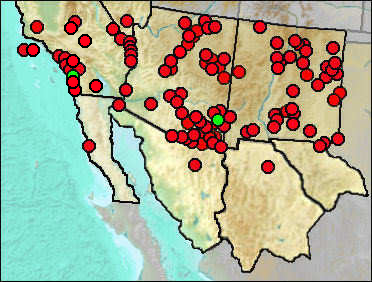
Kurtén and Anderson (1980) applied this name to the taxon treated herein as M. imperator and used the name M. jeffersoni for the taxon recognized here as M. columbi.
Mammuthus columbi is by far the most commonly recovered species of mammoth and nearly the most common mammal recovered from open sites. The reasons for this are apparent: the recency of occurrence and the fact that it's very difficult to overlook such a large creature. The map gives a good impression of the distribution of sites, but in several clusters, especially in southeastern Arizona, sites are so numerous that only a portion of them can be shown.
Fiedel (2009) lists what he considers the nine youngest, credible dates for Mammuthus columbi. These cluster between 11,110 ± 40 and 10,710 ± 130 BP, dating the Columbian Mammoth as a participant in the Pleistocene megafaunal extinction.
Following Mead et al. (2005), it has been assumed that Mammuthus records refer to M. columbi unless specifically assigned to a different species. This is not without danger since such an assumption may be incorrect—however, forewarned is forearmed.
Sites.
Irvingtonian: NE Bowie (Pasenko 2012).
Late Irvingtonian: Elsinore: Pauba Formation (Pajak et al. 1996: cf.).
Irvingtonian/Rancholabrean: St. Vincent de Paul (Jefferson 2014).
Early Rancholabrean: Albuquerque Gravel Pits (Morgan and Lucas 2005); Shoshone Zoo (Jefferson 1991b); Tecopa Basin (Jefferson 2014: cf.).
Rancholabrean: Acton Railroad Station, Soledad Canyon (Jefferson 1991b); Adamana (Agenbroad et al. 2013); Alkali Flat (Morgan and Lucas 2005); Alkali Spring (Morgan and Lucas 2005); Arizpe (Lindsay 1984b); Ash Canyon (Mead et al. 2005); Bain (Mead et al. 2005); Beverly Blvd. and Kilkea Drive (Jefferson 1991b); Big Tooth (Mead et al. 2005); Bill Williams River Fork (Mead et al. 2005); Bitter Springs Playa (Jefferson 2014: cf.); Bixby Park, Long Beach (Jefferson 1991b: cf.); Black Mountain (Mead et al. 2005); Black Point (Mead et al. 2005); Black Rock (Morgan and Lucas 2005); Bloomfield (Morgan and Lucas 2005); Blue Diamond Company, Alameda and 16th streets (Jefferson 1991b: cf.); Boquillas Station (Mead et al. 2005); Bow Willow (Jefferson 2014); Calera Ranch (Mead et al. 2005); Cameron (Mead et al. 2005); Canez Wash (Mead et al. 2005); Capitan (Morgan and Lucas 2005); Cartridge (Mead et al. 2005); Casados Ranch (Morgan and Lucas 2005); Cerro Colorado (Mead et al. 2005); Chambers-McCarrel (Mead et al. 2005); Chandler (Agenbroad et al. 2013); Charley Day Spring (Mead et al. 2005); Choate Ranch (Mead et al. 2005); Colorado River (Agenbroad et al. 2013); Comobabi Mammoth (Mead et al. 2005); Corona (Morgan and Lucas 2005); Cow Springs (Agenbroad et al. 2013); Cypress and Slauson avenues, Hyde Park (Jefferson 1991b); Davies Tank (Morgan and Lucas 2005); Deming (Morgan and Lucas 2005); Dogie Jones Ranch (Morgan and Lucas 2005); Donnet (Mead et al. 2005); Ehrenberg (Mead et al. 2005); Elgin School (Mead et al. 2005); Estancia Sand Pit (Morgan and Lucas 2005); Fenley Hunter (Jefferson et al. 2015: cf.); Fenn Site (Mead et al. 2005); Fort McDowell (Mead et al. 2005); Fort Stanton (Morgan and Lucas 2005); Fort Sumner (Morgan and Lucas 2005); Frito-Lay Plant, Westchester (Jefferson 1991b); Gardner Gravel (Mead et al. 2005); Gila Bend (Agenbroad et al. 2013); Golden Shores (Agenbroad et al. 2013); Goodwater Wash (Mead et al. 2005); Gray (Mead et al. 2005); Guenther Mammoth (Mead et al. 2005); Guadalupita (Gillette et al. 1985); Hawthorne (Jefferson 1991b: cf.); Hereford Dairy (Mead et al. 2005); Hurley (Mead et al. 2005); Inscription House (Agenbroad et al. 2013); Jal (Morgan and Lucas 2005); Jarrett (Mead et al. 2005); Keen Spring (Morgan and Lucas 2005); Kelton (Mead et al. 2005); Las Vegas (Morgan and Lucas 2005); Las Vegas Basin (20 mi N) (Jefferson et al. 2015); Las Vegas Wash, Big Wash (Jefferson et al. 2015); Las Vegas Wash (SSE Corn Creek Springs) (Jefferson et al. 2015: ?); Leikum (Mead et al. 2005); Leupp (Agenbroad et al. 2013); Lindsay Ranch (Mead et al. 2005); Lopez (Mead et al. 2005); Lordsburg Draw (Morgan and Lucas 2005); Los Angeles Brick Yard No. 3 (Jefferson 1991b: cf.); Los Angeles River, San Pedro (Jefferson 1991b); Mammoth (Mead et al. 2005); Melrose Ave. and La Cienega Blvd. (Jefferson 1991a); Mesa Redonda (Morgan and Lucas 2005); Milagro (Morgan and Lucas 2005); Morris Gravel (Mead et al. 2005); Morrow (Mead et al. 2005); Mosan Wash (Mead et al. 2005); Navajo (Agenbroad et al. 2013); Nichols (Lundin and Royse 1973); North of Golden Shores (Agenbroad et al. 2013); Pajarito Creek (Morgan and Lucas 2005); Park La Brea A (Jefferson 2014); Park Place, Irvine (Jefferson 2014); Peña Blanca (Morgan and Lucas 2005); Pettit (Mead et al. 2005); Phoenix (Agenbroad et al. 2013); Pirtleville (Mead et al. 2005); Picuris (Morgan and Lucas 2005); Pomerene West (Mead et al. 2005); Porter Springs (Mead et al. 2005); Quay (Morgan and Lucas 2003); Sacramento Mountains (Morgan and Lucas 2005); Safford (Tegowski and White 2000); Salt Creek, California (Jefferson 1991b); San Clemente State Beach (Jefferson 1991b); San Jose Spring (UTEP); San Pedro (Jefferson 1991b); San Simon (Mead et al. 2005); Sandblast Cave (Emslie 1988); Santa Fe (Morgan and Lucas 2005); Savallini-Williams (Agenbroad et al. 2013); Schaldack (Mead et al. 2005); Scottsdale (Agenbroad et al. 2013); Seal Beach (Jefferson 1991b); Seff (Mead et al. 2005); Sells (Mead et al. 2005); Shoulder (Mead et al. 2005); Shill Ranch (Mead et al. 2005); Sonoita (Mead et al. 2005); Sonoita Creek (Mead et al. 2005); Starvation Draw (Morgan and Lucas 2005); Thompson Sand Pit (Jefferson 2014); Tombstone Gulch (Mead et al. 2005); Tramperos Creek (Morgan and Lucas 2005); Tsegi Canyon (Mead et al. 2005); Tsegihatsosi Canyon (Mead et al. 2005); Tucson Brickyard (Mead et al. 2005); Tule Springs 4 (Jefferson et al. 2015); Vadito (Morgan and Lucas 2005); Wakefield (Mead et al. 2005); Walnut Grove (Mead et al. 2005); Whitewater Draw (Mead et al. 2005); Willcox (Mead et al. 2005); Wiregrass (Agenbroad et al. 2013); Woodruff (Mead et al. 2005); Wupatki Monument (Mead et al. 2005); Youngsville (Morgan and Lucas 2005); Yuma (Mead et al. 2005).
Late Pleistocene: Wanis View (Jefferson 2014).
Sangamon: Chandler Sand Pit, Rolling Hills Estates (Jefferson 1991b).
Wisconsin: Costeau Pit (Jefferson 1991a); Imperial Highway (Jefferson 1991b).
Mid Wisconsin: McKittrick (Schultz 1937); Shonto (Mead et al. 2005).
Mid/Late Wisconsin: Arlington Canyon, Santa Rosa Island (Jefferson 1991b); Diamond Valley (Springer et al. 2009); Rancho La Brea (Stock and Harris 1992); Sandblast Cave (Emslie 1988); Tule Springs (Mawby 1967).
Late Wisconsin: Anderson Basin et al. (Morgan and Lucas 2005); Big Bear (Morgan and Lucas 2005); Blackwater Draw Fauna (Slaughter 1975); Cerros Negros (Mead et al. 2005); China Lake (Jefferson 1991b: cf.); Double Adobe (Mead et al. 2005); Dove Springs Megafauna Loc. (Jefferson 2014); Dry Gulch (Morgan and Lucas 2005); Escapule (Mead et al. 2005); Fain Ranch (Pasenko and Agenbroad 2012: cf.); Hermit's Cave (Harris 1993c); Hurley (Mead et al. 2005); Lehner Site (Hemmings 2007a); M & M Mastodon Site (Agenbroad et al. 2013); McCullum Ranch (Morgan and Lucas 2005); Murray Springs (Hemmings 2007b); Naco (Mead et al. 2005); Placitas (Morgan and Lucas 2005); Saint Johns (Mead et al. 2005); Salt Creek (UTEP: cf.); San Jon (Morgan and Lucas 2005); San Quintín (Guía-Ramírez et al. 2013); Stolle Mammoth Site (Agogino 1985); Toyah (Metcalf 1977); Tule Springs (Mawby 1967); Valley Wells (Reynolds, Reynolds, et al. 1991); VLA (Morgan et al. 2009); Winslow (Mead et al. 2005).
Literature. Agenbroad et al. 2013; Agogino 1985; Fiedel 2009; Emslie 1988; Gillette et al. 1985; Guía-Ramírez et al. 2013; Harris 1993c; Hemmings 2007a, Hemmings 2007b; Jefferson 1991b,2014; Jefferson et al. 2015; Lindsay 1978; Lindsay 1984b; Lundin and Royse 1973; Mawby 1967; Metcalf 1977; Morgan and Lucas 2003, 2005; Mead et al. 2005; Morgan et al. 2009; Pajak et al. 1996; Pasenko 2012; Pasenko and Agenbroad 2012; Reynolds et al. 1991; Schultz 1937, 1943; Slaughter 1975; Springer et al. 2009; Stock and Harris 1992; Tegowski and White 2000.
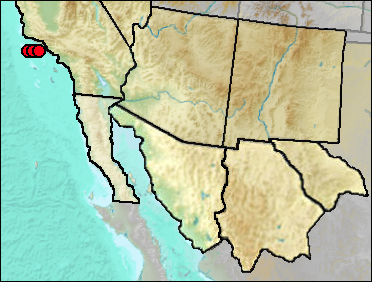
As the common name suggests, this is a pygmy form of Mammuthus. Miniaturization of large mammals after entering island habitats is not uncommon (on the other hand, small mammals may become much larger than their mainland counterparts). The Pygmy Mammoth appears to be descended from M. columbi, with some limb proportional changes that appear to have allowed it to ascend somewhat steeper slopes than were surmountable by M. columbi (Agenbroad 2003).
Radiocarbon dates suggest presence on the island more than 40,000 BP and that it survived until the general timeframe of the late Pleistocene extinctions (Agenbroad 2003).
Sites.
Mid/late Wisconsin: Arlington Canyon, Santa Rosa Island (Jefferson 1991b); Garanon Canyon, Santa Rosa Island (Jefferson 1991b); San Miguel Island (Jefferson 1991b).
Literature. Agenbroad 2003; Jefferson 1991b.
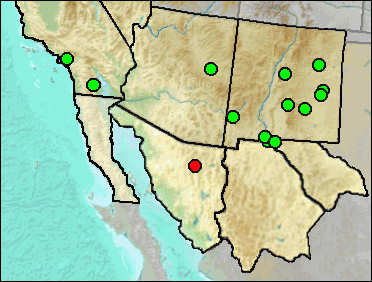
All of the occurrences of Mammuthus imperator have been plotted as Irvingtonian except that from Arizpe (which could be Irvingtonian). Morgan and Lucas (2005) have pointed out that several records have no confirming evidence; they may be Rancholabrean in age.
Osborn (1929) named Mammuthus (Archidiskodon) sonoriensis from Arizpe; Lucas and González-León (1996) place this as a synonym of Mammuthus imperator.
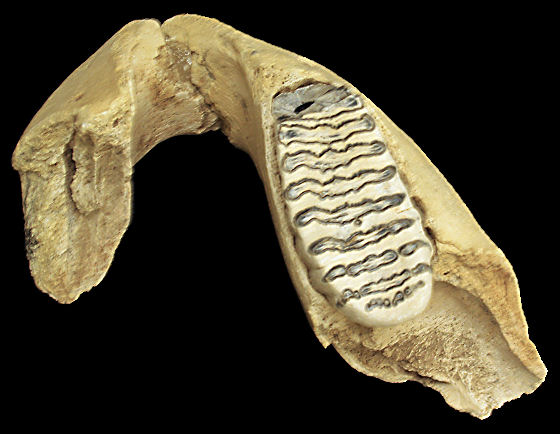
Fig. 1. Lower anterior mandible with m/1 (?) from the eastern side of El Paso, Texas.
Sites.
Early/Medial Pleistocene: Marley Ranch (Morgan and Lucas 2005); Rio Conchas (Morgan and Lucas 2005).
Irvingtonian: Anza-Borrego Desert (Murray 2008).
Irvingtonian ?: Galisteo (Morgan and Lucas 2005); (Morgan and Lucas 2005); San Francisco River (Morgan and Lucas 2005); Taylor (Mead et al. 2005).
Irvingtonian: El Paso (UTEP: ?); Inman Gravel Pit (Morgan and Lucas 2005); Tijeras Arroyo (Morgan and Lucas 2005); Tortugas Mountain Gravel Pit (Morgan and Lucas 2005).
Late Irvingtonian or Early Rancholabrean: Eighteenmile Bend (Morgan and Lucas 2005); X-Bar-X Ranch (Morgan and Lucas 2005).
?Irvingtonian/Rancholabrean: Carrizozo Morgan and Lucas (2006); Emery Borrow Pit (Jefferson 1991b: cf.).
Rancholabrean: Arizpe (White et al. 2010); Chino Hills (Jefferson 2014).
Literature. Jefferson 1991b; Lucas and González-León 1996; Mead et al. 2005; Morgan and Lucas 2005, 2006; Murray 2008; Osborne 1929; White et al. 2010.
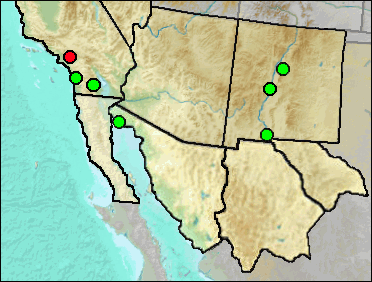
The tendency within the presumed anagenetic line Mammuthus meridionalis-M. imperator-M. columbi is to increase the number of tooth plates and reduce the thickness of the plate enamel. Even if this is not an ancestral-descendent sequence, the tooth morphology follows the trend. As the first in the line, M. meridionalis has relatively few plates with relatively thick enamel.
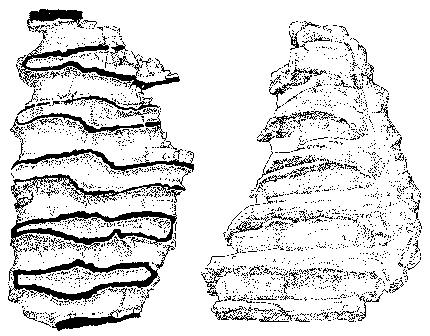
Fig. 1. Occlusal and side view of a tooth of Mammuthus cf. meridionalis from the vicinity of La Union, Doña Ana Co., NM.
Sites.
Irvingtonian: Anza-Borrego (Murray 2008); El Golfo (Croxen et al. 2007: cf.); Tijeras Arroyo (Morgan and Lucas 2005); Adobe Ranch (Morgan and Lucas 2005).
Early Irvingtonian: Matanza Arroyo (Morgan and Harris 2015).
Late Irvingtonian: Elsinore: Pauba Formation (Pajak et al. 1996: cf.).
Rancholabrean: Thompson Sand Pit (Jefferson 2014)
Literature. Croxen et al. 2007; Jefferson 2014; Morgan and Harris 2015; Morgan and Lucas 2005; Murray 2008; Pajak et al. 1996.
Last Update: 3 Feb 2016