
Class Mammalia
Order Pilosa
Family Nothrotheriidae
Nothrotheriops sp.—Nothrotheriops Ground Sloths // Nothrotheriops texanus—Texas Ground Sloth // Nothrotheriops shastensis—Shasta Ground Sloth
The genus Nothrotheriops has been placed in the Megatheriidae until relatively recently. Muizon et al. (2004) raised it from subfamily to family rank and also noted that, although a monophyletic line separate from other sloth families, it is more closely related to the Megalonychidae than the Megatheriidae.
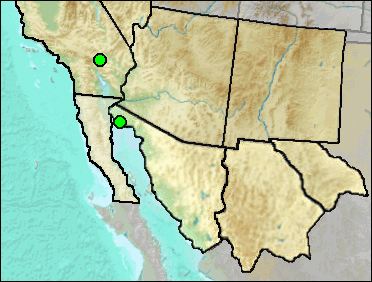
Synonyms. Nothrotherium texanus.
This relatively small species is assumed to be the ancestor of the later Pleistocene Nothrotheriops shastensis.
Sites.
Early Irvingtonian: Gypsum Ridge (Wagner and Prothero 2001).
Irvingtonian: El Golfo (Croxen et al. 2007).
Literature. Croxen et al. 2007; Wagner and Prothero 2001.
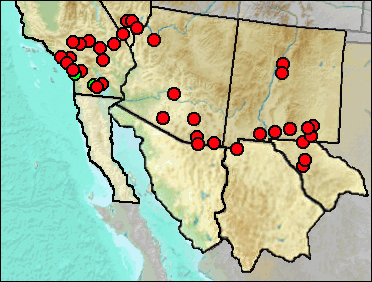
Synonyms. Nothrotherium shastense.
The Shasta Ground Sloth is the smallest of our late Pleistocene ground sloths, with an estimated mean body mass for adults of 463 kg (McDonald 2005). The diet is known to some degree from a number of recoveries of dung from dry caves. For example, Hansen (1978) investigated the plants in sloth dung from Rampart Cave and Muave Cave of the lower Grand Canyon. Samples from a timeframe running from over 40 to about 11 kya (radiocarbon dates) produced 72 genera of plants. Hansen reported the major taxa as Desert Globemallow, Nevada Mormon Tea, saltbushes (Atriplex), Catclaw Acacia, cacti, common reed, and yucca.
 McDonald and Jefferson
(2008) investigated the relationship of elevation and geographic distribution, finding a
correlation between latitude and elevation. Northern occurrences come from progressively lower
elevations as one goes north. This was attributed to the apparently low basal metabolic rate that
restricted the sloth to relatively high minimum temperatures. McDonald and Jefferson (p. 321)
interpreted the data to indicate that the "lower limiting temperature falls in the range of 10
to 20°C. They also point out that the frequent occurrence of remains in caves could well be the
result of sloth thermoregulatory behavior during colder temperature.
McDonald and Jefferson
(2008) investigated the relationship of elevation and geographic distribution, finding a
correlation between latitude and elevation. Northern occurrences come from progressively lower
elevations as one goes north. This was attributed to the apparently low basal metabolic rate that
restricted the sloth to relatively high minimum temperatures. McDonald and Jefferson (p. 321)
interpreted the data to indicate that the "lower limiting temperature falls in the range of 10
to 20°C. They also point out that the frequent occurrence of remains in caves could well be the
result of sloth thermoregulatory behavior during colder temperature.
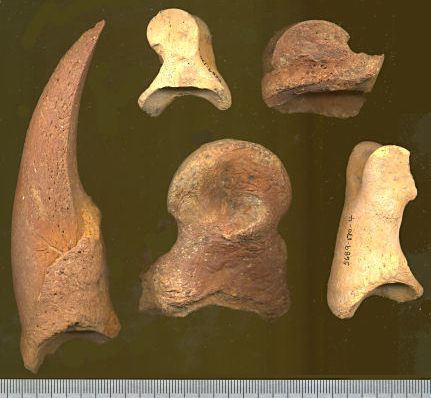
Fig. 1. Assorted phalanges of Nothrotheriops shastensis from U-Bar Cave. Metric scale.
Van Devender et al. (1977) mentioned sloth dung from several caves in our region: William's Cave, Lower Sloth Cave (C-05), and Upper Sloth Cave (C-08) in Guadalupe Mountains National Park. A radiocarbon date on dung from C-05 is 11,590 ± 230 BP (A-1519). Dung of a large artiodactyl (possibly Cervus elaphus merriami) was associated with sloth dung in C-08 and gave a date of 11,760 ± 610 BP. A date from juniper twigs from William's Cave was 12,040 ± 210 BP.
Although some authors have listed only the genus, these have been included under this species since the only known member of the genus in the Rancholabrean is N. shastensis. The other North American species, N. texanus, was a smaller form restricted to the Irvingtonian (McDonald and Jefferson 2008). Shasta Ground Sloths are known from a number of sites in and near Arizona and New Mexico, particularly in the southern parts. One of the best known occurrences is from Aden Fumarole, west-southwest of Las Cruces. Recovered from dry guano approximately 100 feet below the entrance to the nearly vertical shaft, the specimen is of a nearly complete, articulated skeleton with a considerable amount of soft tissue preserved (Lull 1929). This specimen was long thought to be very recent, but radiocarbon dates are 11,080 ± 200 on dung and 9840 ± 160 BP on hide; the latter is thought to possibly be contaminated by organic preservatives (Long and Martin 1974). A juvenile individual from Carlsbad Caverns was dated at about 112 ka (Hill and Gillette 1987).
Conkling (1932) noted that at least seven individuals were represented in Conkling Cavern, including a baby sloth.
Harris (1985) recorded N. shastensis from Dust Cave on the basis of personal communication from L. Logan; the record may be erroneous, based on confusion between Dust Cave and the other two Upper Sloth Caves (both of which contained Nothrotheriops dung). A voucher for presence in Dust Cave has not been found, and the locality is not listed below.
Youngest credible dates listed by Fiedel (2009) fall nicely into the extinction event that affected so many other large mammals; the latest date listed by him is 10,400 ± 275 BP (a later date of 10,035 ± 250 was questioned as possibly contaminated since another date on the same sample was 10,940 ± 60) .
Sites.
Not Given: (Jefferson 2014).
Pleistocene: Manzano Cave (Hibben 1941; McDonald and Jefferson (2008) list the record as spurious or suspect).
Irvingtonian: Anza-Borrego (Murray 2008).
Late Irvingtonian: Pauba Formation (McDonald and Jefferson 2008).
Irvingtonian/Rancholabrean: Fort Irwin (McDonald and Jefferson 2008); Manix Lake (Jefferson 1991b; cf.).
Early Rancholabrean: Robertson Ranch (Jefferson 2014).
Rancholabrean: Campbell Hill (Jefferson 1991b); Carlsbad Caverns (Hill and Gillette 1987); Chino Hills, Harvest Development (Jefferson 2014); Coconino Cavern (Lindsay and Tessman 1974); Las Vegas Wash, Big Wash (Jefferson et al. 2015); Ludlow Cave (Jefferson 1991b); Nichols (Mead et al. 2005: ? gen.); Salton City South (Jefferson 1991b); Tule Springs General (Jefferson et al. 2015); Vallecito Creek (McDonald and Jefferson 2008); Whitewater Draw (McDonald and Jefferson 1998).
Sangamon: Newport Bay Mesa (Jefferson 1991b); San Pedro Lumber Co. (Jefferson 1991b: cf.).
Early/Early-Mid Wisconsin: Rm Vanishing Floor (Harris 1993c).
Mid Wisconsin: Devil Peak (Reynolds, Reynolds, and Bell 1991); Kartchner Cave (McDonald and Jefferson 2008); Rampart Cave (Kenworthy et al. 2004); U-Bar Cave (Harris 1987).
Mid/Late Wisconsin: Animal Fair (Harris 1993c); Dark Canyon Cave (1McDonald and Jefferson 2008); Diamond Valley (Springer et al. 2009); Rancho La Brea (Stock and Harris 1992); Shelter Cave (Harris 1993c); Sierra Diablo Cave (UTEP).
Late Wisconsin: Aden Fumarole (Lull 1929); Algerita Blossom Cave (Harris 1993c); Conkling Cavern (Conkling 1932); Deadman Cave (Mead et al. 1984); Gypsum Cave (Harrington 1940); Lechuguilla Cave (McDonald and Jefferson 2009); Lower Sloth Cave (Logan 1983); Muav Caves (Mead et al. 2005); Newberry Cave (Jefferson 1991b); Pyeatt Cave (Mead et al. 2005); Rampart Cave (Kenworthy et al. 2004); Sandia Cave, Folsom Level (Hibben 1941); U-Bar Cave 13-14 ka (Harris 1989); U-Bar Cave 14-15 ka (Harris 1989); U-Bar Cave 15-18 ka (Harris 1989); Upper Sloth Cave (Logan and Black 1979); Ventana Cave (Colbert 1950).
Late Wisconsin/Holocene: Rancholabrean/?Early Holocene: Mitchell Caverns (Jefferson 1991b); Pendejo Cave (Harris 2003: cf. gen et sp; Zone A); Williams Cave (Ayer 1936).
Literature. Ayer 1936; Colbert 1950; Conkling 1932; Fiedel 2009; Hansen 1978; Harrington 1940; Harris 1985a, 1987, 1989, 1993c, 2003; Hibben 1941; Hill and Gillette 1987; Jefferson 1991b, 2014; Jefferson et al. 2015; Kenworthy et al. 2004; Lindsay and Tessman 1974; Logan 1983; Logan and Black 1979; Long and Martin 1974; Lull 1929; Mawby 1967; McDonald 2005; McDonald and Jefferson 2008; Mead et al. 1984; Mead et al. 2005; Reynolds, Reynolds, and Bell 1991; Springer et al. 2009; Stock and Harris 1992.; Van Devender et al. 1977; Wilson 1942.
1McDonald and Jefferson cite Harris (1985) as the source of the record, but it is not listed for Dark Canyon Cave in that work.
Last Update: 26 May 2015