Class Mammalia
Order Rodentia
Family Cricetidae
Subfamily Sigmodontinae

rule

Bensonomys sp.—Benson Vesper Mice // Bensonomys arizonae—Arizona Vesper Mouse // Sigmodon sp.—Hispid Cotton Rat // Sigmodon hispidus—Hispid Cotton Rat // Sigmodon ochrognathus—Yellow-nosed Cotton Rat

Sigmodontinae—Sigmodontine Mice and Rats

This is primarily a South American subfamily. Two genera (Sigmodon and Oryzomys) reach into the U.S., but only the cotton rats inhabit our region.
rule

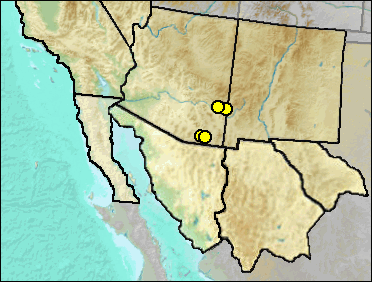
Bensonomys sp.—Benson Vesper MicePleistocene distribution of Bensonomys sp.

Synonyms. Calomys (Bensonomys).

Bensonomys has variously been included as a subgenus of Calomys or as a separate genus. A number of species of Calomys currently occur in South America, but the genus doesn't reach our region. Bensonomys appears to share a common ancestor with Peromyscus. With about a dozen species, Bensonomys is widespread in Hemphillian and Blancan deposits.

Sites.

Late Blancan: Caballo (Morgan et al. 2011).

Literature. Morgan et al. 2011.

rule

Bensonomys arizonae—Arizona Vesper Mouse (Gidley 1922) Pleistocene regional distribution of Bensonomys arizona

Synonyms. Calomys (Bensonomys) arizonae.

Sites.

Late Blancan: 111 Ranch (Morgan and White 2005); California Wash (Johnson et al. 1975); Curtis Ranch (Morgan and White 2005); Virden (Morgan et al. 2008: cf.).

Literature. Johnson et al. 1975; Morgan and White 2005; Morgan et al. 2008.


rule

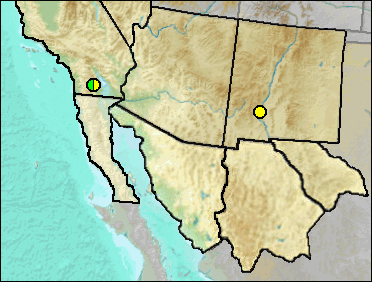
Sigmodon sp.—Cotton RatsPleistocene distribution of Sigmodon sp.

Cotton rats often are considered convergent in ecological niche to the voles, but adapted to warm climatic conditions rather than the cool climates where Microtus centers. Like voles, cotton rats usually are associated with grasses, form runways, and may be active diurnally. Although with some morphological characteristics similar to those of voles, such as short legs and tail, lax fur, and small ears, the dentition differs greatly. The name Sigmodon refers to the more or less "S" shape formed by the cusps, especially those of the third molar.

Palate of Sigmodon hispidus illustrating upper toothrow characteristics   Right lower toothrow of Sigmodon hispidus

Fig. 1 (left). Palate of Sigmodon hispidus illustrating dental and palatal characteristics. Fig. 2 (right). Right lower toothrow of Sigmodon hispidus showing dental characteristics.

Four species occur in our region. Sigmodon arizonae occurs from extreme southwestern New Mexico west into Arizona. Sigmodon hispidus is the most widespread, with S. fulviventer occurring in southeastern Arizona and the southwestern part of New Mexico, with an apparently isolated population in the New Mexican north-central Rio Grande Valley. Sigmodon ochrognathus occurs in the mountains of extreme southwestern New Mexico, in southern Arizona, and in scattered areas of the Trans-Pecos. Isolated population of S. hispidus and S. arizonae also occur in Arizona.

Sites.

Late Blancan: La Union (Morgan and Lucas 2003); San Simon Fauna (Morgan and White 2005); Snowflake (Lindsay and Tessman 1974).

Early Mid or Early Wisconsin: Lost Valley (Harris 1993c).

Late Wisconsin: Algerita Blossom Cave (Harris 1993c); Bonfire Shelter (Frank 1968); Harris' Pocket (UTEP); Human Corridor (Harris 1993c); Lehner Ranch (Lindsay and Tessman 1974); Murray Springs (Lindsay and Tessman 1974).

Late Wisconsin/Holocene: Beyond Bison Chamber (UTEP); Howell's Ridge Cave (Harris 1993c).

Literature. Frank 1968; Harris 1993c; Lindsay and Tessman 1974; Morgan and Lucas 2003; Morgan and White 2005.

rule

Sigmodon hispidus Say and Ord 1825—Hispid Cotton RatPleistocene distribution of Sigmodon hispidus.

Modern distribution of Sigmodon hispidus in the regionSigmodon hispidus is the most widely distributed species in the region (Fig. 1). At one time, the species was thought to continue westward in Arizona; more recently, it was learned that the adjacent populations in Arizona and overlapping slightly into New Mexico represented a cryptic species, Sigmodon arizonae. It is quite possible that U-Bar Cave specimens represent that species rather than S. hispidus; characteristics that could separate the two are unknown for the fossil specimens available.

Fig. 1. Approximate current geographic range of the Hispid Cotton Rat in our region (an isolated population in Arizona is not shown).

The Holocene record from Atlatl Cave in San Juan County, NM, is listed (but not mapped) because it indicates a major expansion of range, presumably during a time when grasslands allowed passage across the continental divide separating the Rio Grande drainage from that of the San Juan River.

Dentary and ventral view of skull of Sigmodon hispidus

Fig. 2. Lateral view of left dentary and ventral view of Sigmodon hispidus skull (UTEP mammal collection 1358). Scale in mm.

Sites.

Mid Wisconsin: Pendejo Cave (Harris 2003); U-Bar Cave (Harris 1987).

Mid/Late Wisconsin: Dark Canyon Cave (Tebedge 1988).

Mid/Late Wisconsin/Holocene: Sierra Diablo Cave (UTEP).

Late Wisconsin: Blackwater Loc. No. 1 (Slaughter 1975); TT II (Harris 1993c: cf.).

Late Wisconsin/Holocene: Balcony Room (Harris 1993c); Fowlkes Cave (Dalquest and Stangl 1984b); Howell's Ridge Cave (UTEP); Pendejo Cave (UTEP).

Middle Holocene: Atlatl Cave (Gillespie 1985).

Literature. Dalquest and Stangl 1984b; Gillespie 1985; Harris 1987, 1993c, 2003; Slaughter 1975; Tebedge 1988.

rule

Sigmodon ochrognathus Bailey 1902—Yellow-nosed Cotton RatPleistocene distribution of Sigmodon ochrognathus.

The Yellow-nosed Cotton Rat generally has been considered as a higher-elevation rodent than S. hispidus. In our region, it occurs in the mountains of the New Mexican bootheel, and in Texas in a number of localities in the Trans-Pecos, including in recent years in non-montane habitats (Schmidly 2004). Hollander et al. (1990) reported it from the Guadalupe Mountains, some 80 miles north of its earlier recognized range, putting it in striking distance of several important Pleistocene fossil sites. It has been reported from Holocene deposits (ca. 3580 BP) of Big Manhole Cave (Lear and Harris 2007) and Pratt Cave (Stangl and Dalquest 1991), though there is some question as to whether Pleistocene material is mixed into the Holocene material at the latter site (see the Pratt Cave account).

Upper right first molar of Sigmodon ochrognathusStangl and Dalquest (1991) investigated dental differences between S. hispidus and S. ochrognathus. They found that the upper toothrow is smaller in S. ochrognathus at comparable degrees of wear, and especially pronounced with M1. Their measurements of the occlusal surfaces of M1 (in mm) gave a mean of 2.29 ± 0.10 (s.d.) for S. hispidus compared to 2.02 ± 0.10 for S. ochrognathus, and for width, respectively, 1.73 ± 0.10 and 1.51 ± 0.10. Extremes, however, did overlap.

Fig. 1. Upper right first molar of fossil Sigmodon ochrognathus from Dust Cave.

Another character noted by Stangl and Dalquest concerned the anterocone of M1; they found it compressed or flattened anteriorly in 47 of 50 S. ochrognathus as compared to a usually convex anterocone in S. hispidus. The latter, however, did show compression in 12 out of 50 specimens of S. hispidus. Roger Barbour photo of Sigmodon ochrognathusThe anterior of the anterocone, viewed laterally, was said to form an even slope from the alveolus to the occlusal surface in S. hispidus, but to be recessed posteriorly in S. ochrognathus.

Fig. 2. Sigmodon ochrognathus. Photograph by Roger W. Barbour, courtesy of the Smithsonian National Museum of Natural History.

Sites.

Early/Early-Mid Wisconsin: Lost Valley (UTEP).

Mid/Late Wisconsin: Dust Cave (this volume).

Mid/Late Wisconsin/Holocene: Sierra Diablo Cave (UTEP cf.)

Late Wisconsin: Pendejo Cave (UTEP); U-Bar Cave 15-18 ka (Harris 1989).

Late Wisconsin/Holocene: Fowlkes Cave (Stangl and Dalquest 1991); Pendejo Cave (UTEP); Pratt Cave (Stangl and Dalquest 1991).

Literature. Harris 1989; Hollander et al. 1990; Lear and Harris 2007; Schmidly 2004; Stangl and Dalquest 1991.

rule

Last Update: 9 Mar 2013