
Class Mammalia
Order Carnivora
Family Felidae
Smilodon fatalis—Sabertooth // Smilodon gracilis—Gracile Sabertooth // Xenosmilus sp.—Strange Cats
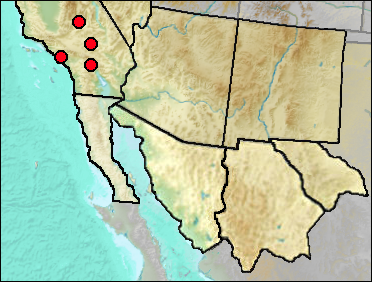
Sites.
Rancholabrean: Bitter Springs Playa (Jefferson 2014); Lake View Hot Springs (Jefferson 2014); Outfall Sewer North, Sabertooth, Culver City (Jefferson 1991b); San Pedro Lumber Yard (Jefferson 1991a).
Sangamon: Malaga Cove Wash, Palos Verdes Estates (Jefferson 1991b).
Late Wisconsin: China Lake (Jefferson 1991a).
Literature. Jefferson 1991b, Jefferson 2014
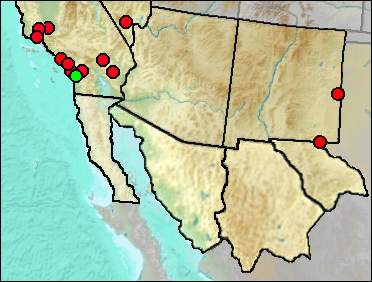
Smilodon fatalis appears to be absent from the core of our region. This may, of course, be a matter of sampling error. The pattern suggests limitation to the Great Plains on the eastern edge of our region, though it certainly is not constrained to grasslands elsewhere, and then appearing again in California. Kurtén and Anderson (1980) report that at the time of their writing, there were more than 40 Rancholabrean sites and that records occur as far south as Peru in South America. They do note, however, that cave finds are relatively rare.
Christiansen and Harris (2005) estimate that body mass ranged from 160 kg (352 lbs) to 280 kg (616 lbs), comparable to that of the Siberian Tiger.
The taxon is well known from ample material recovered from the Rancho La Brea tar pits.
Sites.
Late Irvingtonian: Elsinore: Pauba Formation (Pajak et al. 1996).
Rancholabrean: Alameda and Workman streets (Workman Storm Drain) (Jefferson 1991b: cf.); Campbell Hill (Jefferson 1991b: cf.); Desert Sunlight Project (Jefferson 2014); Twenty Five Mile Stream (Morgan and Lucas 2005).
Sangamon: San Pedro Lumber Co. (Jefferson 1991b).
Early Wisconsin: Carpinteria (Shaw and Quinn 2015).
Wisconsin: Costeau Pit (Jefferson 1991b: cf.).
Mid Wisconsin: McKittrick (Schultz 1937).
Mid/Late Wisconsin: Diamond Valley (Springer et al. 2009); Rancho La Brea (Stock and Harris 1992).
Late Wisconsin: Blackwater Loc. No. 1 (Lundelius 1972); Maricopa (Jefferson 1991b); Park Place, Irvine (Jefferson 2014).
Literature.
Christiansen and Harris 2005; Jefferson 1991b, 2014; Kurtén and Anderson 1980; Lundelius 1972; Morgan and Lucas 2005; Pajak et al. 1996; Schultz 1937; Springer et al. 2009); Stock and Harris 1992).
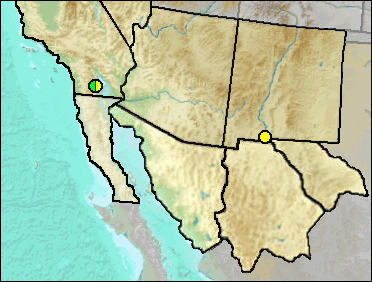
Smilodon gracilis is a relatively poorly known sabertooth that may have given rise to S. fatalis (Kurtén and Anderson 1980).
The suggested size of this sabertooth was roughly that of modern jaguars at 55-100 kg (121-220 lbs) (Christiansen and Harris 2005).
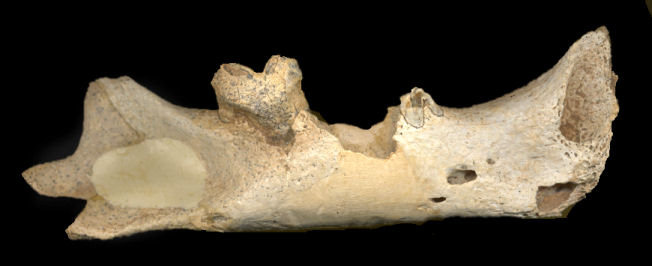
Fig. 1. Right dentary of Smilodon gracilis, UTEP 97-2.
Sites.
Late Blancan/Irvingtonian: Anza-Borrego (Shaw and Cox 2006).
Late Blancan: Mesilla Basin Fauna B (Morgan and Lucas 2003).
Literature. Christiansen and Harris 2005; Kurtén and Anderson 1989; Morgan and Lucas 2003; Shaw and Cox 2006.
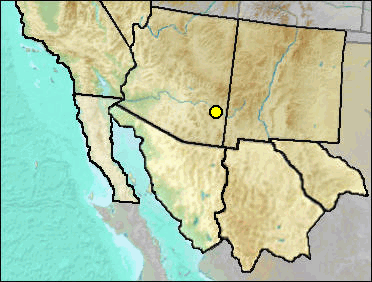
This is one of the scimitar sabertooth cats, but combines some features of the dirk-toothed cats such as Smilodon with the canine configuration of Homotherium. Thus the relatively massive limbs as seen in Smilodon together with characters relating it to the homotheres (Martin et al. 2000). Late Blancan to Irvingtonian.
Sites.
Late Blancan: San Simon Fauna (Morgan and White 2005).
Literature.
; Martin et al. 2000Last Update: 16 May 2015