
Class Mammalia
Order Artiodactyla
Suborder Tylopoda
Family Camelidae
Hemiauchenia sp.—American Llamas // Hemiauchenia blancoensis—Blanco Llama // Hemiauchenia gracilis—Gracile Llama // Hemiauchenia macrocephala—Big-headed Llama // Hemiauchenia undescribed—Undescribed Llama
Synonyms. Tanupolama
The llamas are relatively long-limbed camels built quite differently than the stocky Camelops.
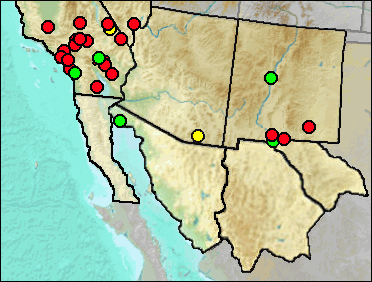
Several sites have fossils of Hemiauchenia preserved, but the publications do not list a species identification.
Sites.
Late Blancan: Curtis Ranch (Lindsay 1984); Tecopa Lake Beds (Woodburne and Whistler 1991: 2 species, cf. gen.).
Irvingtonian: El Golfo (Croxen et al. 2007: small); El Paso (UTEP: cf.); Elsinore: Microtus/Mammuthus (Pajak et al. 1996).
Early Irvingtonian: Gypsum Ridge (Wagner and Prothero 2001: cf. gen.); Mesas Mojinas (Morgan and Harris 2015).
Late Irvingtonian/Early Rancholabrean: Thorn, Victorville (Jefferson 1991b).
Early Rancholabrean: Shoshone Zoo (Jefferson 2014); Tecopa Basin (Jefferson 1991b).
Rancholabrean: Bitter Springs Playa (Jefferson 1991b); Bow Willow (Jefferson 2014); Campbell Hill (Jefferson 1991b); Desert Sunlight Project (Jefferson 2014: Cf.); Edwards Air Force Base (Jefferson 2014: cf.); Kramer (Jefferson 1991b); Pinto Basin (Jefferson 1991b); Redondo Steam Generating Plant, Redondo Beach (Jefferson 1991b); Surprise Springs (Jefferson 1991b).
Late Rancholabrean: East Cave (O'Laughlin 1977).
Sangamon: Newport Bay Mesa (Jefferson 1991b); U. S. Veterans Hospital, Long Beach (Jefferson 1991b).
Wisconsin: Costeau Pit (Jefferson 1991b).
Early/Early-Mid Wisconsin: Sabertooth Camel Maze (Harris 1993c).
Late Wisconsin: Antelope Cave (Reynolds, Reynolds, Bell, and Pitzer 1991); Bison Chamber (Harris 1993c); China Lake (Jefferson 1991b); Conkling Cavern (Conkling 1932); Gypsum Cave (Jefferson et al. 2015); Human Corridor (Harris 1993c); Kokoweef Cave (Reynolds, Reynolds, et al. 1991); Maricopa (Jefferson 1991b); Schuiling Cave (Jefferson 1991b); Valley Wells (Reynolds et al. 1991).
Fig. 1 shows the typical proportions of the fused metatarsals III and IV.

Fig. 1. Posterior view of the fused metatarsals III and IV of Hemiauchenia macrocephala (UTEP 25-202). White bar is 10 cm (3.94 in) long.
Literature. Conkling 1932; Harris 1993c; Jefferson 1991b, 2014; Jefferson et al. 2015; Lindsay 1984; Morgan and Harris 2015; Morgan and Lucas 2003; O'Laughlin 1977; Pajak et al. 1996; Reynolds et al. 1991; Reynolds, Reynolds, et al. 1991; Reynolds, Reynolds, Bell, and Pitzer 1991; Wagner and Prothero 2001; Woodburne and Whistler 1991.
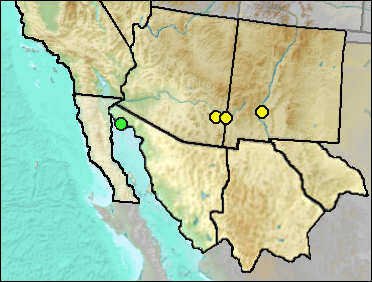
This is a moderately large Hemiauchenia and is the most common member of the genus recovered from Blancan sites in New Mexico (Morgan et al. 2011).
Sites.
Late Blancan: Caballo (Morgan et al. 2011); San Simon Fauna (Morgan and White 2005); Virden (Morgan et al. 2008).
Irvingtonian: El Golfo (Croxen et al. 2007: cf.).
Literature.Croxen et al. 2007; Morgan and White 2005; Morgan et al. 2008; Morgan et al. 2011.
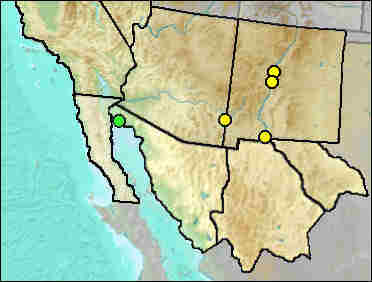
Meachen (2005) described a relatively small, gracile Hemiauchenia from several sites in Florida, mentioning that a phalanx possibly pertaining to this taxon was present in the Blancan of southeastern Arizona. Morgan et al. (2011) noted its presence at Virden and La Union and characterized its size as smaller than H. macrocephala.
Sites.
Blancan: Abo Arroyo (Morgan and Harris 2015)
Latest Blancan: Isleta (Morgan and Harris 2015); La Union (Morgan et al. 2011); Virden (Morgan et al. 2011).
Irvingtonian: El Golfo (Croxen et al. 2007).
Literature.
Croxen et al. 2007; Meachen 2005; Morgan and Harris 2015; Morgan et al. 2011.
Synonyms. Tanupolama stevensi.
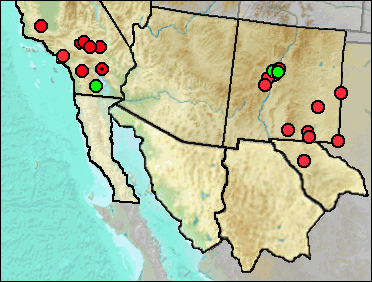
Hemiauchenia macrocephala appears to be the only post-Blancan species of the genus in our region. Likely those in the Hemiauchenia sp. account also belong to this species. Isolated post-cranial material (frequently consisting of phalanges) seem to be separable from that of Camelops by size alone.
This is a large animal, very roughly the same size as Camelops hesternus which had limbs about 20% longer than those of the living Dromedary Camel (Kurtén and Anderson 1980). However, where Camelops limb bones are relatively short stocky, those of Hemiauchenia are extraordinarily slender and long (see Fig. 1 of the Hemiauchenia sp. account).
A number of elements of at least three adults and one young individual were recovered from the Camel Room site of Dry Cave. The position of the skeletal elements suggests that a small herd (family group?) fell together into the Entrance Fissure of Dry Cave. The physical layout of the cave entrance makes this more likely than it might seem, especially if the group was fleeing from a predator. With an approach from the downslope side, the entrance is not apparent until a few feet from the drop off.
Two of the three adult mandibles lack any indication of p3, which might suggest a familial genetic trait. Webb (1974) mentions that the type specimen of the species lacks this tooth, but that it occurs in the greater portion of the H. macrocephala samples.
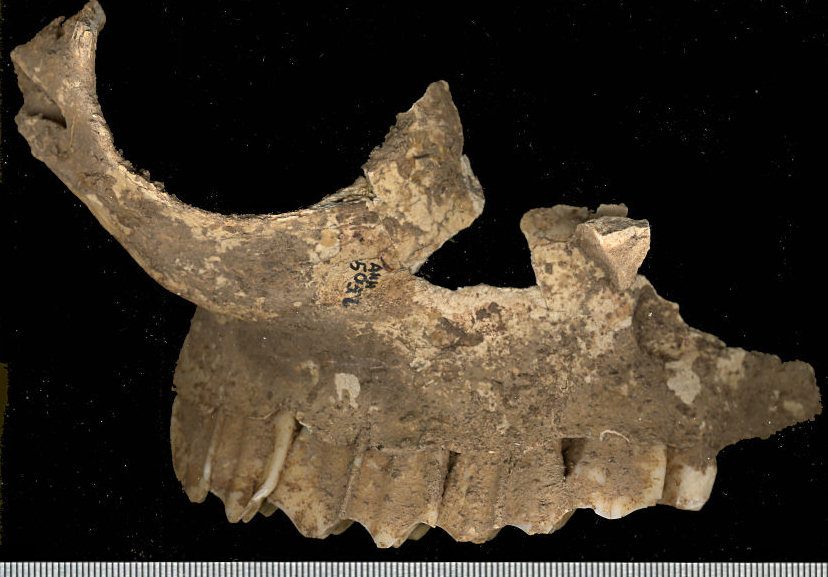
Fig. 1. Lateral view of the maxilla of Hemiauchenia macrocephala from the Camel Room site, Dry Cave. Anterior is to the right. The crescent-shaped portion to the upper left is part of the zygomatic arch. Scale in mm.
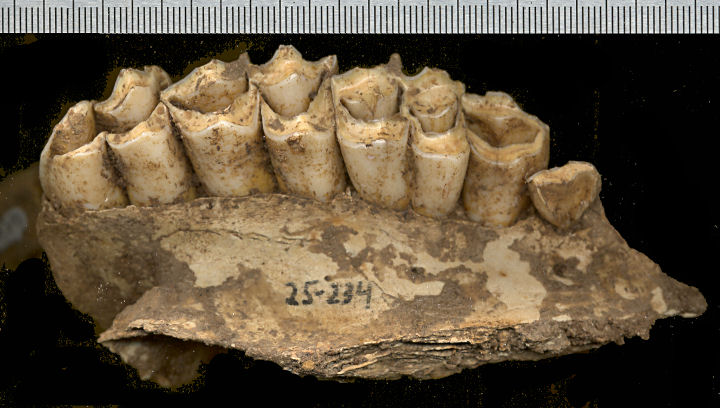
Fig. 1. Palatal view of the same specimen as in Fig. 1. P3, P4, and the three molars show nicely. Scale in mm.
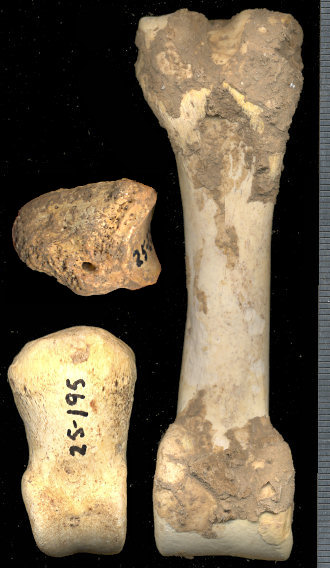
Fig. 3. Phalanges of Hemiauchenia macrocephala from Camel Room site, Dry Cave. Left upper, PH III, oblique dorsal view; left lower, PH II, ventral view; right, PH I, ventral view. Scale in mm.
Sites.
Irvingtonian: Anza-Borrego (Murray 2008); Gutierrez Gravel Pit (Morgan and Lucas 2005); Tijeras Arroyo (Morgan and Lucas 2005).
Early Irvingtonian: Kirtland AFB (Morgan and Harris 2015: cf.).
Late Irvingtonian/Early Rancholabrean: Rancho California (Jefferson 1991b: cf. gen. et sp.).
Irvingtonian/Rancholabrean: Manix Lake (Jefferson 1991b).
Rancholabrean: Cool Water Coal Gasification Solid Waste Site (Jefferson 1991b); Jal (Morgan and Lucas 2005); Ludlow Cave (Jefferson 1991b); Roswell (Morgan and Lucas 2005).
Early Rancholabrean: Albuquerque Gravel Pits (Morgan and Lucas 2005).
Wisconsin: Big Manhole Cave (Harris 1993c).
Mid Wisconsin: McKittrick (Schultz 1937); Pendejo Cave (Harris 2003).
Mid/Late Wisconsin: Diamond Valley (Springer et al. 2009); Rancho La Brea (Stock and Harris 1992); Sierra Diablo Cave (UTEP).
Late Wisconsin: Algerita Blossom Cave (Harris 1993c); Animal Fair 18-20 ka (Harris 1989); Blackwater Loc. No. 1 (Morgan and Lucas 2005); Camel Room (Harris 1993c); Charlies Parlor (Harris 1989); Pendejo Cave (Harris 2003); Sandia Cave (Thompson and Morgan 2001); TT II (Harris 1993c).
Late Wisconsin/Holocene: Calico Lakes (Jefferson 1991b); Isleta Cave No. 2 (Harris 1993c); Pendejo Cave (Harris 2003).
Literature. Harris 1989, 1993c, 2003; Jefferson 1991b; Kurtén and Anderson 1980; Morgan and Harris 2015; Morgan and Lucas 2005; Murray 2008; Schultz 1937; Springer et al. 2009); Stock and Harris 1992); Thompson and Morgan 2001; Webb 1974.
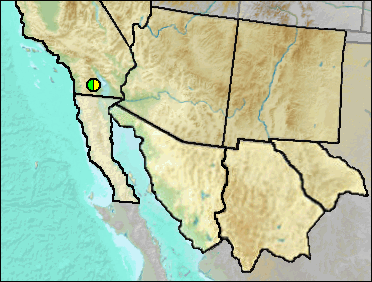
This undescribed species has very slender metapodials and small phalanges, along with some dental differences from other known Anza-Borrego llamas (Webb et al. 2006).
Sites.
Late Blancan/Irvingtonian: Anza-Borrego (Webb et al. 2006).
Literature. Webb et al. 2006.
Last Update: 3 Feb 2016