
Class Mammalia
Order Soricomorpha
Family Talpidae
Scalopus (Hesperoscalops) sp.—Hesperoscalops Mole // Scalopus (Hesperoscalops) blancoensis—Mt. Blanco Mole // Scapanus sp.—Western Moles // Scapanus latimanus—Broad-footed Mole // Scapanus malatinus—Ancestral Broad-footed Mole
Moles are highly adapted to a fossorial life, seldom venturing from their burrow systems. They are adapted also for an insectivorous diet, feeding largely on invertebrates encountered through their burrowing activities. Arid conditions decrease the number of soil invertebrates and often also result in inhospitable soil types. As mid-continental climates became increasingly arid during the Cenozoic, moles became eradicated from mid-continental North America, separating western members of the family from those in the East. Thus presence in areas of the Southwest currently lacking moles suggests less arid conditions. That moles have not been recorded from the Rancholabrean of our region suggests other factors also may be involved.
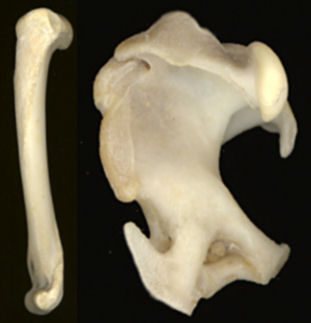
The fossorial adaptations of moles render most skeletal elements easily recognizable; if present in a retrieved fauna, mole elements almost certainly would be recognized (Fig. 1).
Fig. 1. A comparison of the humerus of a domestic cat (left) to that of a mole (adjusted to the same length) to illustrate the extreme modifications for a fossorial life that allow mole skeletal elements to be easily identified. The stout construction and enlarged projections for muscle attachment help power the digging-adapted forelimbs.
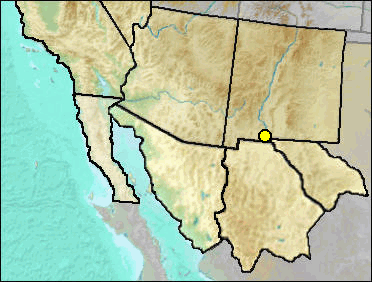
Currently, moles are limited to the eastern portion of the U.S. and the Far West, with modern records of moles within our region limited to relictual populations in the Big Bend region and nearby in the Panhandle of Texas.
Sites.
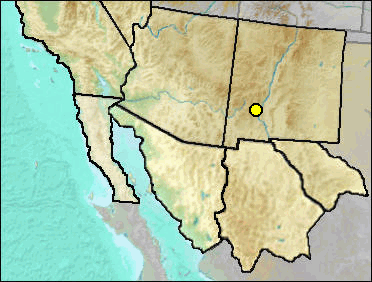
Latest Blancan: La Union (Morgan and Lucas 2003).
Literature.
Synonyms: Hesperoscalops blancoensis.
Morgan et al. (2011) reported a partial mandible of a large species of Scalopus from Caballo. The specimen is only tentatively referred because of dentition differences between the heavily worn Caballo specimen and S. blancoensis (Morgan et al. 2011).
Sites.
Late Blancan: Caballo (Morgan et al. 2011: cf.).
Literature. Morgan et al. 2011.
Sites.
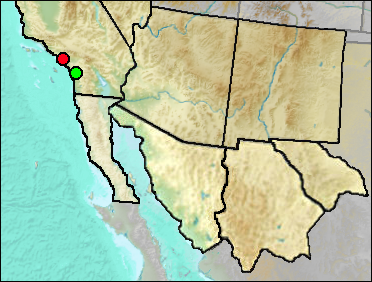
Irvingtonian: Elsinore: Microtus/Mammuthus (Pajak et al. 1996).
Late Irvingtonian: Elsinore: Pauba Formation (Pajak et al. 1996: cf.).
Wisconsin: Zuma Creek (Jefferson 1991b).
Mid/Late Wisconsin: Tsuma Properties, San Clemente (Jefferson 2014).
Literature. Jefferson 1991b, 2014; Pajak et al. 1996.
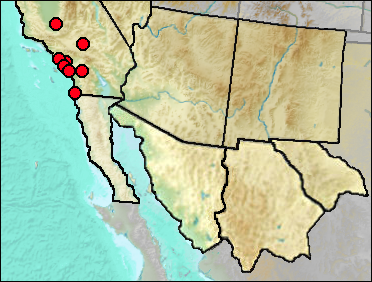
Current distribution is from northern Baja California north to Oregon, including parts of extreme western Nevada.
Sites.
?Irvingtonian/Rancholabrean: Emery Borrow Pit (Jefferson 1991b>.
Rancholabrean: Cool Water Coal Gasification Solid Waste Site (Jefferson 1991b); Eagle Crest (Jefferson 2014: ?).
Sangamon: Newport Bay Mesa (Jefferson 1991b).
Wisconsin: Glen Abbey (Majors 1993).
Mid Wisconsin: Pacific City (Wake and Roeder 2009).
Mid/Late Wisconsin: Diamond Valley (Springer et al. 2009); Rancho La Brea (Akersten et al. 1979).
Literature. Akersten et al. 1979); 1991b, 2014; Majors 1993; Springer et al. 2009; Wake and Roeder 2009.
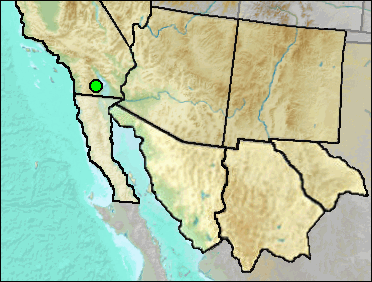
Hutchison (1987:3) described Scapanus malatinus from the Vallecito badlands of the Anza-Borrego Desert:
Small size (humerus total length = 12.2-13.3 mm): lower molars with longitudinally compressed trigonlds and anterior cingulid and entocingulid spanning the base of the paraconid; M1 with enamel extending down labial side of root below gum line, at least below the trigonid; M2-3 with sharp and well-developed ectocingulids spanning hypoflexids: M3 does not show enamel excursion down the root; upper molars with metacingulum joining lingual edge of metacone: trough between base of infraorbital bridge and ridge for insertion of masseter muscles narrow and shallow; infraorbital bridge strap-like rather than rod-like; frontal region convexly arched: shaft length of the radius about 60% of humerus length.
Sites.
Irvingtonian: Anza-Borrego (Hutchison 1987).
Literature. Hutchison 1987.
Last Update: 20 Aug 2019