Lesson 13: Future Directions
Katherine L. Squires
Comm.
5350, Dr. Ingle
Sometimes,
you just cannot say it better than a resource that has already indicated the
future direction for online instruction and distance learning. The Council
for Higher Education Accreditation in its Update, Number Two on Distance
Learning in Higher Education has a report on The Expanding Universe
of Distance Learning[1] that states:
“The
International Data Corporation (IDC) released a report in January 1999 titled
Online Distance Learning in Higher Education, 1998-2002. The report
estimates that 2.2 million college students will be enrolled in distance education
by 2002, up from approximately 710,000 in 1998. The number of distance learning
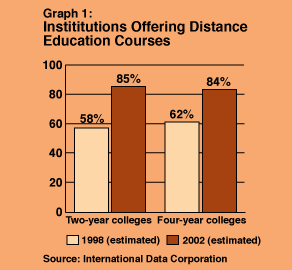
programs is expected to grow to meet the demand. IDC’s research estimates
that 85 percent of two-year colleges will offer distance learning courses
by 2002, compared to 58 percent in 1998. In addition, four-year colleges and
universities that offer distance education courses will jump to 84 percent
in 2002, an increase from 62 percent in 1998.
In
March 1999, the State Higher Education Executive Officers (SHEEO) published
a survey of state policies and distance education technology. Forty-four states
responded to the survey, which identified trends and changes in state policy
in light of the increasing number of degree programs offered through distance
education technology. The following are some of the findings.
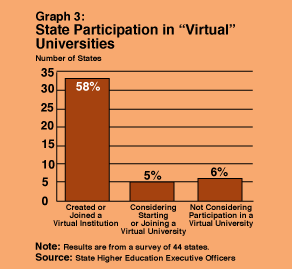
- Thirty-three states have created a statewide "virtual
university" or have elected to participate in a regional or national
virtual university (e.g., Western Governors University or Southern Regional
Electronic Campus) to deliver degree programs through distance education
technology.
- Of the states that currently are not participating
in virtual universities, five are considering the option: Illinois, Kansas,
Missouri, Pennsylvania, and Rhode Island. Six states report that they are
not considering joining a regional virtual university or creating a statewide
virtual university: Connecticut, Iowa, New Hampshire, Ohio, South Dakota,
and Wisconsin.
- In order to improve access to library services
for distance education students, almost all of the responding states offer
inter-library loans, access to statewide networks, and statewide licensing
agreements for electronic library databases. Eleven of the responding states
have implemented a statewide library card.
· Responses
by the states to the survey showed that several important issues are shaping
their distance education agendas: overall coordination and planning; statewide
infrastructure; program development; and faculty and curriculum development.
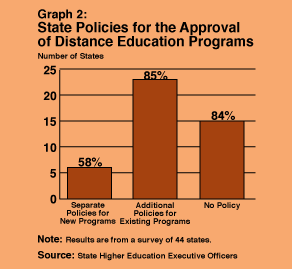
· Only six states have separate policies for approving new degree
programs offered through distance education technology. However, in 23 of
the responding states, an institution must go through additional processes
to offer an existing course or program at a distance.
In addition, a report on Internet2, shows that high-speed
networks are rapidly emerging. to build better network technologies. This
new super-fast data pipeline will link the institutions at speeds 45,000 times
faster than the best telephone modems now used. Internet2 relies on two ultra
high-speed network services: Abilene and the Backbone Network Service (vBNS).
It is expected that some 70 of the member universities and research facilities
will be connected to Internet2 by the year 2000. According to the report,
Internet2 is already being used in many ways. To name only two types of applications,
Georgetown and Gallaudet Universities are using Internet2 to broadcast sign
language instruction, and Duke University is using it to advance research
on distance learning and telemedicine.
Like most other rapidly emerging technologies, many applications spawned by
the advent of Internet2 will be available to other networks. Some of the applications
being developed include:
- Media Streaming. Internet2
will allow distance learning instructors to use high-quality audio and video
illustrations in their courses and let them post those materials onto the
course website. Students will be able to view video illustrations even if
they are using a 28.8k modem;
- Live Video Broadcasts.
Through Internet2, instructors will be able to capture live video and audio,
convert it to a computer-compatible format, and "broadcast" it
to multiple users who have standard Windows software with a Netscape browser
plug-in; and
- 3-D Brain Mapping. Watching
the Brain in Action. This application will allow real-time visualization
of brain activity during visual and memory tasks while the study subject
is in a MRI scanner in a different location. It also provides audio and
video links for demonstrators to interact with scanner operators.”[2]
All
of these reports show the extraordinary potential for best practices and strategies
for taking current and emerging technologies into the “virtual classroom”
or online learning. Growth is rapid and dynamic and the future is filled with
unlimited possibilities.