
Class Mammalia
Order Carnivora
Family Canidae
Canis sp.—Wolves // Canis armbrusteri—Armbruster's Wolf // Canis dirus—Dire Wolf // Canis edwardii—Edward's Wolf // Canis latrans/lupus—Coyote/Gray Wolf // Canis latrans—Coyote // Canis lepophagus—Johnson's Coyote // Canis lupus—Gray Wolf // Canis rufus—Red Wolf
Our species of Canis are larger than the foxes of the region. A traditional way of separating Canis from foxes is the dorsal curvature of the postorbital process, which is convex in Canis and has a depression in the foxes. Of little use, of course, if the frontal bone is not present. The dentary of Urocyon has a distinct step on the ventral border near the proximal end. Size of elements, however, will be of most use regionally.
Within the genus, size and massiveness again are the usual criteria for identification. Canis lupus is significantly larger than Canis latrans and somewhat smaller and less massive than Canis dirus.
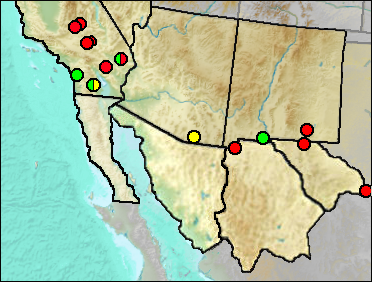
Included here are fossil specimens that can be identified to genus, but are of such nature to prevent identification to species.
Sites.
Late Blancan: Johnson Pocket (Johnson et al. 1975).
Late Blancan/Irvingtonian: Anza-Borrego (Murray 2008).
Irvingtonian: Elsinore: Microtus/Mammuthus (Pajak et al. 1996).
Late Irvingtonian: Adobe Ranch (Morgan and Lucas 2003: coyote size).
Irvingtonian/Rancholabrean: Cadiz (Jefferson 2014: Cf.); Fort Irwin (Jefferson 1991b).
Rancholabrean: Bitter Springs Playa (Jefferson 1991b); Pinto Basin (Jefferson 2014); Tule Springs 1 (Jefferson et al. 2015); Tule Springs 5 (Jefferson et al. 2015).
Mid Wisconsin: U-Bar Cave (UTEP).
Late Wisconsin: Balcony Room (UTEP); Bison Chamber (Harris 1993c: cf.); China Lake (Jefferson 1991b); Dove Springs Megafauna Loc. (Jefferson 2014: cf.).
Late Wisconsin/Holocene: Cueva Quebrada (Lundelius 1984); Lower Sloth Cave (Logan 1983); McKittrick Cave (Harris 1993c).
Literature. Harris 1993c; Jefferson 1991b; 2014; Jefferson et al. 2015; Johnson et al. 1975; Logan 1983; Lundelius 1984; Morgan and Lucas 2003; Murray 2008; Pajak et al. 1996.
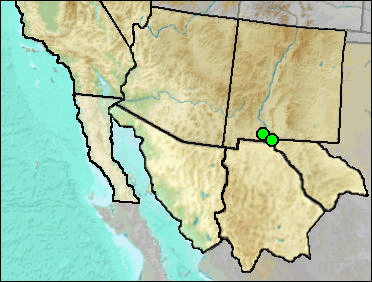
Vanderhill (1986) noted that this taxon and the living Gray Wolf are quite similar. He follows Nowak (1979) in considering them to be separate species and concludes that the Mesilla Basin specimen listed here is C. armbrusteri. The El Paso specimen is from a gravel pit in the Lower Valley.
Tedford et al. (2009) note that this taxon appeared in the early Irvingtonian and eventually gave rise to Canis dirus.
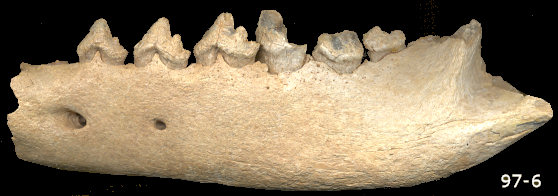
Partial left dentary of Canis armbrusteri from southern Doña Ana Co., New Mexico. UTEP specimen.
Sites.
Early Irvingtonian: Adobe Ranch (Morgan and Lucas 2003).
Irvingtonian: El Paso (UTEP).
Literature. Morgan and Lucas 2003; Nowak 1979; Tedford et al. 2009; Vanderhill 1986.
Synonyms. Aenocyon dirus.
The Dire Wolf was a more heavily built animal than the Gray Wolf. The massive dentition has led some to suggesting morphological convergence with the bone-crushing character of modern hyaenas (Kurtén and Anderson 1980).
Nowak (2002) indicated that this species was descended from C. armbrusteri.
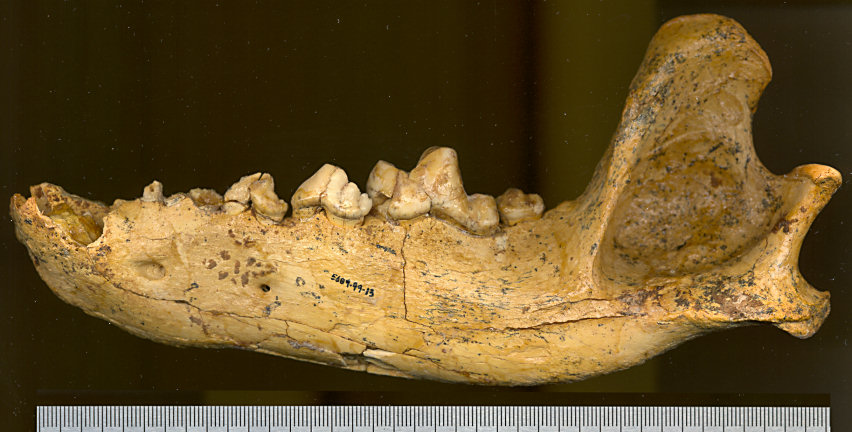
Fig. 1. Left dentary of Canis dirus from U-Bar Cave, Late Wisconsin, 13-15 ka. Scale in mm.
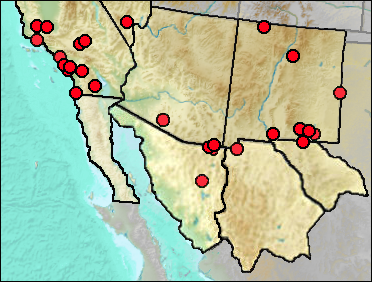
Sites.
Irvingtonian/Rancholabrean: Manix Lake (Jefferson 1991b: cf.).
Rancholabrean: Bitter Springs playa (Jefferson 2014); Bow Willow (Jefferson 2014); Harbor Freeway and 112-113th streets (Jefferson 1991b: cf.); Los Angeles Police Station (Jefferson 1991b); National City West (Jefferson 2014); Santa Cruz (Morgan and Lucas 2005); Whitewater Draw (Mead et al. 2005).
Sangamon: San Pedro Lumber Co. (Jefferson 1991b: ?); Newport Bay Mesa (Jefferson 1991b: cf.); Pacific Ave. and Olive St., San Pedro (Jefferson 1991a).
Wisconsin: Carpinteria (Wilson 1933: cf.); Costeau Pit (Jefferson 1991b: cf.).
Early/Early-Mid Wisconsin: Sabertooth Camel Maze (Harris 1993c).
Mid Wisconsin: McKittrick (Schultz 1937); Térapa (Mead et al. 2006).
Mid/Late Wisconsin: Dark Canyon Cave (Tebedge 1988); Diamond Valley (Springer et al. 2009); Rancho La Brea (Stock and Harris 19920.
Late Wisconsin: Conkling Cavern (Harris 1993c); Blackwater Loc. No. 1 (Lundelius 1972); Gypsum Cave (Jefferson et al. 2015: ?); Hermit's Cave (Harris 1993c); La Mirada (Jefferson 1991b: cf.); Lehner Ranch (Mead et al. 2005); Maricopa (Jefferson 1991b); Murray Springs (Hemmings 2007a); Muskox Cave (Logan 1981); Navajo Lake (Morgan and Lucas 2005); Park Place, Irvine (Jefferson 2014); U-Bar Cave 14-15 ka (Harris 1989); U-Bar Cave 15-18 ka (Harris 1989: cf.); Ventana Cave (Colbert 1950).
Late Wisconsin/Holocene: Williams Cave (Ayer 1936: cf.)
Literature. Ayer 1936; Colbert 1950; Harris 1989, 1993c; Hemmings 2007a; Jefferson 1991b, 2014; Jefferson et al. 2015; Kurtén and Anderson 1980; Logan 1981; Lundelius 1972; Mead et al. 2005; Morgan and Lucas 2005; Nowak 2002; Schultz 1937; Stock and Harris 1992); Springer et al. 2009); Tebedge 1988; Wilson 1933.
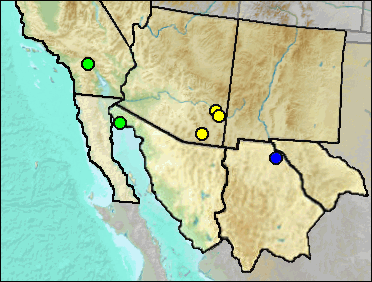
Sites.
Pleistocene: Mina Erupción (Nowak 1979).
Late Blancan: 111 Ranch (Morgan and White 2005); Curtis Ranch (Lindsay 1984); San Simon Fauna (Morgan and White 2005).
Irvingtonian: El Golfo (Croxen et al. 2007).
Early Irvingtonian: El Casco, San Timoteo Badlands (Albright 2000).
Literature. Albright 2000; Eaton 1923; Croxen et al. 2007; Lindsay 1984; Morgan and White 2005.
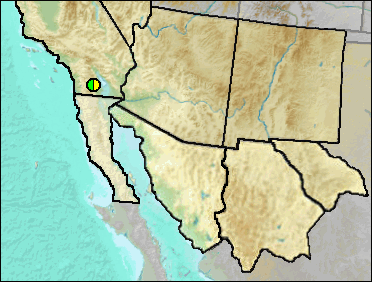
Sites.
Late Blancan/Irvingtonian: Anza-Borrego (Murray 2008).
Literature. Murray 2008.
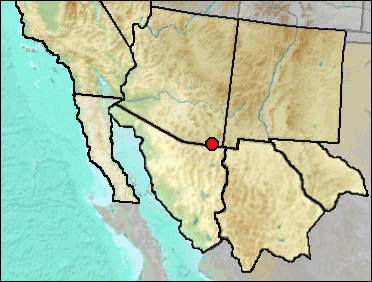
There is some possibility of domestic dog (Hemmings 2007a).
Sites.
Late Wisconsin: Murray Springs (Hemmings 2007a).
Literature. Hemmings 2007a.
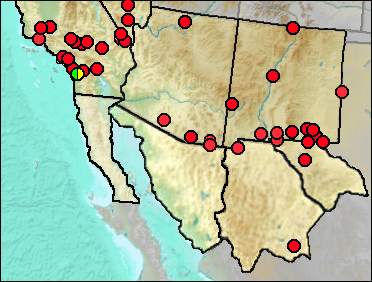
Synonyms. Canis caneloensis, Canis microdon. Skinner (1942) named C. caneloensis on the basis of a skull from Papago Springs Cave. Schultz and Howard (1935) recorded both C. latrans and C. microdon from Burnet Cave. Canis microdon and C. caneloensis, along with a number of other names, have long since been put into synonymy with C. latrans.
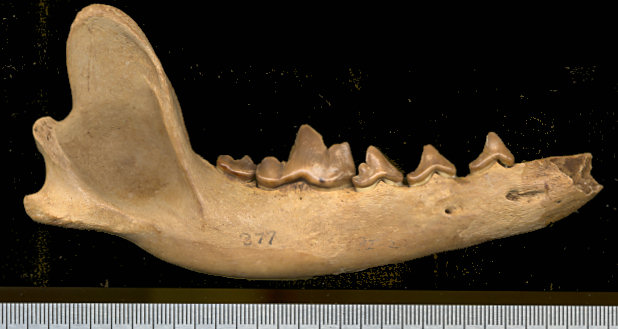
Fig. 1. Right dentary of Canis latrans, Isleta Cave No. 2. Scale in mm.
Sites.
Late Blancan/Early Irvingtonian: Elsinore: Mimomys (Pajak et al. 1996; cf. sp. et gen.).
Late Irvingtonian: Elsinore: Pauba Formation (Pajak et al. 1996).
?Late Irvingtonian/Rancholabrean: Emery Borrow Pit (Jefferson 1991b).
Irvingtonian/Rancholabrean: Manix Lake (Jefferson 1991b).
Rancholabrean: Anthony Gap Cave (UTEP); Bitter Springs Playa (Jefferson 2014); Centennial Parkway, Las Vegas Valley (Jefferson et al. 2015: Cf. gen. et sp.); Century City, Los Angeles (Jefferson 1991b); Clay Mine Road (Jefferson 2014); Harbor Freeway and 112-113th streets (Jefferson 1991b); Ludlow Cave (Jefferson 1991b); Papago Springs Cave (Skinner 1942); Piute Ponds (Jefferson 2014); Tule Springs 4 (Jefferson et al. 2015).
Sangamon: U. S. Veterans Hospital, Long Beach (Jefferson 1991b: cf.).
Wisconsin: Carpinteria (Wilson 1933); Costeau Pit (Jefferson 1991b).
Early/Early-Mid Wisconsin: Lost Valley (Harris 1993c); Rm Vanishing Floor (Harris 1993c: cf.).
Mid Wisconsin: McKittrick (Schultz 1937); Pendejo Cave (Harris 2003); Pintwater Cave (Hockett 2000).
Mid Wisconsin-Holocene: Shelter Cave (Harris 1993c).
Mid/Late Wisconsin: Dark Canyon Cave (Tebedge 1988); Diamond Valley (Springer et al. 2009); NW Talus Slope (Harris 1993c); Rancho La Brea (Stock and Harris 1992).
Mid/Late Wisconsin/Holocene: Jimenez Cave (Messing 1986); Sierra Diablo Cave (UTEP).
Late Wisconsin: Algerita Blossom Cave (Harris 1993c); Animal Fair 18-20 ka (Harris 1989); Antelope Cave (Reynolds, Reynolds, Bell, and Pitzer 1991); Big Manhole Cave (Harris 1993c); Blackwater Loc. No. 1 (Lundelius 1972); Camel Room (UTEP); Charlies Parlor (Harris 1989); Double Adobe (Mead et al. 2005); Harris' Pocket (Harris 1970a); La Mirada (Jefferson 1991b: cf.); Maricopa (Jefferson 1991b)Mountain View Country Club (Jefferson 2014); Mystery Light Cave (this volume); Park Place, Irvine (Jefferson 2014); Pendejo Cave (Harris 2003: cf.); Rocky Arroyo No. 1 (UTEP); Salt Creek (UTEP: cf.); Stalag 17 (Harris 1993c); TT II (Harris 1993c); U-Bar Cave 13-14 ka (Harris 1989); U-Bar Cave 14-15 ka (Harris 1989); U-Bar Cave 15-18 ka (Harris 1989); Valley Wells (Reynolds et al. 1991): cf.); Ventana Cave (Colbert 1950).
Late Wisconsin/Holocene: Aden Fumarole (UTEP); Burnet Cave (Schultz and Howard 1935); Conkling Cavern (Conkling 1932); Isleta Cave No. 1 (UTEP); Isleta Cave No. 2 (UTEP); Kokoweef Cave (Reynolds, Reynolds, et al. 1991); Newberry Cave (Jefferson 1991b); Pendejo Cave (Harris 2003); SAM Cave (Rogers et al. 2000: cf.); Stanton's Cave (Olsen and Olsen 1984); Tule Springs (Mawby 1967).
Literature. Colbert 1950; Conkling 1932; Harris 1970a, 1989, 1993c, 2003; Hockett 2000; Jefferson 1991b, 2014; Jefferson et al. 2015; Lundelius 1972; Mawby 1967 ; Mead et al. 2005; Messing 1986; Olsen and Olsen 1984; Pajak et al. 1996; Reynolds et al. 1991; Reynolds, Reynolds, et al. 1991; Reynolds, Reynolds, Bell, and Pitzer 1991; Rogers et al. 2000; Schultz 1937; Schultz and Howard 1935; Skinner 1942; Springer et al. 2005, 2009); Stock and Harris 1992); Tebedge 1988; Wilson 1933.
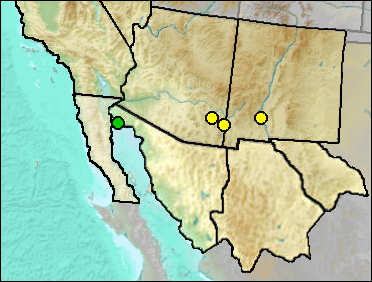
This species may be the direct ancestor of Pleistocene and Holocene Canis latrans and, in its Old World form, of wolves, according to Kurtén and Anderson (1980) who point out that this taxon is very similar to the Coyote except for minor dental differences and less cursorial limb proportions.
Morgan and Lucas (2003) reported mandibles similar in size and morphology to this taxon from the Virden and Caballo local faunas and indicated that the age likely is latest Blancan. They further noted that C. lepophagus generally is considered as limited to the Blancan. However, its occurrence at El Golfo indicates survival into the Irvingtonian (Croxen et al. 2007).
Sites.
Late Blancan: 111 Ranch (Morgan and White 2005); Caballo (Morgan et al. 2011: ?); La Union (Morgan et al. 2011); Virden (Morgan and Lucas 2003).
Irvingtonian: El Golfo (Croxen et al. 2007).
Literature. Croxen et al. 2007; Kurtén and Anderson 1980; Morgan and Lucas 2003; Morgan and White 2005; Morgan et al. 2011.
Synonyms. Canis nubilus.
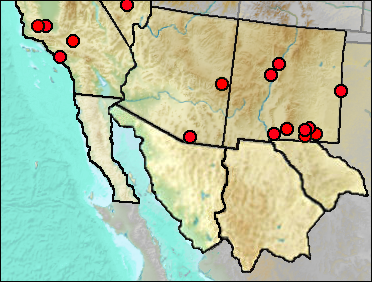
Canis lupus is the wolf so common throughout North America historically. It has been identified from the early Irvingtonian and through the Pleistocene, apparently entering the New World shortly after evolving in the Old (Kurtén and Anderson 1980). However, it apparently did not extend into mid-latitude North American until the late Rancholabrean (Tedford et al. 2009). It was widespread in the late Pleistocene and Holocene, numbers decreasing only with human attempts to eradicate them to protect livestock.
In Fig. 1, a fossil jaw from Isleta Cave No. 2 is compared to a modern, northern subspecies of Gray Wolf that is larger than the historic subspecies occurring in the Southwest. The greatest length of the carnassial of the fossil specimen is 27.9 mm; of the modern, 29.2 (the Coyote figured in the Canis latrans account is larger than the average modern southern New Mexico/western Trans-Pecos Coyote; the carnassial measurement is 24.5 mm). Since Isleta Cave No. 2 is mixed late Wisconsin and Holocene, the jaw could be Holocene.
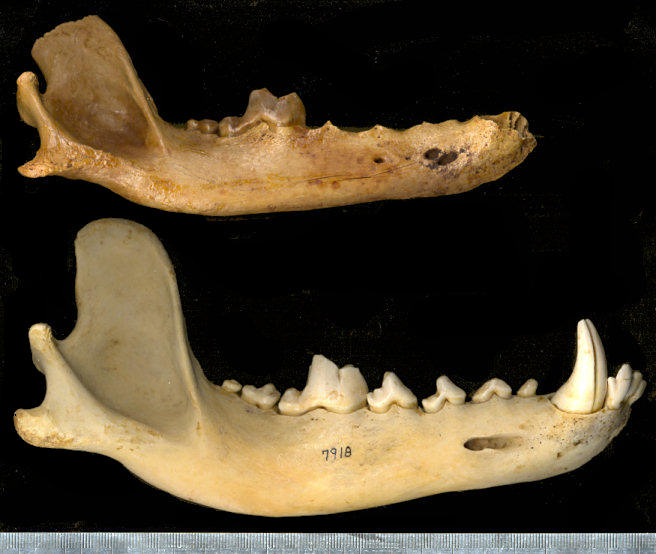
Fig. 1. Fossil (top) and modern Canis lupus. Fossil is from Isleta Cave No. 2; modern is from Montana. Scale in mm.
Sites.
Rancholabrean: Papago Springs Cave (Skinner 1942).
Early/Early-Mid Wisconsin: Rm Vanishing Floor (Harris 1993c); Sabertooth Camel Maze (Harris 1993c).
Mid Wisconsin: McKittrick (Jefferson 1991b); Pendejo Cave (Harris 2003: cf gen ? sp); Pintwater Cave (Hockett 2000); Screaming Neotoma Cave (Glennon 1994: cf.).
Mid/Late Wisconsin: Dark Canyon Cave (Tebedge 1988); Hampton Court (Harris 1993c: ?); Pit N&W Animal Fair (Harris 1993c); Rancho La Brea (Stock and Harris 1992).
Late Wisconsin: Animal Fair 18-20 ka (Harris 1993c); Blackwater Loc. No. 1 (Slaughter 1975); Gypsum Cave (Jefferson et al. 2015: ?); Hermit's Cave (Harris 1993c); Maricopa (Jefferson 1991b); Sandia Cave, Folsom Level (Hibben 1941: cf.); Stalag 17 (Harris 1993c); Stevens Cave (Emslie 1988).
Late Wisconsin/Holocene: Burnet Cave (Schultz and Howard 1935); Conkling Cavern (Conkling 1932: "the smaller wolf" in respect to Dire Wolf); Isleta Cave No. 1 (UTEP); Isleta Cave No. 2 (UTEP); Pendejo Cave (Harris 2003); Schuiling Cave (Jefferson 1991b: cf.).
Literature. Conkling 1932; Emslie 1988; Glennon 1994; Harris 1993c, 2003; Hibben 1941; Hockett 2000; Jefferson 1991b; Jefferson et al. 2015; Kurtén and Anderson 1980; Slaughter 1975; Schultz and Howard 1935; Skinner 1942; Stock and Harris 1992); Tebedge 1988; Tedford et al. 2009.
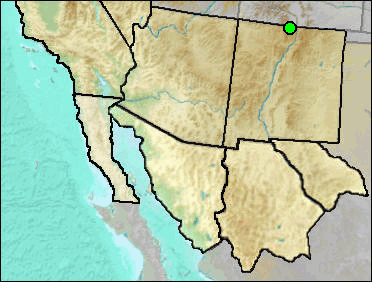
Wozencraft (2002) included C. rufus in the synonymy of C. lupus, considering it a hybrid between the Gray Wolf and the Coyote (but discussed dissenting viewpoints). Nowak (2002) concluded that there was a population distinct, though intermediate, from either of those two species. Nowak discussed problems with Canis at length and included entry into the literature for various viewpoints.
Morgan and Lucas (2003) indicate that the SAM cave record is questionable and the specimen likely represents C. armbrusteri.
Sites.
Medial Irvingtonian: SAM Cave (Rogers et al. 2000).
Literature. Morgan and Lucas 2003; Nowak 2002; Rogers et al. 2000; Wozencraft 2005.
Last Update: 27 May 2015