
Class Mammalia
Order Perissodactyla
Family Equidae
Equidae—Family Equidae // Equidae sp.—Horses // Equus sp. (small)—Small Horse // Equus sp (large)—Large Horse // Equus calobatus—Stilt-legged Onager // Equus conversidens—Mexican Horse // Equus cumminsii—Cummings' Ass // Equus enormis—Enormous Horse // Equus fraternus—Fraternal Horse // Equus giganteus—Giant Horse // Equus occidentalis—Western Horse // Equus pacificus—Pacific Horse // Equus (Plesippus) sp.—American Zebra // Equus (Plesippus) francescana—Francescana Zebra // Equus (Plesippus) simplicidens—American Zebra // Equus Species A—Unidentified Equus // Haringtonhippus francisci—Harington's Stilt-legged Horse
The content of the genus Equus has varied from time to time as various workers have differed in how similar taxa should be in order to be considered as members of the genus. Barrón-Ortiz et al. (2019) recently considered what criteria could best define a genus, coming up with a "working hypothesis for discussing distinct paradigms for understanding higher level taxonomy, particularly in regards to the definition of the genus Equus" (Barrón-Ortiz et al. 2019:2). This in part was stimulated by the erection of a new genus, Haringtonhippus, for the species Equus francisi, long considered as belonging to the genus Equus (Heintzman et al. 2017).
Aside from the generally accepted requirement that the members of a genus should be monophyletic (all members descended from a common ancestor), Barrón-Ortiz et al. (2019) defined four other conditions to be considered in defining a genus. In the case of Equus, the defined generic hypothesis excluded several taxa often considered as members (within our area and time span, Plesippus), but included H. francisci. Thus they concluded Haringtonhippus should be considered a synonym of Equus.
Haringtonhippus was partially based on molecular evidence largely unavailable for other fossil equines (Heintzman et al. 2017) and thus unable to be addressed by Barrón-Ortiz et al. (2019). For this reason, I've opted to use the genus Haringtonhippus until further evidence clarifies the relationships.
Names in the menu above are listed as reported in the literature except where the recent literature has formally or by implication made changes applying to all of a listed taxon. An example is Haringtonhippus francisci, just recently (Heintzman et al. 2017) transferred from Equus to Haringtonhippus.
North American horse nomenclature has been a mess for many years, with various authors placing Pleistocene species as closely related to various extant Old World groups such as zebras, asses, Asian asses, and caballines (the lineage to which the domestic horse belongs). More recently, Weinstock et al. (2005), using molecular evidence, suggested that late Pleistocene North American horses were of only two lineages: caballine and New World stilt-legged horses (NWSL), and suggested that these two lineages may each have consisted of single species. It should be noted, however, that their sample is highly biased toward northern and northwestern North America with only one specimen (from Gypsum Cave, Nevada) from south of Wyoming. Since then, Barrón et al. (2017), and Heintzman et al. (2017), among others, have reset late Pleistocene horse nomenclature, including the erection of a new genus to include the NWSL horses.
Winans (1989) recognized one group in the late Rancholabrean of North America possessing elongated metapodials (stilt-legged horses: Equus francisci group) and two groups of stout-legged horses: large horses which she assigned to the Equus laurentius group and a small horse assigned to the E. alaskae group. She did note (p. 295) that "It is possible that some of the groups which I have defined encompass more than one species, . . ." Winans' groups differed somewhat from those of an earlier study by Harris and Porter (1980), who recognized three species at Dry Cave: E. scotti (later re-identified as E. occidentalis by Harris [2013]), E. niobrarensis, and E. conversidens. Winans (1989) recognized none of these latter three names, assigning horses generally assigned to E. occidentalis to the E. laurentius group, E. niobrarensis as a synonym of the E. scotti group, and E. conversidens as a synonym of her E. alaskae group.
The names used herein are used for convenience, having been widely used for Southwestern species; no attempt at solving nomenclatural issues is implied. For further comments on the validity of E. conversidens, see Scott (2004).
The conclusions of Weinstock et al. (2005) do not hold up with the morphological data from the Southwest. Weinstock et al. implied that the morphological differences seen within North American stout-legged horses are adaptations of a single species to different environments. However, occurrences of two to three "morphological species" in what basically is geographic and chronologic sympatry (as at Dry Cave) renders this unlikely since interbreeding would quickly break down the morphological differences. On the other hand, it is easy to visualize different species morphologically adapted to different environments overlapping in space and time.
Dry Cave serves as an example. In attempts to characterize the equine fauna of Dry Cave, measurements of horses from McKittrick and Rancho La Brea were taken as representing E. occidentalis and those from San Josecito Cave as representing E. conversidens. Ae third group at Dry Cave gave measuremets intermediate in size (e. g., Fig. 1). Data from Dry Cave specimens and the summary measurements of Winans' (1985), strongly suggest mismatches to groups in Winans.
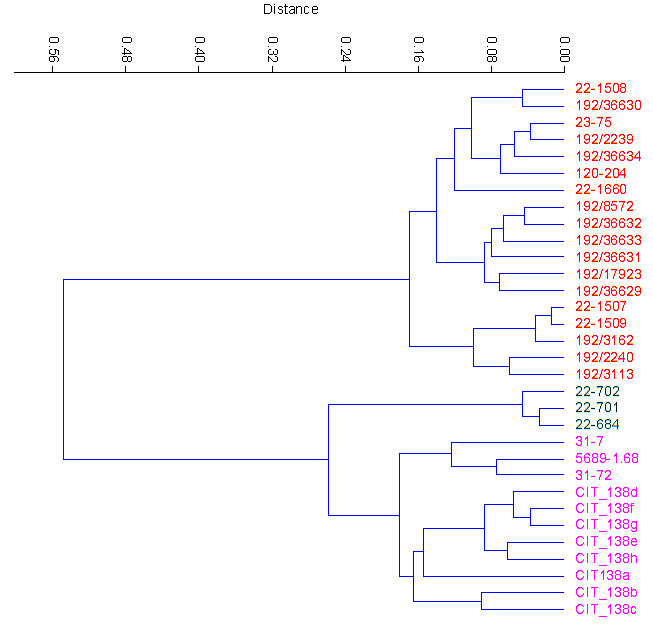
Fig. 1. Dendrogram showing clustering of second phalanges, interpreted as representing E. conversidens (red), an intermediate-sized horse (blue-green), and E. occidentalis (magenta). Specimens with labels starting with 192/ are from San Josecito Cave; those starting with CIT are from McKittrick; the remainder are from UTEP specimens. All measurements are by myself. Based on measurements 1-6 of Harris and Porter (1980).
Utilizing a variety of univariate measurements on Dry Cave metacarpal IIIs, the specimens used as representing E. occidentalis and E. conversidens agree well with Winans' (1985) summary univariate statistics for Rancho La Brea and San Josecito, respectively. The Southwestern specimens hypothesized by Harris and Porter (1980) as E. niobrarensis, which were placed in the "big horses" category by Winans (1985), differ in various measurements (e.g., proximal metacarpal width) from Winans' Rancho La Brea sample (of Winans' "big horses" category) by p = <0.001; that sample also differs from Winans' San Josecito sample ("little horses") by p = <0.001. The overall result of both univariate and multivariate analyses is division into three groups best considered as separate species. It thus appears that the late Rancholabrean large, stout-legged horses of Winans include at least three species (Fig. 2).
This confirmation that the Dry Cave fauna included three stout-legged species led to looking more closely at the horses identified by Harris and Porter (1980) as E. niobrarensis. Utilizing the data in Winans (1985), it became apparent that the Dry Cave measurements fit closely with those of E. scotti, though Winans (1989) had listed its chronologic range as late Blancan and early Irvingtonian. This fit between E. scotti and various samples of late Rancholabrean horses has been noted by others (e.g., Lundelius 1984). Presence of an infundibulum in the lower incisors further separates this taxon from E. conversidens and E. occidentalis. On the basis of the characters noted, I now recognize E. scotti rather than E. niobrarensis as present in the Southwest and I accept E. niobrarensis as a synonym of E. scotti.
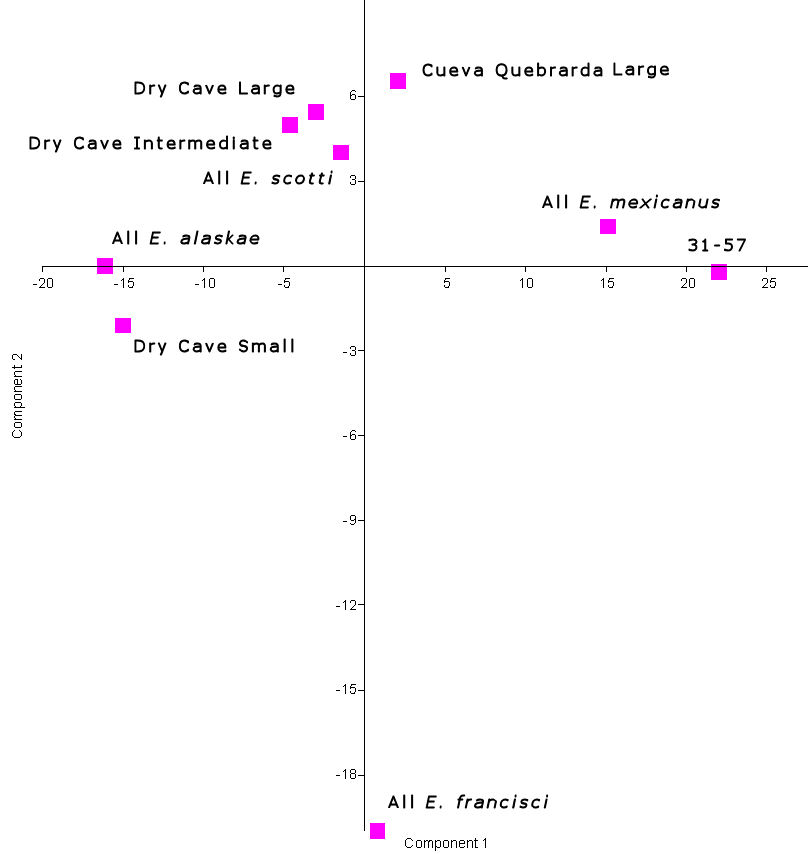
Fig. 2. Principal components plot of Equus metacarpal measurements. "All large Dry Cave", "All E. scotti", "All E. alaskae", "All E. mexicanus", "All E. francisci", and "Cueva Quebrada Large" are based on data from Winans (1985). "Dry Cave Intermediate" and "31-57" are from my data. Measurements 1-8 of Harris and Porter (1980).
Winans (1989) recognized only one stilt-legged horse, E. francisci, Irvingtonian to Rancholabrean. However using her data, Coleman (listed as E. francisci) clusters with E. conversidens in a principal components plot, and the Arkalon small horse, the type of E. calobatus, and the Silverton specimen plot far from the otherwise tight cluster, leading to the suspicion that more than one species is involved. Likewise, such statistics as the coefficient of variation and the standard error of the mean are much larger than in a comparable sample of E. conversidens.
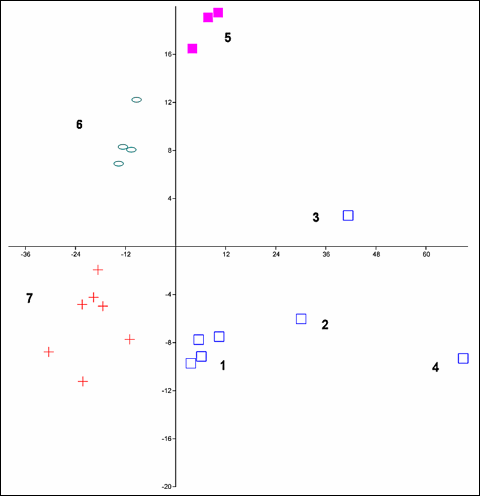
Fig. 3. Principal components plot of metacarpals considered by Winans (1989) to represent E. francisci showing the separation from the stout-legged taxa (numbered 5 - 7) and the wide spread of "francisci" (numbered 1 - 4). Measurements 1-8 of Harris and Porter (1980).
In Fig. 3, the emphasis is on the separation of Winan's E. francisci group from her stout-legged groups and on the wide spread within the E. francisci group. The outliers of the E. francisci group are 2, Arkalon small Equus; 3, E. calobatus, and 4, Silverton.
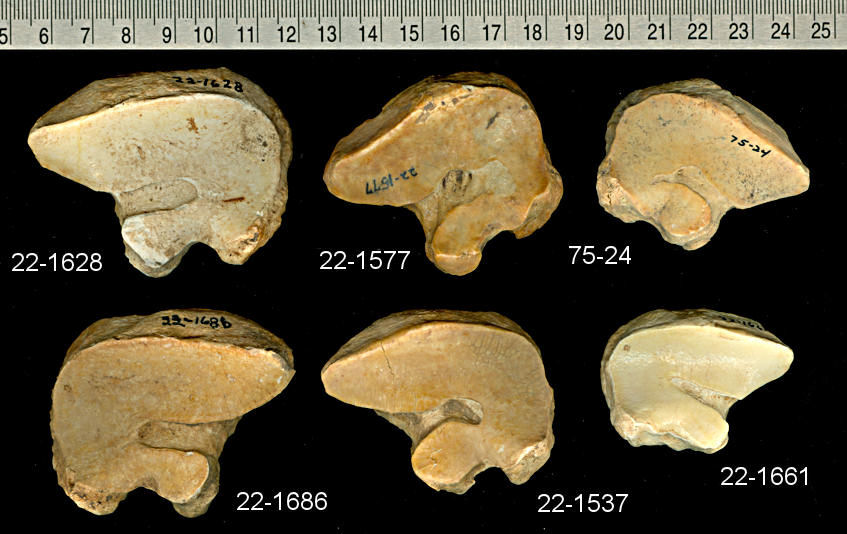
Fig. 4. Navicular (central tarsal) of three species of fossil horse (left to right): E. occidentalis, E. scotti, E. conversidens. UTEP locality 22 is the Animal Fair complex of Dry Cave; locality 75 is Dark Canyon Cave.
In the late 1970s, I made measurements of a number of equine elements at the Los Angeles County Museum and the Philadelphia Academy of Natural Sciences, which I gratefully acknowledge. Records of occurrence of horses with the source given as "Harris data" are based on those studies.
Based on tooth enamel patterns, Barrón-Ortiz and Theodor (2011:148) found three morphological groups of stout-legged Equus in the late Pleistocene: ". . . a medium stout-legged equid (specimens previously identified as E. conversidens, E. fraternus, and E. lambei), a large stout-legged horse (specimens previously identified as E. complicatus, E. niobrarensis, and E. mexicanus) and E. occidentalis."
Since the above was written, Barrón-Ortiz (2016) completed his doctoral dissertation on late Pleistocene horses of the Interior of North America. Based on a combination of ancient mitochondrial DNA and tooth morphology, he recognized two caballine and two non-caballine taxa, although he stressed that the names he applied were tentative. Caballine horses are those related to the domestic horse, now often recognized as Equus ferus caballus. According to Barrón-Ortiz, one taxon, E. ferus lambei, is found only in the Far North (Beringia). The other is a large horse which is recognized above as E. scotti and by Barrón-Ortiz as E. ferus scotti). The remaining two, non-caballine taxa, according to their dental morphology, are E. cedralensis from Mexico (no DNA available) and E. conversidens distributed from Mexico to southern Canada on basis of both dental morphology and mitochondial ancient DNA.
Building in part on Barrón-Ortiz (2016), Barrón-Ortiz et al. (2017) published a major study of late Pleistocene Equus from the Western Interior of North America, combining cheek tooth morphology and ancient mitochondrial DNA (where available). Two caballine and two stilt-legged groups were recognized. In our region, a caballine species is recognized as conspecific with E. ferus (E. ferus scotti). The widespread E. conversidens falls among the stilt-legged group, despite the relatively stout metapodials (possibly a result of a geographic, north-south cline in slenderness, most slender to the north). A second non-caballine group did not produce mitochondrial DNA and was referred provisionally to E. cedraleneis.
Late 2017 saw another major change with the description of a new genus of horses to encompass the New World Stilt-legged Horses (Heintzman et al. 2017). This genus, Haringtonhippus, includes one species, H. francisci. This taxon is treated further in the account of that species. Inclusion within this taxon is based on DNA evidence, and some problems remain due to differences between the DNA evidednce and morphological evidence.
Barrón et al. (2017) noted the importance of subjecting holotypes of other named species of horses to dental morphological and DNA analyses where suitable material exists. Until such studies clarify nomenclatural and taxonomic relationships, no broadscale attempt at synonyms are made.
Literature.
Barrón-Ortiz 2016; Barrón-Ortiz and Theodor 2011; Barrón-Ortiz et al. 2017; Barrón-Ortiz et al. 2019; Harris and Porter 1980; Harris 2013; Heintzman et al. 2007; Scott 2004; Weinstock et al. 2005; Winans 1985, 1989.
Last Update: 17 Sep 2019