Water Week 26 - Event Details
Events at El Paso, Texas
World Water Week Community Organizations Tabling
Tabling at World Water Week is a fantastic opportunity to engage with a diverse audience of community organizations passionate about water-related issues.
Time: 9:00a - 12:30p
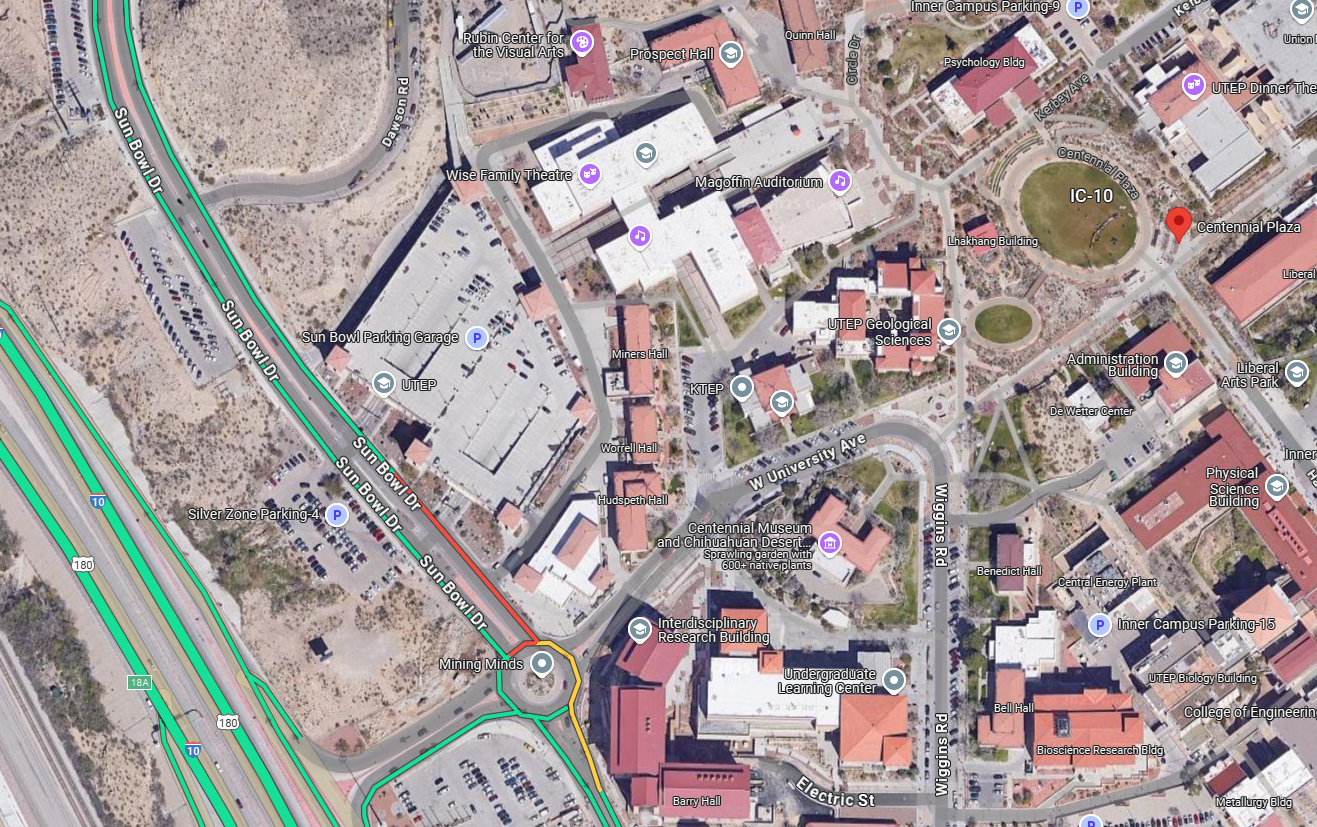
Location: UTEP Campus - Centennial Corridor
Welcome: Water, Health and Gender of Water Week
World Water Week will feature organizations passionate about water-related issues providing a fantastic opportunity to engage and network with our community and students while on campus.
Presenters: President Dr. Heather Wilson (UTEP) & Lic. Marco Licon Barraza (JMAS)
Time: 2:30p - 3:15p
Location: UTEP Campu - IDRB Auditorium 2.204
Water quality in the border region and its impacts in the human health
Presenters: Beatriz Rocha Gutierrez (UACH)
Time: 3:30p - 4:30p
Location: UTEP Campu - IDRB Auditorium 2.204
The use of reclaimed water in the border region
Analyze the pollutants present in water in the border region, types of treatment for its potabilization and the impact of the water quality in human health.
Presenters: Maria de Lourdes Ballinas (UACH)
Time: 4:30p - 5:30p
Location: UTEP Campu - IDRB Auditorium 2.204
Water scarcity AI solution applying the natural water cycle model at the US - Mexico border states
Major ideas for water scarcity with proposal solution using AI Models. Zoomed in on the Paso Texas – Ciudad Juarez, Chih, these cities are basically fused together across the border, they share weather, water and problems, the heart of the proposed method is a tool called the “altered natural water cycle value” also known as “the natural water general cycle index (NWGCI).
Presenters: Dr. Jorge Garza-Ulloa
Time: 9:30a - 10:30a
Location: UTEP Campus - IDRB Auditorium 2.204 (VIRTUAL)
Water and artificial intelligence
The global water crisis, driven by climate change and population growth, demands an urgent transition to "Smart Water Management." This presentation explores how Artificial Intelligence (AI) has evolved from a futuristic tool to a fundamental operational pillar that enables optimization across a wide range of applications, from agricultural irrigation to urban water consumption.
Presenters: Diego Almanzo, Vladik Kreinovich, Cielo Zambrano and Dafne Delgado
Time: 10:30a - 11:30a
Location: UTEP Campus - IDBR Auditorium 2.204
Mitigating Urban Flooding Through Residential Rainwater Harvesting Using GIS and HEC-HMS
As urbanization expands, the loss of pervious surfaces has led to greater stormwater runoff and contributed to an increase in urban flooding—localized flooding in areas not formally designated as flood zones. This study evaluates the potential of decentralized active rainwater harvesting (RWH) to mitigate urban flooding in semi-arid urban environments.
Presenters: Isabel Lopez
Time: 1:00p - 1:20p
Location: UTEP Campus - IDRB Auditorium 2.204
Green stormwater infrastructure for El Paso: What should it look like – and how do we get there?
Slowing the movement of water results in tangible benefits: healthier trees, cooler streets, reduced stormwater infrastructure, improved water quality and aquifer recharge of our most precious resource.
Panelists from diverse backgrounds and expertise will discuss the current status, opportunities, and future of the Slow Water movement in El Paso, and begin discussion of What To Do Next.
Presenters: Maya Sanchez, Mike Gaglio, Jennifer Barr, Sarah Hurteau, Oscar Villalobos, Jorge Castillo, Emigdio Gonzalez
Time: 1:25p - 3:00p
Location: UTEP Campus - IDRB Auditorium 2.204
Poster Participant Breakfast
Time: 8:30a - 9:00a
Location: UTEP Campus - IDRB Back Foyer
Student and Faculty Poster Session
World Water Week Posters 2026
Presenters: Students
Time: 9:00a – 10:00a
Location: UTEP Campus - IDRB Back Foyer
Flowing movement practice
Embodied Practice featuring soundbath and accesible yoga practice
Presenters: Melissa Melpignano & Fernanda Lugo
Time: 11:00a - 12:00p
Location: UTEP Campus - IDRB Auditorium 2.204
Keynote Speech -Sanitation Revolution: Placing gender at the center of global water, sanitation, and hygiene policy
Presenters: Kathleen O'Reilly, PhD
Time: 12:30p – 2:00p
Location: UTEP Campus - IDRB Auditorium 2.204
Groundwater Signatures and Mixing Patterns around El Paso del Norte Area of the Rio Grande Aquifer System
Data analysis of environmental tracer groundwater data in the literature for the Rio Grande aquifer system around El Paso that illustrates the connectivity of the aquifers in the region
Presenters: Astrid Lozano
Time: 2:00p - 3:00p
Location: UTEP Campus - IDRB Auditorium 2.204
Short Film - PBS archive: Echoes of the Rio
One El Paso filmmaker calls on her Indigenous and Mexican ancestors to explore the cyclical starvation of the Rio Grande river and the human and inhumane factors contributing to the disappearance of its culture and bounty.
Presenters: Jackie Iyari Barragan
Time: 3:30p - 4:30p
Location: Centennial Museum
Climate Change and Human Adaptations in the Arctic
Climate change is reshaping Arctic ecosystems, including aquatic environments, and how Indigenous and local communities are responding to these transformations. By bridging interdisciplinary perspectives and Indigenous knowledge, the panel explores experiences and lessons learned from research projects, knowledge sharing and co-production. It also addresses the challenges and opportunities associated with water insecurity, environmental change, and resilience in a rapidly changing Arctic.
Presenters: Olga Lauter
Time: 10:30a - 12:00p
Location: UTEP Campus - IDRB Auditorium 2.204
The Effectiveness of Using Eco-Friendly/Environmental Digital Games: A Text Mining of Players' Experiential Narratives
The government and non-profit organizations have introduced digital games to change players' conservation behaviors (EPA, 2025). Commonly known as eco-friendly or "environmental" games (King, 2020, n.p.), these entertainment-education tools allow water conservation organizations to take advantage of the immersive and interactive capabilities to engage players
Presenters: Yowei Kang, Ph.D.
Time: 12:30p - 1:00p
Location: UTEP Campus - IDRB Auditorium 2.204
Using AI-Assisted Image Analysis Tools to Analyze Water Conservation Campaigns
Water conservation organizations, particularly small ones, often face consumer and organizational obstacles to implementing environmental campaigns (Sustainability Directory, 2024). Changing individual habits in water usage and conservation requires in-depth consumer behavioral insights, which many small water conservation organizations do not have (Sustainability Directory, 2024).
Presenters: Kenneth C. C. Yang, Ph.D.
Time: 12:30p - 1:00p
Location: UTEP Campus - IDRB Auditorium 2.204
The Women Bring the Water: Braiding Water and Memory through Rematriation
Story Map
Presenters: Andrea Everett
Time: 3:00p - 4:00p
Location: UTEP Campus - IDRB Auditorium 2.204

Roberto Bustamante Water Treatment Plant Tour
Join our tour to learn how the plant functions:
Get a behind the scenes look at how water is treated and managed, and learn how it supports the wetlands at Rio Bosque Wetlands Park.
Presenters: Sergio Samaniego (UTEP) & Rocio Ronquillo (UTEP)
Time: 8:30a 9:30a
Location: Rio Bosque Wetlands Park - Roberto Bustamante Water Treatment Plant
Rio Bosque Wretlands Park: Restoring Wetlands and Communities
Coffee & Conversation with Park Manager’s
Enjoy light refreshments and get a behind the scenes look from the park managers through a presentation. Afterwards, have a chat with them, ask questions, and connect in a relaxed community setting.
Presenters: Sergio Samaniego (UTEP) & Rocio Ronquillo (UTEP)
Time: 10:00a 11:00a
Location: Rio Bosque Wetlands Park - Visitor Center
Featuring: Rubin Center for the Visual Arts Plumas, Colores, y Vida en El Río Bravo
Transforms complex data on climate change and social crises into powerful woven narratives of resilience and hope.
Presenters: Janette Terrazas
Time: 11:00a 1:30p
Location: Rio Bosque Wetlands Park - Visitor Center
Keystone Heritage Park Tour
We would also like to offer a tour of the Chihuahuan Desert Experience, The Kevin Von Finger Wetlands, and the Desert Botanical Garden. The tour could probably take up to two hours:
Tours closer to sunset are the best option since bird activity increases around sunset. Plus we want attendees to be comfortable.
Presenters: TBA
Time: 6:00pm (RSVP online)
Location: Keystone Heritage Park
Events at Ciudad Juárez
Sundrop: A Sustainable Solar Water Disinfection Container for Vulnerable Communities
Sundrop emerges as a social response to the severe water crisis in Venezuela, where shortages force families to store water precariously for periods of up to three months. This situation, exacerbated by hyperinflation and the El Niño phenomenon, has significantly increased the risk of bacterial diseases and the spread of waterborne illnesses.
Presenters: Alibell Matheus
Time: 9:00a - 9:30a
Location: Instituto de Ciencias Biomédicas Edificio de Posgrado Auditorio G1
Inauguración de exhibición de pinturas
Time: 10:00a
Location: Centro Cultural las Fronteras Mezanine/Sala Platino
Visual poetic essay: The return of water
This photographic essay was created through ethnographic journeys along the irrigation canals. It reflects on the river, a border river called the Rio Bravo/Grande, which was once wild and now flows like a wound across the Chihuahuan Desert.
Presenters: Brenda Ceniceros Ortiz
Time: 10:00a
Location: Centro Cultural las Fronteras Mezanine/Sala Torre
La Saladita: Despite the years, continues to accumulate in what was El Salado, a salt factory in Samalayuca, Chihuahua
Photograph of how water, despite the years, continues to accumulate in what was El Salado, a salt factory in Samaluyca, Chihuahua, where the vestiges show the splendor of the Samalayuca desert in Ciudad Juarez, Chihuahua.
Presenters: Berenice Ivette Vazquez Bernal
Time: 10:00a
Location: Centro Cultural las Fronteras Mezanine/Sala Torre
Verses of Water: collective poetic cartography
The activity consists of a performance of a collection of collective micro-poems (including those written by children) that address the theme of water in relation to public health and gender equality. The proposal includes a digital photographic exhibition of the collection (and its authors) and an interactive exercise in which the audience can create new verses on the spot, thus generating an artistic and participatory experience that links the concepts of water, poetry, and community.
Presenters: Montserrat Hernández Ramírez, Andrea Reyes, Gabriela Álvarez & Sofía Trevizo
Time: 10:00a
Location: Centro Cultural las Fronteras Mezanine/Sala Torre
METAGENOMICS IN IRRIGATION WATER QUALITY
Sundrop emerges as a social response to the severe water crisis in Venezuela, where shortages force families to store water precariously for periods of up to three months. This situation, exacerbated by hyperinflation and the El Niño phenomenon, has significantly increased the risk of bacterial diseases and the spread of waterborne illnesses.
Presenters: Rocio Infante-Ramirez & Karina Ibarra-Legarda
Time: 10:00a - 11:00a
Location: Instituto de Ciencias Biomédicas Edificio de Posgrado Auditorio G1 (VIRTUAL)
Water conservation marketing campaigns
Presenters: Adriana Reyes Sánchez & Gabriela Velasco Rodríguez
Time: 10:00a - 11:00a
Location: Instituto de Ciencias Biomédicas Edificio de Posgrado Auditorio G1 (VIRTUAL)
Who deserves water? Water, health, and gender through design
An interactive, interdisciplinary exhibition involving the participation of students and faculty from the various programs within the Institute of Architecture, Design, and Art (IADA)—Graphic Design, Industrial Design, Digital Design, Advertising, Fashion Design, Interior Design, and Architecture—through a participatory dynamic based on role-playing and decision-making regarding water usage in a household over the course of 1 wk.
Presenters: Dra. Gloria Guadalupe Vázquez Apodaca, Dra. María Alicia Herrera Hernánde & Mtro. Diego Roldán Martínez Méndez
Time: 9:00a - 5:00p
Location: Sala de exposiciones Edificio A 1er piso - IADA (UACJ)
Water Aporophobia
The presentation will address the concept of water aporophobia as an emerging analytical category to explain the forms of structural exclusion in effective access to drinking water in urban contexts marked by socioeconomic inequality and environmental scarcity, such as Ciudad Juárez, Chihuahua. From a human rights and environmental constitutional perspective, it will examine how poverty, territorial location, and social marginalization affect the availability, quality, continuity, and affordability of water services, generating materially unequal treatment incompatible with the principle of equality and non-discrimination.
Presenters: Jorge Antonio Breceda Pérez
Time: 9:00a - 9:30a
Location: Instituto de Ciencias Biomédicas Edificio de Posgrado Auditorio G1
IMPROVEMENTS IN THE USE OF RENEWABLE ENERGIES
Use of renewable energies with a focus on water treatment plants
Presenters: Ing. Marycruz Reyes & Ing. Maya Juárez
Time: 11:30a - 12:30p
Location: Instituto de Ciencias Biomédicas Edificio de Posgrado Auditorio G1
Water, School, Environmental and Gender Education. Experiences in Ciudad Juárez
A proposal describing environmental education experiences—incorporating a gender perspective and focusing on the right to water—conducted in schools in Ciudad Juárez during and after the pandemic period, based on student testimonies and their learning experiences amidst this shifting context. Particular emphasis is placed on cases within marginalized areas of this border city.
Presenters: Alfredo Limas Hernández
Time: 3:00p 3:30p
Location: Instituto de Ciencias Biomédicas Edificio de Posgrado Auditorio G1
Data centers in the Paso del Norte region and the risks to cross-border public health
In 2025, the construction of two large data centers, known as Project Jupiter and Meta, was announced in the media of the Paso del Norte region. These centers are located in Doña Ana County, New Mexico, and northeast of the city of El Paso, Texas, respectively.
Presenters: Dra. Thelma J. García & Dr. Jorge Arturo Salas Plata Mendoza
Time: 3:30p - 4:00p
Location: Instituto de Ciencias Biomédicas Edificio de Posgrado Auditorio G1 (VIRTUAL)
Panel: Water, society and its relationship with the Sustainable Development Goals
A panel discussion will be held featuring academics from the Autonomous University of Ciudad Juárez (UACJ) and El Colegio de Chihuahua (El Colech) on the relationship between water, society, and its connection to the Sustainable Development Goals established by the United Nations (UN), from the perspectives of environmental history, environmental education, and sociological and socio-environmental aspects.
Presenters: Dra. Celina Alvarado Gamiño, Dra. Esmeralda Cervantes Rendón, Claudia Janet Laffont Castañón, Dra. Gabriela Montano Armendáriz
Time: 4:00p - 5:00p
Location: Instituto de Ciencias Biomédicas Edificio de Posgrado Auditorio G1
Who deserves water? Water, health, and gender through design
An interactive, interdisciplinary exhibition involving the participation of students and faculty from the various programs within the Institute of Architecture, Design, and Art (IADA)—Graphic Design, Industrial Design, Digital Design, Advertising, Fashion Design, Interior Design, and Architecture—through a participatory dynamic based on role-playing and decision-making regarding water usage in a household over the course of 1 wk.
Presenters: Dra. Gloria Guadalupe Vázquez Apodaca, Dra. María Alicia Herrera Hernánde & Mtro. Diego Roldán Martínez Méndez
Time: 9:00a - 5:00p
Location: Sala de exposiciones Edificio A 1er piso - IADA (UACJ)
Book presentation: Water Justice. Water Scarcity in the Rio Grande Hydrological Region
A panel discussion will be held featuring academics from the Autonomous University of Ciudad Juárez (UACJ) and El Colegio de Chihuahua (El Colech) on the relationship between water, society, and its connection to the Sustainable Development Goals established by the United Nations (UN), from the perspectives of environmental history, environmental education, and sociological and socio-environmental aspects.
Presenters: José Carlos Chávez Arias
Time: 10:00a - 11:00a
Location: Instituto de Ciencias Biomédicas Edificio de Posgrado Auditorio G1
Visual poetic essay: The return of water - Presentation
This photographic essay was created through ethnographic journeys along the irrigation canals. It reflects on the river, a border river called the Rio Bravo/Grande, which was once wild and now flows like a wound across the Chihuahuan Desert. Through walking, the project documents the river using photographic and written entries in a field journal, and reflects on the natural elements and the landscape, the contrast between the natural and the artificial, the ruins, and the lingering memories.
Presenters: Brenda Ceniceros Ortiz
Time: 11:00a - 12:00p
Location: Instituto de Ciencias Biomédicas Edificio de Posgrado Auditorio G1
Never say "I won't drink from that water": Mexican theater for children.
Presenters: Susana Leticia Báez Ayala
Time: 2:00p - 3:00p
Location: Instituto de Ciencias Biomédicas Edificio de Posgrado Auditorio G1
Who deserves water? Water, health, and gender through design
An interactive, interdisciplinary exhibition involving the participation of students and faculty from the various programs within the Institute of Architecture, Design, and Art (IADA)—Graphic Design, Industrial Design, Digital Design, Advertising, Fashion Design, Interior Design, and Architecture—through a participatory dynamic based on role-playing and decision-making regarding water usage in a household over the course of 1 wk.
Presenters: Dra. Gloria Guadalupe Vázquez Apodaca, Dra. María Alicia Herrera Hernánde & Mtro. Diego Roldán Martínez Méndez
Time: 9:00a - 5:00p
Location: Sala de exposiciones Edificio A 1er piso - IADA (UACJ)
RECHARGE ALTERNATIVES FOR RESTORING STATIC WATER LEVELS
FOCUS ON RECHARGE METHODS FOR AQUIFERS (INFILTRATION AND/OR INJECTION)
Presenters: Ing. Maya Juarez
Time: 9:00a – 10:00a
Location: UACJ Campus - ICB - Edificio de Posgrado Auditorio G1
Detection of non-visible leaks
The detection of non-visible leaks, the sectorization of distribution networks, and increased physical efficiency benefit equitable access to water in border areas of Mexico, such as Ciudad Juárez, by significantly reducing water losses within drinking water distribution systems and ensuring that the available resource reaches the population more fairly. Detecting hidden leaks allows for the recovery of water volumes that were previously wasted, while sectorization facilitates more precise control of flow, pressure, and consumption in different areas, helping to identify zones with higher losses or lower service levels.
Presenters: Ing. Paola Arely Moreno Pulido
Time: 10:00a – 10:00a
Location: UACJ Campus - ICB - Edificio de Posgrado Auditorio G1
Water culture, perceptions and perspectives of the average citizen
This is a proposal for a presentation focusing on Ciudad Juárez as a border city where water is viewed not only as a service, but also as a daily experience shaped by urban inequality, infrastructure, institutional distrust, and constant cross-border comparisons. The presentation proposes to address water culture as a set of practical knowledge, domestic routines, memories of crises, emotions, and moral criteria through which citizens interpret scarcity, water quality, and the legitimacy of public decisions.
Presenters: Lizardo García Soto
Time: 11:30a – 12:00p
Location: UACJ Campus - ICB - Edificio de Posgrado Auditorio G1
Comprehensive flood control system and sanitary drainage infrastructure in the Las Víboras stream.
HOW TO PREVENT FLOODING IN RURAL AREAS
Presenters: Ing. Cesar Triana
Time: 12:00p – 1:00p
Location: UACJ Campus - ICB - Edificio de Posgrado Auditorio G1
Digital Health Ecosystems: Social Marketing Strategies and Technology for Water Justice
This proposal addresses the water crisis from a systemic approach. Digital Health provides the technical infrastructure for epidemiological monitoring, while Social Marketing ensures community adoption and the sustainability of the message.
In the border region, women are the primary users of health services and water managers; therefore, the session will explore how to use mHealth tools and segmented communication strategies to reduce gender gaps and improve public health indicators linked to water resources.
Presenters: Dra. Elisa Barrera Ramírez
Time: 1:00p – 1:40p
Location: UACJ Campus - ICB - Edificio de Posgrado Auditorio G1 (VIRTUAL)
Water as a fundamental right: health, gender and water justice in everyday life
The proposal outlines a participatory space, based on the framework of Fundamental Rights, which will allow for reflection on the Right to Water, while also prioritizing its connection to public health and gender equality. Through an inclusive discussion and creative activities, the project will analyze how access to water impacts men and women differently, thus infringing upon certain fundamental rights. The aim is to strengthen the Right to peaceful coexistence by promoting awareness, dialogue, and advocacy for the protection of water as one of the principal Fundamental Rights.
Presenters: Manuel Ornelas Morales
Time: 1:30p – 2:30p
Location: UACJ Campus - ICB - Edificio de Posgrado Auditorio G1 (VIRTUAL)
Transforming the green spaces of our city, reducing water waste, promoting native flora, and mitigating urban fragmentation
This project addresses the problem of excessive water use and the lack of adequate green spaces in Ciudad Juarez and El Paso. Through an action plan based on environmental education, it seeks to raise community awareness about water conservation and the importance of native flora and fauna. Through school campaigns and outdoor activities, it aims to strengthen residents' connection with their natural environment and promote more sustainable practices that benefit both the environment and the health of the community.
Presenters: Genesis Rodriguez
Time: 2:30p – 3:00p
Location: UACJ Campus - ICB - Edificio de Posgrado Auditorio G1
What the water hides and the system ignores: Resistant parasites, occupational risk, and the public health debt owed to women.
This project addresses the problem of excessive water use and the lack of adequate green spaces in Ciudad Juarez and El Paso. Through an action plan based on environmental education, it seeks to raise community awareness about water conservation and the importance of native flora and fauna. Through school campaigns and outdoor activities, it aims to strengthen residents' connection with their natural environment and promote more sustainable practices that benefit both the environment and the health of the community.
Presenters: Genesis Rodriguez
Time: 2:30p – 3:30p
Location: UACJ Campus - ICB - Edificio de Posgrado Auditorio G1
Water, health and gender in Mexican mining contexts. A comparative analysis.
Presenters: Dra. Verónica Vázquez García | Colegio Posgraduados
Time: 9:00a - 11:00a
Location: UACJ Campus - ICB - Edificio de Posgrado Auditorio G1
Clausura - Premiacion
Presenters:
Time: 12:00p – 2:00p
Location: UACJ Campus - ICB - Edificio de Posgrado Auditorio G1
Presentation (Comisión Internacional De Límites y Aguas; CILA)
Presenters:
Time: 5:00p - 6:00p
Location: UACJ Campus - ICB - Edificio de Posgrado Auditorio G1
La Rodadora Espacio Interactivo :
About water: Interactive activities, Me and the water: Drawings, Water organisms: before and
after filtration, Rotifers in my face: face painting rotifers
Presenters: Dra. Rosa Saucedo, Dr. Manuel Castellanos, Dr. Luís Cisneros, Dra. Judith Ríos & Dra. Karla Tovar
Mtra. Abril Sánchez Solís
Time: 11:00a - 7:00p
Location: La Rodadora: Interactive Museum