
Spring 2026 PhD Graduates Spotlight
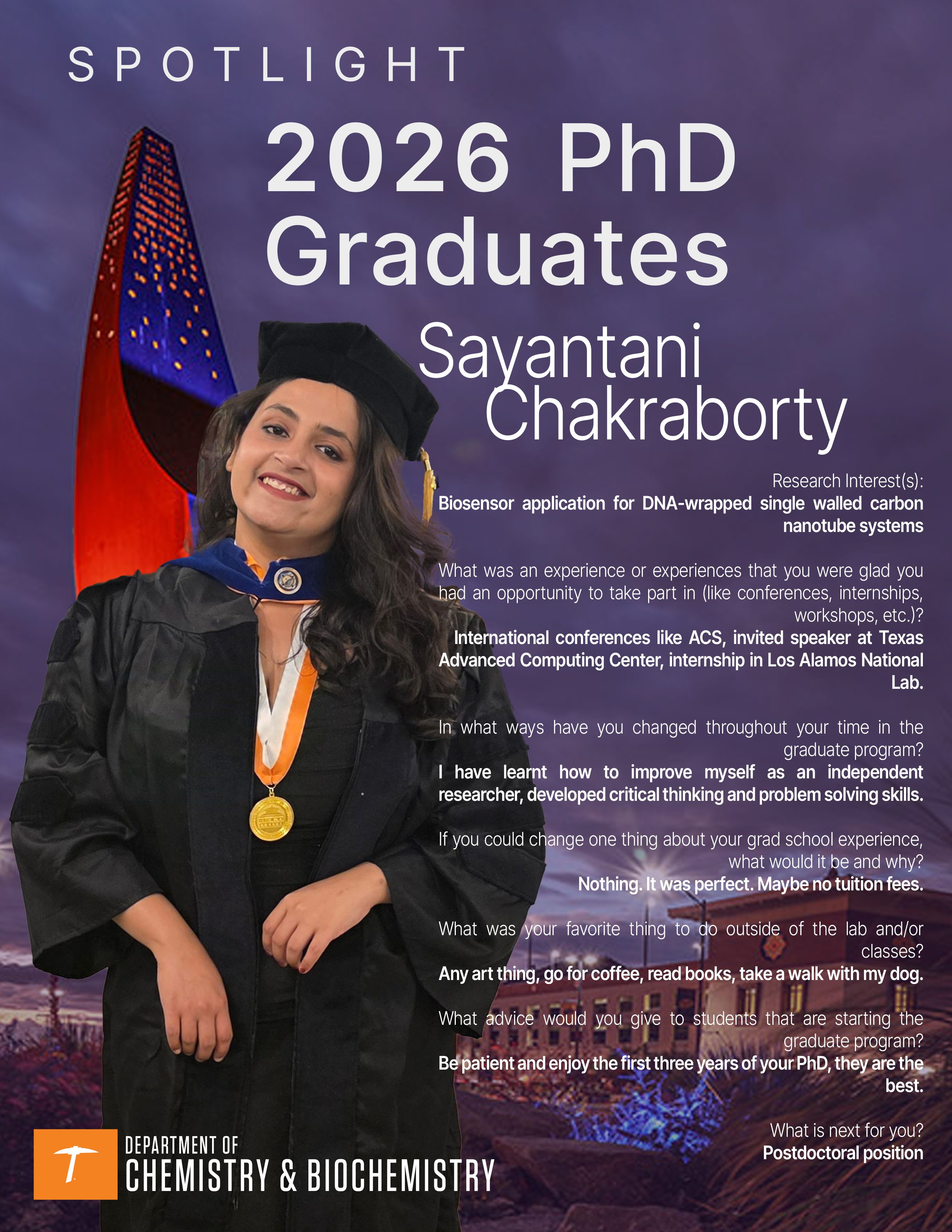
Sayantani Chakraborty
Your Research Interest/Interests
What was an experience or experiences that you were glad you had an opportunity to take part in (like conferences, internships, workshops, etc.)?
In what ways have you changed throughout your time in the graduate program?
If you could change one thing about your grad school experience, what would it be and why?
What was your favorite thing to do outside of the lab and/or classes?
What advice would you give to students that are starting the graduate program?
What is next for you?
Biosensor application for DNA-wrapped single walled carbon nanotube systems
What was an experience or experiences that you were glad you had an opportunity to take part in (like conferences, internships, workshops, etc.)?
International conference like ACS, invited speaker at Texas Advanced Computing Center, internship in Los Alamos National Lab.
In what ways have you changed throughout your time in the graduate program?
I have learnt how to improve myself as an independent researcher, developed critical thinking and problem solving skills.
If you could change one thing about your grad school experience, what would it be and why?
Nothing. It was perfect. Maybe no tuition fees.
What was your favorite thing to do outside of the lab and/or classes?
Any art thing, go for coffee, read books, take a walk with my dog.
What advice would you give to students that are starting the graduate program?
Be patient and enjoy the first three years of your PhD, they are the best.
What is next for you?
Postdoctoral position
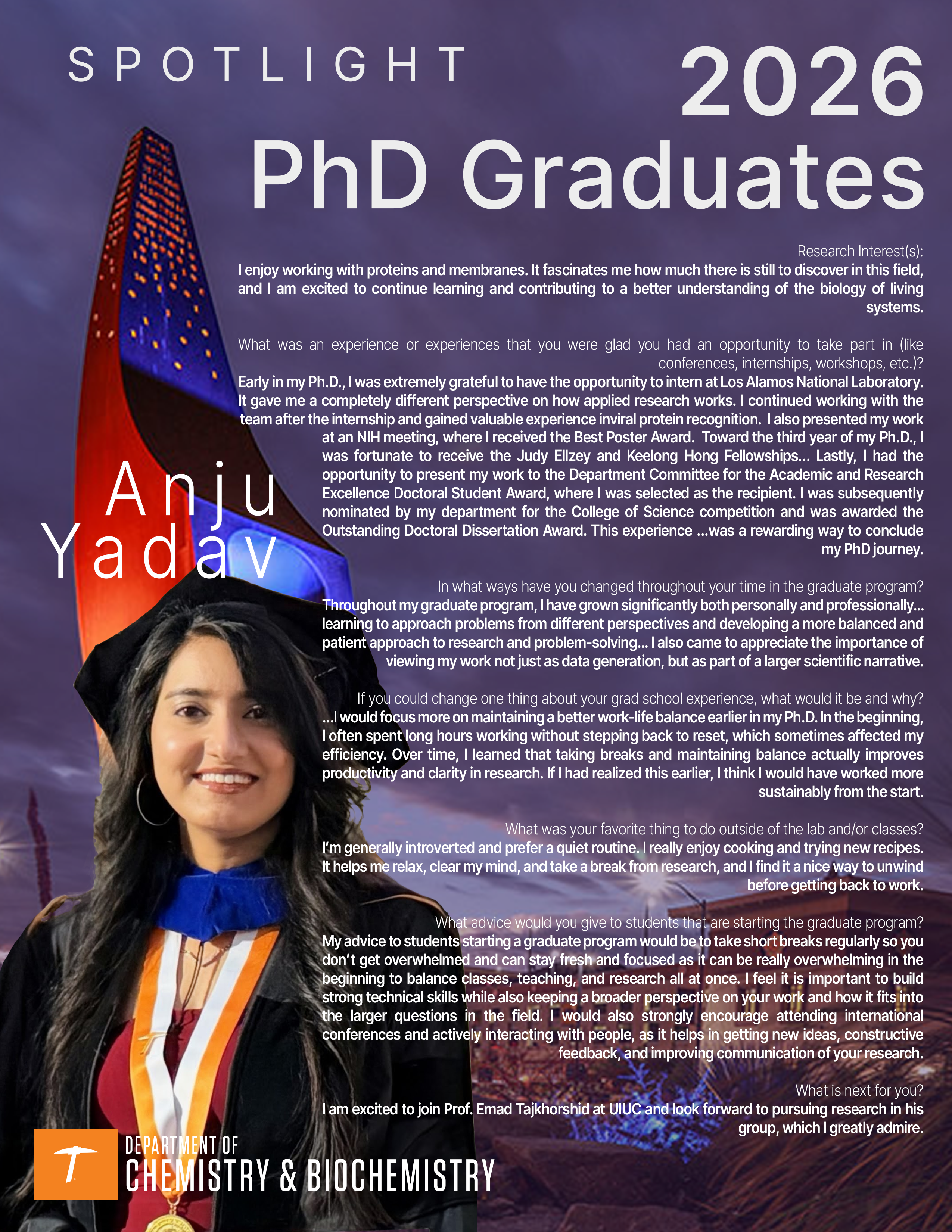
Anju Yadav
Your Research Interest/Interests
What was an experience or experiences that you were glad you had an opportunity to take part in (like conferences, internships, workshops, etc.)?
In what ways have you changed throughout your time in the graduate program?
If you could change one thing about your grad school experience, what would it be and why?
What was your favorite thing to do outside of the lab and/or classes?
What advice would you give to students that are starting the graduate program?
What is next for you?
I enjoy working with proteins and membranes. It fascinates me how much there is still to discover in this field, and I am excited to continue learning and contributing to a better understanding of the biology of living systems.
What was an experience or experiences that you were glad you had an opportunity to take part in (like conferences, internships, workshops, etc.)?
Early in my Ph.D., I was extremely grateful to have the opportunity to intern at Los Alamos National Laboratory. It gave me a completely different perspective on how applied research works. I continued working with the team after the internship and gained valuable experience in viral protein recognition. I also presented my work at an NIH meeting, where I received the Best Poster Award. It was a great and rewarding experience for me. Toward the third year of my Ph.D., I was fortunate to receive the Judy Ellzey and Keelong Hong Fellowships. This support allowed me to transition to a research assistant role and continue my work with greater focus and productivity. Additionally, throughout my Ph.D., I have presented my work at international conferences, where I have consistently received constructive feedback on my research and valuable insights into the growth and future direction of the field. Lastly, I had the opportunity to present my work to the Department Committee for the Academic and Research Excellence Doctoral Student Award, where I was selected as the recipient. I was subsequently nominated by my department for the College of Science competition and was awarded the Outstanding Doctoral Dissertation Award. This experience strengthened my ability to communicate my research effectively to a broader audience and was a rewarding way to conclude my PhD journey.
In what ways have you changed throughout your time in the graduate program?
Throughout my graduate program, I have grown significantly both personally and professionally. I have learned to approach problems from different perspectives and to be more open-minded in my thinking. I have also realized that not every experiment or idea leads to immediate success, and this has taught me to stay optimistic and resilient. Whenever I feel stuck, I try to step back, reset, and begin again with a fresh mindset. Overall, this experience has helped me develop a more balanced and patient approach to research and problem-solving. In the earlier years of my Ph.D., I focused heavily on strengthening my technical skills and learning through hands-on experience. However, in later years, I began to appreciate the importance of a broader perspective, thinking more deeply about how my research contributes to the field and how to effectively communicate a coherent scientific story from my results. This shift helped me view my work not just as data generation, but as part of a larger scientific narrative.
If you could change one thing about your grad school experience, what would it be and why?
If I could change one thing about my graduate school experience, I would focus more on maintaining a better work-life balance earlier in my Ph.D. In the beginning, I often spent long hours working without stepping back to reset, which sometimes affected my efficiency. Over time, I learned that taking breaks and maintaining balance actually improves productivity and clarity in research. If I had realized this earlier, I think I would have worked more sustainably from the start.
What was your favorite thing to do outside of the lab and/or classes?
I’m generally introverted and prefer a quiet routine. I really enjoy cooking and trying new recipes. It helps me relax, clear my mind, and take a break from research, and I find it a nice way to unwind before getting back to work.
What advice would you give to students that are starting the graduate program?
My advice to students starting a graduate program would be to take short breaks regularly so you don’t get overwhelmed and can stay fresh and focused as it can be really overwhelming in the beginning to balance classes, teaching, and research all at once. I feel it is important to build strong technical skills while also keeping a broader perspective on your work and how it fits into the larger questions in the field. I would also strongly encourage attending international conferences and actively interacting with people, as it helps in getting new ideas, constructive feedback, and improving communication of your research.
What is next for you?
I am excited to join Prof. Emad Tajkhorshid at UIUC and look forward to pursuing research in his group, which I greatly admire.
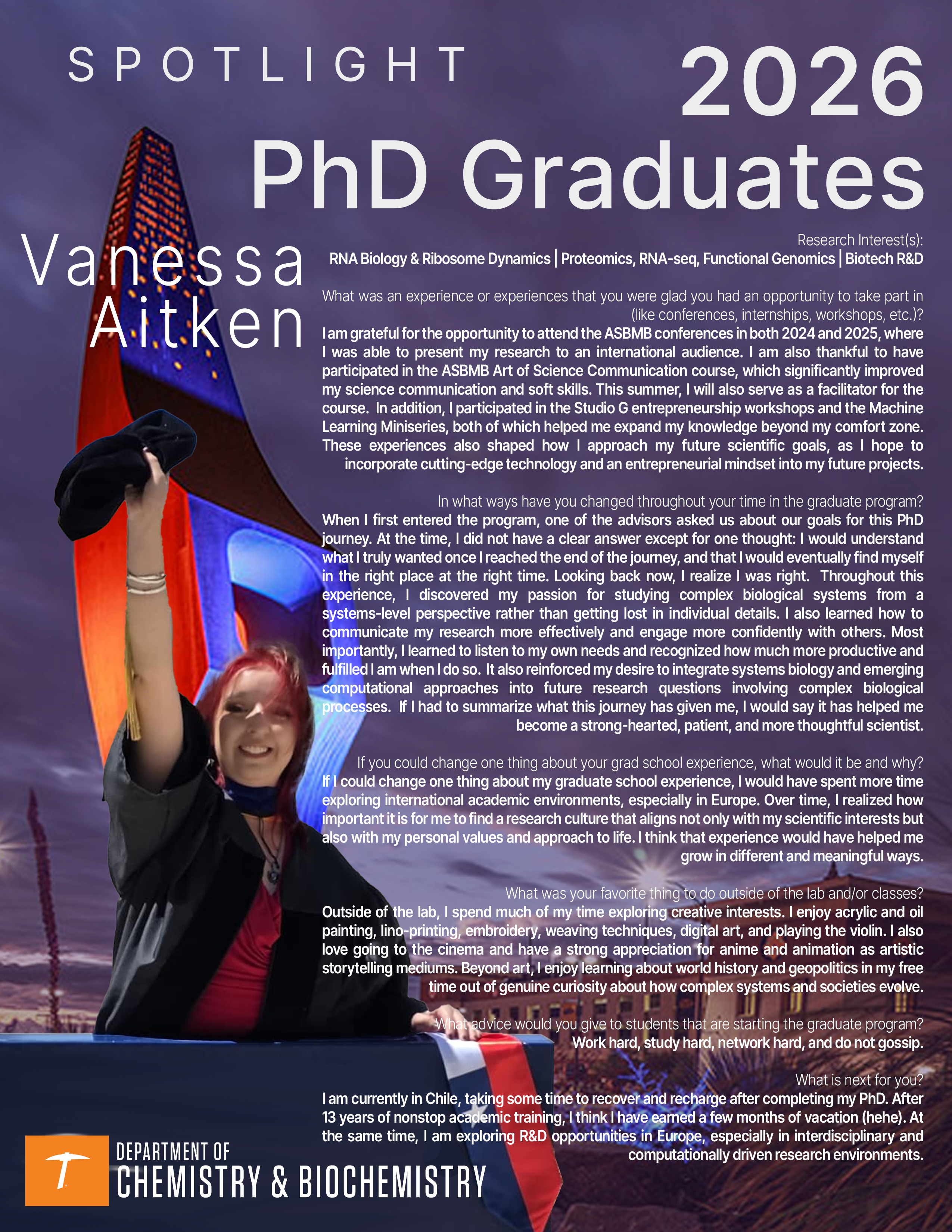
Vanessa Aitken
Your Research Interest/Interests
What was an experience or experiences that you were glad you had an opportunity to take part in (like conferences, internships, workshops, etc.)?
In what ways have you changed throughout your time in the graduate program?
If you could change one thing about your grad school experience, what would it be and why?
What was your favorite thing to do outside of the lab and/or classes?
What advice would you give to students that are starting the graduate program?
What is next for you?
RNA Biology & Ribosome Dynamics : Proteomics, RNA-seq, Functional Genomics : Biotech R&D.
What was an experience or experiences that you were glad you had an opportunity to take part in (like conferences, internships, workshops, etc.)?
I am grateful for the opportunity to attend the ASBMB conferences in both 2024 and 2025, where I was able to present my research to an international audience. I am also thankful to have participated in the ASBMB Art of Science Communication course, which significantly improved my science communication and soft skills. This summer, I will also serve as a facilitator for the course. In addition, I participated in the Studio G entrepreneurship workshops and the Machine Learning Miniseries, both of which helped me expand my knowledge beyond my comfort zone. These experiences also shaped how I approach my future scientific goals, as I hope to incorporate cutting-edge technology and an entrepreneurial mindset into my future projects.
In what ways have you changed throughout your time in the graduate program?
When I first entered the program, one of the advisors asked us about our goals for this PhD journey. At the time, I did not have a clear answer except for one thought: I would understand what I truly wanted once I reached the end of the journey, and that I would eventually find myself in the right place at the right time. Looking back now, I realize I was right. Throughout this experience, I discovered my passion for studying complex biological systems from a systems-level perspective rather than getting lost in individual details. I also learned how to communicate my research more effectively and engage more confidently with others. Most importantly, I learned to listen to my own needs and recognized how much more productive and fulfilled I am when I do so. It also reinforced my desire to integrate systems biology and emerging computational approaches into future research questions involving complex biological processes. If I had to summarize what this journey has given me, I would say it has helped me become a strong-hearted, patient, and more thoughtful scientist.
If you could change one thing about your grad school experience, what would it be and why?
If I could change one thing about my graduate school experience, I would have spent more time exploring international academic environments, especially in Europe. Over time, I realized how important it is for me to find a research culture that aligns not only with my scientific interests but also with my personal values and approach to life. I think that experience would have helped me grow in different and meaningful ways.
What was your favorite thing to do outside of the lab and/or classes?
Outside of the lab, I spend much of my time exploring creative interests. I enjoy acrylic and oil painting, lino-printing, embroidery, weaving techniques, digital art, and playing the violin. I also love going to the cinema and have a strong appreciation for anime and animation as artistic storytelling mediums. Beyond art, I enjoy learning about world history and geopolitics in my free time out of genuine curiosity about how complex systems and societies evolve.
What advice would you give to students that are starting the graduate program?
Work hard, study hard, network hard, and do not gossip.
What is next for you?
I am currently in Chile, taking some time to recover and recharge after completing my PhD. After 13 years of nonstop academic training, I think I have earned a few months of vacation (hehe). At the same time, I am exploring R&D opportunities in Europe, especially in interdisciplinary and computationally driven research environments.


