
MinerAlert
MinerAlert

February 2025
By Anna Carrillo '19, '21
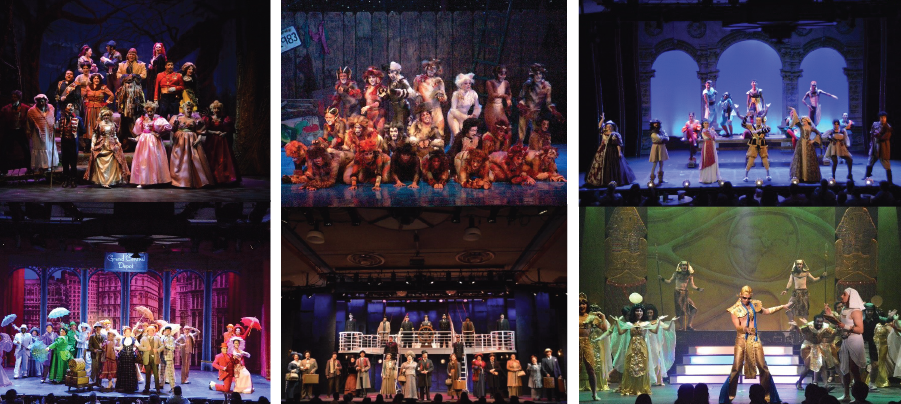
For over four decades, the UTEP Dinner Theatre (UDT) has been a cornerstone of El Paso’s performing arts scene, bringing high-quality musical theatre productions to the community since 1983. I recently had the chance to go behind the scenes with Jaime Barba, UDT’s Interim Director, whose journey with the theatre began in 1992 as a performer. Since then, he has worn many hats—literally and figuratively—working as a costume designer, director, educator, and now as the theatre’s leader. With a background as a local high school teacher and former Artistic Director of VIVA! El Paso, Jaime brings a wealth of experience and passion to UDT. In this conversation, he shares insights into the creative process, the challenges and rewards of producing musical theatre, and what audiences can look forward to in the upcoming season.
“I can honestly say the UDT is at the forefront of providing next to professional quality musical theatre that is entirely locally produced, making sure that the UTEP campus, the community at large and most importantly, the students, have a place to come and experience what I have had the pleasure to experience for the past 33 years. I am so grateful for what the UDT has given me and El Paso”. - Jamie Barba
Q: What does the creative process look like from start to finish when putting together a UDT production?
A: The saying “it takes a village” has never been truer than when bringing one of our productions to life. Our production staff is truly collaborative, with each member having the opportunity to contribute to the overall design of our shows.
In the past, planning would begin 6 to 12 months in advance, with UDT staff submitting potential show titles. A vote was then held to determine the four productions for the season. According to Barba, several key factors influence the selection process:
"Can we produce it on our stage? Will it attract an audience? Is it creatively engaging for our staff to design and build? And, most importantly, is it financially feasible?"
Once a show is selected, its inclusion in the season ultimately depends on securing the production rights.
Now that the UDT is part of the Department of Theatre and Dance, the financial structure and process has changed. These selections are then submitted to a committee—which includes faculty and students—for a vote.
The committee selects two productions to be staged during the academic year (October and April), while the UDT staff determines the summer production. Each show requires two to three months of planning before it’s ready to open for an audience.
Q: What’s the process for designing and crafting costumes for a production?
A: There’s no such thing as a small musical. I was taught it is all about the “detail” and that is how I costumed shows. It’s not just the dress, but also the hairstyle, hat, gloves, jewelry, stockings, makeup, and shoes. Once the season was set, I’d start by reading the script and planning about three months in advance. I needed to know which characters appeared in each scene, what was happening, and whether any special costume requirements were needed, especially for big production (dance) numbers.
Budget played a crucial role in shaping these decisions. I would first check what we had in storage that could be repurposed or see what needed to be created from scratch. After casting, I could then go full steam ahead and finalize the costume plot—an outline of all costumes needed for the show. Once outfits were assembled, actors were brought in for fittings, adjustments were made, and costumes were prepared for dress rehearsals. Final tweaks happened during dress rehearsal week, ensuring everything was performance-ready for opening night.
(From 2006 to 2023, Barba served as the UDT Costume Designer, designing and constructing costumes for four productions each season.)
Q: What’s the role of live musicians in the UTEP Dinner Theatre, and how do they enhance the overall experience?
A: Live musicians are a vital component of any stage musical, bringing an energy and depth that pre-recorded tracks simply cannot replicate. Taped music is very flat and non-dimensional. Live music adds an exhilarating layer to the performance, allowing both the singers and the audience to fully engage with the moment.
With live music, performers can connect with the rhythm and emotion of the piece in real-time, feeling the vibrations through their bodies. This interaction enhances the overall performance. In contrast with canned music, the singer has to work a lot harder to convey that extra element that the live music gives. The musicians and the performers are both individual parts of a living breathing entity, that is the performance.
Q: Can you share some insights into the collaboration & teamwork involved in pulling everything together?
A: Collaboration is essential to ensuring a production is stage-ready. The director, lighting designer, set designer, costume designer, music director, choreographer, prop master, and video projection designer (if used) must work in sync to create a seamless experience for the audience. It is the director’s role to coordinate these various elements, ensuring they come together.
UDT designers understand that teamwork is key to success. While each brings their own creative vision to the production, they also recognize the need for flexibility and adjustments. Ultimately, our shared goal is to deliver a beautiful, engaging performance, and that means working together to bring every detail to life.
Q: What are some of the biggest challenges you face when producing a dinner theatre show?
A: Time and budget are two of the biggest challenges. Musicals are incredibly expensive to stage—from securing performance rights and copyrights to building sets, designing costumes, and hiring a live band, the costs add up quickly. In this age of funding being cut, we have to carefully consider which productions are financially possible.
Beyond budget constraints, the sheer scale of musicals presents another challenge. They often feature large casts, complex multi-location sets, and extensive lighting requirements. With a production team of just eight staff members and a handful of student employees, getting everything done on time is a constant challenge.
Q: What’s one thing you wish more people knew about the UDT and what do you feel makes the UDT experience unique compared to other theatre productions?
A: I wish more people knew we are here.
After 42 years here, I can’t count how many times I’ve heard, "I didn’t even know you were here." I think our location on the UTEP campus leads to some confusion about who we are. Our mission is not only to educate our students but also to offer top-tier, nearly professional-quality productions to our audiences. What sets us apart is our ability to produce high-quality musicals—close to professional level—on a tight budget, all while keeping it a local effort.
Q: What are the most impactful ways the community and the university can support the UTEP Dinner Theatre?
A: The most impactful ways the community and the university can support the UTEP Dinner Theatre are by purchasing tickets to our productions and contributing to our department through donations.
As production costs continue to rise each year, we’ve placed a greater emphasis on fundraising. Any financial support—large or small—is greatly appreciated. We’ll also be hosting a fundraising gala in June to help raise much-needed funds for our productions and programs.
Barba also shares that working closely with Greg Taylor, the founder and former Director of the UTEP Dinner Theatre, for so many years has given him the best education as far as directing and producing musicals. He was able to make the theatre a success for 40 years and he has taken what he’s learned from him and has been able to parlay that into going on with two more years of success.
Theatre enthusiasts can look forward to the upcoming production of Grease, running from April 4-20, 2025. Following that, the UDT will stage The SpongeBob Musical, based on the beloved animated TV show SpongeBob SquarePants, from July 11-27, 2025. For more details, visit https://www.utep.edu/liberalarts/udt/