
MinerAlert
MinerAlert

June 2025
By Sandra Ramirez, ’08, ’21
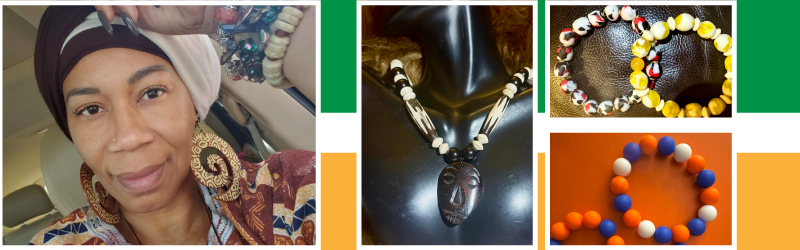
Skillfully manipulating glass, crystals and semi-precious gemstones into culturally inspired jewelry is a craft Kimberly McDaniel ’97 has worked to master over the past six years. She is a self-taught artisan who recalls struggling to find bracelets that fit and necklaces that matched her vision—something she heard echoed by others.
McDaniel identified a need that became the catalyst for a new expressive art form—and a way to connect with both her culture and her community.
“The more I got into jewelry, the more my spirit got into it. The more the African side came out and expressed itself in the jewelry. I use a lot of things from the continent of Africa,” she said.
A graduate of The University of Texas at El Paso, McDaniel holds a bachelor’s degree in computer information systems and a master’s degree in behavioral health. She is also the owner of the JMM Fusion Gallery in El Paso, which displays African American art exhibits and handmade jewelry.
Raised by artists—her father was a visual artist and her mother a pianist—McDaniel believes art is a powerful tool for connection. Two of her four children, she says, are also artistic.
“Art seems to be the medium that is the most pleasant, and the easiest way to have conversations. It is non-threatening. We can educate through it, and we can admire it,” she said.
Community involvement is central to McDaniel’s identity. She has been involved in community work for more than 40 years. Her approach to art mirrors her approach to service.
“I see what’s missing, and I will fulfill that if it is within my skill set and capability,” she said.
That mindset led her to make and distribute hand sanitizer during the COVID-19 pandemic. It also inspired her to purchase books by African American authors to help address literacy challenges in her community.
Today, one of McDaniel’s key focuses is encouraging the Black community to understand its history—especially when it comes to holidays like Juneteenth.
Juneteenth marks the day in 1865 when 2,000 U.S. Army troops arrived in Galveston Bay, Texas, to announce that more than 250,000 enslaved Black people in Texas were free—more than two years after the Emancipation Proclamation took effect in 1863.
While the significance of Juneteenth is tied to events in Texas, it was officially declared a federal holiday in 2021. McDaniel worries that its meaning has become diluted.
“It has to be known that Juneteenth is the day enslaved people were set free in Texas. It wasn’t nationally. A lot of states observe Juneteenth, but it was in Texas that slaves got word that they were free,” she said, emphasizing that other states had their own timelines for emancipation.
That confusion, she says, is part of the reason Juneteenth risks becoming just another day off. Her hope is that the holiday will spark deeper learning.
“I love the concept of Juneteenth. I love it, but it should be something that opens a conversation,” she said.
McDaniel has lived in El Paso since 1992 and remembers a time when Juneteenth was hardly recognized—even in Texas. While she welcomes the increasing visibility, she hopes education and cultural expression remain central to the celebration.
“I was in El Paso for quite some time, and it took a while for it to start catching on and for people to learn about it. It gradually grew, and now there are T-shirts, events, poetry—all kinds of stuff,” she said. “I would like to see it brought out artistically, and more conversations celebrating what Juneteenth is, and discussions about the timeline of when slaves were told they were free.”