Overview
Community Engagement & Leadership (CEL) Designation
Advancing Community-Engaged Teaching Across UTEP
What is CEL?
Community Engagement & Leadership (CEL) is a formal designation signifying a course that integrates meaningful community engagement with student learning, leadership development, and civic responsibility. Dedicated faculty leaders in. UTEP’s College of Liberal Arts developed a structured model for integrating community-based learning into academic coursework. Building on that successful foundation, InSPIRE in collaboration with the Provost’s Community Engagement Council, the faculty-driven CEL Advisory Panel, and the Engage division support the expansion of CEL designation across all colleges. Together, this team ensures consistency, academic rigor, and lasting value are represented in all courses carrying the CEL designation.
Quick Facts:
“CEL” is a university-approved academic designation that requires an application and review process. To qualify for designation, a course must:
- Integrate community engagement into at least one academic learning objective
- Requires a minimum of 20 hours of sustained, experiential engagement
- Embed structured reflection throughout the semester
- Develops leadership and transferable skills
- Engage reciprocal, mutually beneficial community partnerships
CEL courses:
- Deepen student learning through real-world application
- Strengthen reciprocal university–community partnerships
- Advance UTEP Edge high-impact experiential learning practices
- Support leadership development and civic responsibility
- Reinforce UTEP’s institutional commitment to community engagement and public impact
Alignment with UTEP Edge
- Sustained experiential learning
- Structured and ongoing reflection
- Transferable skill development
- Leadership growth
- Civic and community-connected practice
UTEP is advancing two distinct course designations that formally recognize faculty leadership and contributions in community engagement and undergraduate research, scholarship, and creative inquiry. The Community Engagement and Leadership (CEL) Designation, housed in the InSPIRE, and the Research, Scholarly, and Creative Inquiry (RSCI) Designation, administered through COURI, are independently governed and reflect UTEP’s commitment to academic excellence, student success, and public-serving scholarship.
Core Elements

All CEL-designated courses must meet the following core criteria. The review process is holistic; however, all core elements must be present for approval.
1. Connection to Course Objectives
- Community engagement activities are explicitly tied to at least one course learning objective.
- Engagement is integrated into course content and assessment.
- Students articulate the connection between engagement and academic learning through reflections, assignments, or discussions.
2. Student Learning & Skill Development
Students must demonstrate measurable growth in at least two of the following areas:
- Ethical reasoning
- Social justice awareness
- Communication
- Critical thinking
- Teamwork
- Community-based research
- Initiative and responsibility
- Change-making
- Innovation and entrepreneurship
These competencies reflect UTEP Edge transferable skill categories and career readiness outcomes.
3. Service Hours & Grading
- Students complete a minimum of 20 approved hours of sustained community engagement.
- Community engagement comprises 20% to 80% of the final course grade.
- Students are expected to demonstrate professionalism, reliability, and active participation.
4. Reflection & Evaluation
- Reflection is structured and ongoing throughout the semester.
- A final evaluation component is required and may include:
- A project or presentation
- Community partner feedback
- A final reflective analysis
5. Community Partner Engagement
- A clearly identified community partner or project.
- Evidence of mutual benefit and reciprocity.
- Clearly documented expectations (formal agreements recommended).
Enhanced Elements (Strongly Encouraged)
- Explicit discussion of reciprocity and positionality
- Interdisciplinary collaboration
- Feedback loops with community partners
- Sustainable, long-term partnerships
CEL Review Cycles & Important Dates
CEL designation operates on two annual review cycles aligned with the university course schedule publication calendar.
Faculty are strongly encouraged to apply early to ensure CEL designation appears at initial schedule rollout.
Spring Courses
(Spring schedule posts October 1)
Target to Appear at Initial Rollout
- Application Acceptance Begins: Mid-September
- Advisory review begins in late September
- CEL designation visible when schedule opens in October 1
Policy Compliance – Final Submission Window
- Mid-December
- Approximately 4 weeks before January start
- CEL tag may appear after initial October 1 rollout
Summer and Fall Courses
(Summer and Fall schedule posts March 1)
Target to Appear at Initial Rollout
- Application Acceptance Begins: Mid-September
- Advisory review begins in late September
- CEL designation visible when schedule opens in October 1
Policy Compliance – Final Submission Window
- Summer Submission (Late April); Fall Submission (Late June)
- Approximately 8–9 weeks before late-August start
- CEL tag may post after initial March 1 rollout
Standard Review Timeline
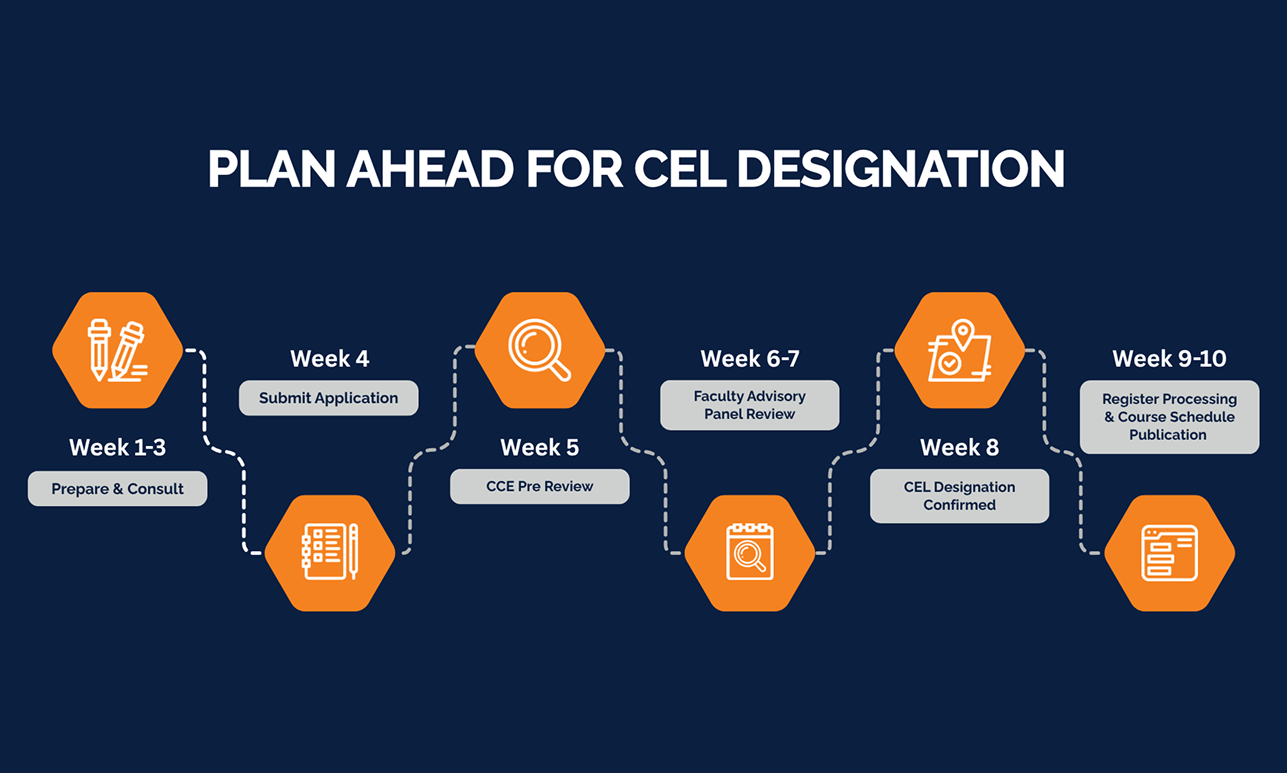
Faculty follow a structured 10-week review process to move from preparation to final course designation.
- Weeks 1–3 (Beginning August 1 / January 1): Faculty preparation and consultation
- Week 4 (Beginning September 1 / February 1): Application submission deadline
- Week 5 (Second week of September / February): InSPIRE pre-review
- Weeks 6–7 (Third week of September / February): Advisory Panel review begins
- Week 8 (Fourth week of September / February): CEL designated confirmation
- Weeks 8–9 (Late September / Fourth week of February): Registrar flags approved CEL courses
- Week 10 (October 1 / March 1): Course schedule publishes with CEL designations visible to students
Planning Guidance
Faculty are encouraged to begin preparation at least one semester before the intended offering of the course.
Early consultation with InSPIRE is recommended to ensure timely review and schedule visibility.
Designing a CEL Course

To support the development of high-quality community-engaged courses, CCE provides faculty with guidance and resources for course design. This section outlines recommendations for aligning engagement activities with course learning outcomes, supported by rubrics and examples. It also includes templates and a timeline overview to help faculty establish clear expectations and onboarding processes with community partners.
Course Design Support
- Mapping community engagement to learning objectives
- Structuring engagement as 20–80% of course grade
- Designing structured reflection (weekly, midterm, final)
- Embedding UTEP Edge language in syllabus
Community Engagement Models
- Required engagement model (minimum 20 hours)
- Project-based service
- Community-based action research
- Hybrid hour-based and grade-based models
Templates & Tools
- Partnership agreement template
- Reflection prompts packet
- Assessment examples
- Student professionalism checklist
- Community partner matching through the CUE portal
Faculty Support
- CEL consultation appointments
- Office hours (January & June cycles)
- Workshops and department presentations
Contact: inspire-cel@utep.edu
About the CEL Advisory Panel

The CEL Advisory Panel ensures fair, transparent, and consistent review of CEL applications across colleges. The panel supports the integrity, academic rigor, and institutional alignment of community-engaged teaching at UTEP.
Membership Structure
Two or three faculty nominated by their respective college.
Service Commitment
- Two meetings per academic year
- Review of assigned applications in advance
- Two-year renewable term
- Orientation provided by InSPIRE
Why Serve?
- Influence campus-wide standards for community-engaged teaching
- Advance high-impact pedagogy
- Strengthen campus-community partnerships
- Receive institutional recognition for service
Contact & Support
Institute for Scholarship, Pedagogy, Innovation, and Research Excellence (InSPIRE)
InSPIRE supports faculty, students, and community partners in advancing community-engaged teaching and scholarship across UTEP.
For consultations, application questions, or partnership support: inspire-cel@utep.edu