
MinerAlert
MinerAlert
Written by Cassandra Avila
For Sergio Iñiguez, professor of psychology, a sheet of paper tacked up at a scientific conference announced his selection as a Fellow of the American College of Neuropsychopharmacology (ACNP).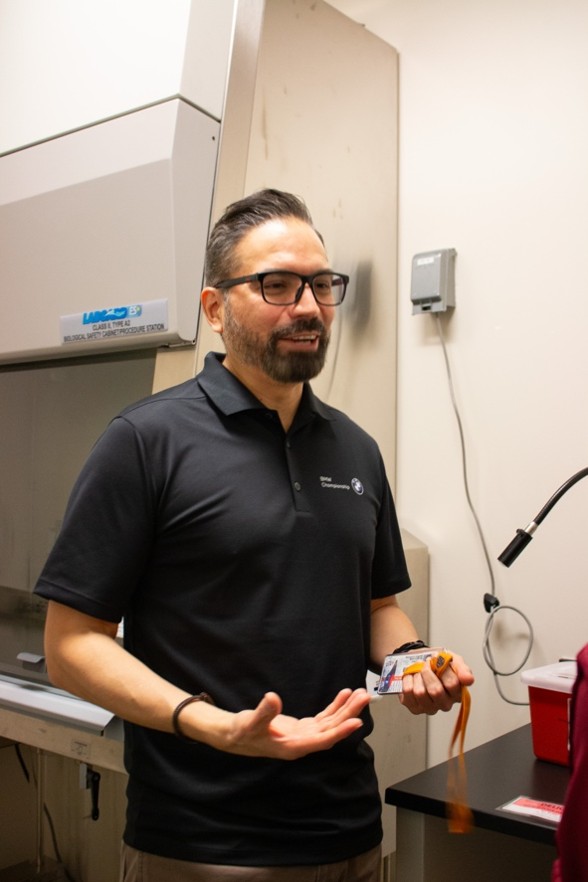
There was no ceremony or fanfare, but the announcement marked one of the highest honors within his discipline. His election recognizes substantial contributions to a field that brings together leading researchers across neuroscience, psychiatry, psychology and pharmacology.
Reading about accomplishments like these, it can be easy to see the achievement without seeing the path that came before it. But the path that brought Iñiguez here may feel familiar to many in the UTEP students, where approximately half of the population are the first in their families to attend college. Iñiguez shares that experience. “I’m the first one, the first in my family to get a B.A., to go to graduate school, to get a master’s, a Ph.D.”
His own path began far from the scientific organizations and universities that would eventually shape his career. Iñiguez grew up in a small village in Jalisco, Mexico, where, as he recalls, there was only one school offering first through third grade. As a teenager, he moved to California, learned English, and began an educational journey that would eventually bring him to UTEP.
“It’s not by chance that I’m here,” Iñiguez said of his decision to come to UTEP. His own experiences shaped his decision to join a Hispanic-serving institution where he could mentor students from backgrounds historically underrepresented in science and help create pathways for them to pursue research careers. It’s with this perspective that Iñiguez hopes to provide students and trainees with "the same sense of possibility that my mentors gave me; to help them see that a career in science is possible and that they belong in it.”
For researchers staring down a stubborn question, a stalled manuscript, or the next proposal deadline, the next step may not require a new tool, but a new way of looking at the question. “It’s your creativity that moves forward in your science, not those tools,” he said. Finding that new angle can mean stepping outside the boundaries of your own work. He recalled attending seemingly unrelated talks as a graduate student, only to recognize later how much they shaped his thinking.
Iñiguez’s research on depression and anxiety explores how factors such as age and biological sex influence responses to stress and antidepressant treatments. That willingness to approach longstanding questions from different perspectives also shapes his research, combining rigorous methodology with creativity.
But following those questions also requires persistence: “Research is full of unexpected results, failed experiments, and setbacks, and meaningful discoveries rarely happen overnight.” Remaining open to new directions has allowed him to integrate unexpected results into the research process rather than seeing them as its end. His curiosity and creativity are sustained by that persistence.
Sergio Iñiguez's selection as an ACNP Fellow reflects a long view of research: work that may not receive immediate attention can take years, even decades, to find broader recognition or influence.
This perspective also shapes how he mentors his students, encouraging them to engage with researchers beyond their own areas of study. And with his ACNP Fellowship comes an opportunity to open the door to more of these experiences. As an ACNP Fellow, he invited his most recent graduate student, now a postdoctoral researcher at Harvard, to attend the upcoming conference in January.
This perspective also shapes how he mentors his students, encouraging them to engage with researchers beyond their own areas of study. And with his ACNP Fellowship comes an opportunity to open the door to more of these experiences. As an ACNP Fellow, he invited his most recent graduate student, now a postdoctoral researcher at Harvard, to attend the upcoming conference in January.
His advice to researchers and students follows the same philosophy: “Often, the most meaningful discoveries come from staying curious and committed when the path forward is not yet clear."
Last Updated on October 23, 2026 | Originally published October 23, 2026