
CHS Student Helps Fellow Miners Breathe Easy with AI Powered App
Published July 9, 2026
By Darlene Muguiro
UTEP College of Health Sciences
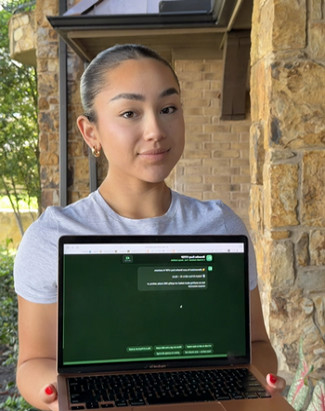
Senior Bachelor of Public Health student Patricia Gonzalez is taking on the task of alerting her fellow Miners about unhealthy environmental conditions through a recently launched app called UTEP Breathe Easy. The app uses artificial intelligence (AI) to answer what Gonzalez says are common questions about air quality in El Paso and potential impacts on health.
Gonzalez’s route to a Public Health degree had a few twists and turns. She began her undergraduate education at UTEP but paused her studies before declaring her major to pursue a career in real estate. After three years in the field, she felt an urge to refocus her attention and decided to come back to UTEP.
“I wanted to pursue something meaningful, and I knew that I wanted to be in health care, but I didn’t want to go to medical school,” she said. “I did my research and found public health. Like many people, I really didn’t know about the breadth of job opportunities within the field, but I fell in love with it pretty quickly.”
Gonzalez says that her experience with AI began as a hobby. While watching videos on AI, she became intrigued by the idea of marrying public health and technology to better serve her community.
“The best way I can describe what I felt is that public health would be the heart and technology would be the brain of what I would focus on,” she said. “I felt like it would be the perfect duo for me.”
Gonzalez first had the opportunity to put her passions into practice through a class group project focused on creating interventions for critical issues on campus. Students were asked to research and identify areas that had critical gaps. She and fellow students Rosie Moreno and Iarayagil Martinez quickly identified air quality as a major concern.
“El Paso is a border city with a lot of pollution – we’re in the top 25 areas for worst air quality. One major contributor is the transportation infrastructure, with heavy trucks crossing over,” she said. “The more we learned, we saw that there really wasn’t a lot of information about air quality and its impact on health of people on the UTEP campus, and we wanted to create awareness and then actually do something about it.”
Gonzalez and her group members began promoting their project through tabling events across campus. She found herself wanting to do more, and proposed the idea of an accessible app to her peers. All agreed that having something on hand for UTEP students and others on campus to quickly check air quality, and then take actionable steps to protect their respiratory health, was valuable. Gonzalez volunteered to take on the task of actually developing the app, which would serve a dual purpose for her portfolio for future applications to post-graduate programs.
“I shared a screenshot of what the app would look like with my professor, Dr. Maria Fuentes, and promised her that I would share the results after it was done,” she said. “Then, I took this summer to train myself in HTML, CSS, React and Java Script. I also learned GitHub and Netlify, which is the website it’s on right now.”
While training the AI-powered health assistant, Gonzalez used health messaging that is grounded in public health evidence, including epidemiological data on air pollution exposure, respiratory disease prevalence, and health disparities among Latino border communities. The app pulls data in real time from the city’s general Air Quality Index on Open-Meteo (www.open-meteo.com) and uses Claude AI to answer health questions, responding in both English and Spanish. The app also connects users to free N95 masks and campus health resources.
Gonzalez hopes that users of UTEP Breathe Easy will walk away with actionable steps for prevention of chronic diseases linked to poor air quality. She says that many people have the perception that there isn’t much they can do about the issue, but with the right information, they can take steps to protect their health.
After her graduation in fall 2027, Gonzalez plans to continue her academic journey and will apply to the University of Dallas master’s program in AI for biomedical sciences and University of Texas Southwestern's master’s program in health informatics. She aims to continue designing other public health projects using CDC data.
“My dream career is to be a healthcare AI engineer or work in a healthcare setting creating AI projects to run their systems,” she said.
To access UTEP Breathe Easy, visit: https://utepbreatheeasy.netlify.app/
Disclaimer: UTEP Breathe Easy is a student-developed app and not an official UTEP app.
###
Go Miners!


