
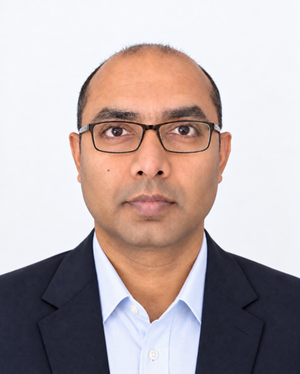
CHS Welcomes New Faculty: Meet Dr. Anirban Dutta
Published October 13, 2026
By Darlene Muguiro
UTEP College of Health Sciences
This fall, the College of Health Sciences (CHS) is welcoming several new faculty members across several departments. We are pleased to present the fourth profile featuring Dr. Anirban Dutta, Regents Research Excellence Professor of Physical Therapy and Movement Sciences. Dr. Dutta comes to UTEP from the University of Birmingham in the United Kingdom, where he was working with the National Health Service (NHS) on a randomized clinical trial investigating the effects of intermittent pneumatic compression and transcutaneous electrical stimulation of the lower limb on cerebral haemodynamics in patients with ischaemic stroke. Prior to that appointment, he was an associate professor at the University at Buffalo (SUNY).
Dr. Dutta obtained his master’s degree in mechanical engineering from the University of Florida and his PhD in biomedical engineering from Case Western Reserve University. He also has a second master’s degree in cerebrovascular medicine from Charité - Universitätsmedizin Berlin, Germany. He completed a postdoctoral fellowship in bionic medicine at the Rehabilitation Institute of Chicago, followed by an Alexander von Humboldt Fellowship at the University Medical Center Göttingen, Germany, with Professor Michael Nitsche, focusing on combining transcranial electrical stimulation with peripheral nerve stimulation for neurorehabilitation. He subsequently established and led the NeuroPhys4NeuroRehab research team at INRIA in France, focusing on neurophysiology-guided neuroengineering approaches to neurorehabilitation. His research focuses on the validation of neurotechnological interventions through health technology assessment in low-resource settings. He works with faculty in basic laboratory science to develop medical technologies and test interventions in real-world settings, with the goal of bringing laboratory science to the community.
###
Like many research faculty who have been recruited to come to UTEP, Dr. Anirban Dutta felt drawn to the unique opportunities for research in the Paso del Norte border region.
“I had worked in similar settings in India, along the border between India and Bangladesh,” he said. “I’m very interested in this specific border because some patients actually come here from Mexico to seek gold-standard care.”
Dutta says his focus will be on needs-driven approaches to patient care along the U.S.-Mexico border region. He plans to collaborate with fellow physical therapy faculty, clinicians at University Medical Center, and the Stanford Mussallem Center for Biodesign to bridge the gap between basic science and clinical practice. By building on existing research evidence and identifying unmet clinical needs, these collaborations will aim to translate scientific discoveries into innovative medical technologies with the potential to become commercially viable products that improve patient care.
As one of his first projects, Dutta is interested in learning whether stroke monitoring technology that has been tested for feasibility in the United Kingdom (UK) can be successfully applied here. Prior to joining UTEP, Dutta was working on a clinical study with the UK’s National Health Service to evaluate the use of a portable brain imaging device in patients with hyperacute stroke. A secondary objective was to assess stroke severity and recovery using wearable bedside monitoring, with measurements compared against established MRI and CT imaging. The multimodal brain imaging approach has demonstrated feasibility in UK hyperacute stroke settings, and Dutta plans to advance this work in collaboration with Openwater, Inc., in the USA, for potential future use in Paso del Norte stroke care settings.
Dutta mentioned that there are major differences in healthcare infrastructure between the UK and the United States, translating into different approaches for someone in his field. Essentially, the publicly funded healthcare system in the UK emphasizes cost-effective approaches, while in the US, healthcare technologies must also navigate specific reimbursement requirements set by insurance companies.
“Insurance companies in the US use specific codes that determine which approaches and devices can be reimbursed for specific diagnoses. So, any time a new technology is developed, an appropriate reimbursement code needs to be identified or established,” he said. “Even though MRI is more costly, MRI scanners are readily available in certain areas of the country, so insurance companies are ultimately asking about the value of a new device, despite its lower cost.”
Dutta mentioned that the Paso del Norte region offers largely untapped opportunities for industry to address unmet healthcare needs through affordable, accessible medical technologies. His position will provide an opportunity to begin addressing these gaps, specifically in the areas of stroke care and stroke rehabilitation.
“On the academic side, there is a lot that has already happened in this community, and there are many resources. And in healthcare institutions as well. For example, University Medical Center has created a mobile stroke unit. So, this is a nice challenge that is being presented at this stage of my career, and I’m excited to see what I can do to help,” he said.
Dutta’s goals for his first year at UTEP also include mentoring master’s and PhD students, helping them take concepts from their dissertations and develop them into tangible products, services, or therapies that can be used in the community. He is looking to build his lab team and wants to bring in students who have an entrepreneurial spirit.
“I would love to have PhD students who can bring their projects forward and perhaps even develop startup companies here in the region in the future,” he said. “They need to be comfortable being part of an ecosystem of clinicians, researchers, and others.”
For more information about Dr. Dutta’s research and how to join his lab, please email him at adutta4@utep.edu.
###
Go Miners!


