
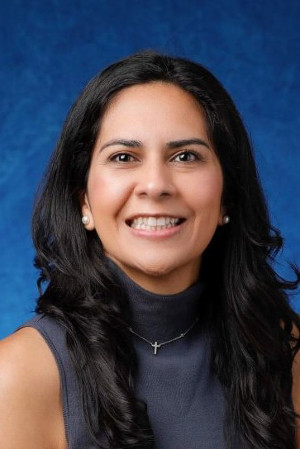
CHS Welcomes New Faculty – Meet Dr. Karla Armendariz
Published September 24, 2026
By Darlene Muguiro
UTEP College of Health Sciences
This fall, the College of Health Sciences (CHS) is welcoming several new faculty members. We are pleased to present the third profile, featuring Dr. Karla Armendariz, assistant professor of Speech, Language and Hearing Sciences. Dr. Armendariz received her PhD in Augmentative and Alternative Communication from Penn State University. She completed a postdoc at the same institution, focused on how to improve augmentative communication among multilingual populations.
###
Like many of her peers, Dr. Karla Armendariz was initially drawn to UTEP and the city of El Paso due to her family of origin. Armendariz is originally from Torreon, Mexico. The promise of being able to pursue her research in an R1 institution whose climate, culture, language and student body reminded her of herself and her home country was thrilling.
“When I saw the job announcement for UTEP, I felt like it was a perfect fit for me – my line of research and what they were looking for, like a perfect synergy. I didn’t see that anywhere else,” she said.
Upon arriving at UTEP for her interview, Armendariz was struck by how quickly she bonded with the students. She says she sees herself reflected in them now that she’s on the other side of the podium as a professor.
“It’s just priceless to me that we can talk in the classroom about how we share the same culture. I went to Miner Palooza and was so happy to hear songs that I grew up listening to and eat the food that I grew up eating,” she said. “I feel a sense of responsibility and pride as well, to make sure that Mexico is represented in my work.”
Armendariz is eager to continue her research in El Paso, where she will work on a concept called codesign, in the context of augmentative and alternative communication for multilingual populations. On a global level, over 97 million people can benefit from augmentative alternative communication.
“The people who are benefiting the most right now from these services are English speakers, but we know also that there is a huge disparity among people who don’t speak English. I think of the movie Spanglish, for example, where the daughter has to constantly translate for her mother. But in the cases of these children, who can speak for them if they don’t speak the same language as the practitioner?”
Armendariz’s first step in building her research will be strengthening relationships with community partners – anyone who is multilingual and who has a child who needs communication supports, or organizations that support children with these needs. Her target population is children with intellectual and developmental disorders, including Down’s syndrome and Autism Spectrum Disorder, as well as cerebral palsy, among others.
Armendariz says her next step will be to build her lab team. She is eager to serve as a mentor to both students who are looking to focus on their clinical careers as well as those who might be considering a career in research and higher education. She has some words of advice for those looking to move into academia and seeking mentorship.
“My trajectory has really been about seeking mentors wherever I go, and they definitely propelled me into getting a PhD and getting into higher education,” she said. “I was happy in my clinical role, but I realized that in writing and doing research, I could impact others on a larger scale. I’m happy to serve students in the same way, and being a mentor through their master’s degree or all the way through to a PhD.”
For more information about Dr. Armendariz’s research and opportunities to participate in her laboratory, please contact her at kparmendariz@utep.edu.
###
Go Miners!


