
UTEP Social Work Students Gain EDGE Skills in Summer Research Experience in Panama
Published August 10, 2026
By Darlene Muguiro
UTEP College of Health Sciences
In collaboration with Indicasat AIP, the College of Health Science’s Virtual Center for Global and Border Engagement (Virtual Center) organized a summer research experience for two UTEP Social Work students in Panama City, Panama. The Virtual Center aims to provide participating students with a deeper understanding of chronic illness and health disparities facing communities in a global context, and selects students annually through a competitive application process. Each research experience also aims to increase specific UTEP EDGE skills, including social responsibility, global awareness, critical thinking, problem solving and teamwork.
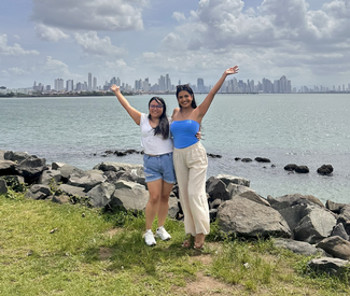
This year's cohort included Paola Anchondo and Genesis Rodriguez, both second-year students in the Master of Social Work program. The students were assigned to a research team at Indicasat AIP, a longstanding partner of UTEP’s Virtual Center, based in Panama. The students worked directly with PARI-HD staff (Panama Aging Research Initiative – Health Disparities). PARI-HD was established in 2011 to study healthy aging and cognitive function in older adults, evaluating the relationship between cognitive health and demographic and genetic factors, as well as genetics, through a series of cognitive assessments, body fluid analysis, and neuroimaging. Researchers at PARI-HD also aim to compare sociodemographic characteristics and cognitive function among older adults in both rural and urban Panama, focusing specifically on the communities of Chitre and Panama City.
Anchondo and Rodriguez were brought into the PARI-HD project to help promote the role of social workers in healthy aging and providing support for older adults and their caregivers. In addition to assisting the research team with conducting cognitive assessments on the PARI-HD study participants, the students developed a brochure (English and Spanish versions) for caregivers of patients with Alzheimer’s disease. The brochure provides basic information about the stages of Alzheimer’s, signs and symptoms of “caregiver burnout,” a frequently diagnosed condition for caregivers of these patients, and simple suggestions for self-care. Anchondo and Rodriguez said that the idea for the brochure came directly out of their experiences and interactions with caregivers during the patients’ cognitive assessments.
“We noticed that during the assessments, caregivers would just be waiting in the other room with nothing to do,” said Anchondo. “We know that older adults with dementia who have strong support systems experience lower stress and depression, so we decided to develop this brochure to provide practical tips for self-care for their caregivers.”
Anchondo said that her experience in Panama strengthened her commitment to working with the geriatric population, a passion she developed early in life through her personal experiences with her great-grandfather.
Rodriguez noted that working with the interdisciplinary team at INDICISAT allowed her to strengthen specific UTEP EDGE related skills in teamwork and communication. She says that it also ignited an interest in interdisciplinary research in dementia.
Through a closer examination of the two cities in the study, both students noted the incredible impact of social determinants of health on aging – access to healthcare, higher social mobility and stronger family incomes in Panama City, Panama were directly linked to better health outcomes for patients living in that area, compared to patients in Chitre.
“This project has strengthened our commitment to health equity and social justice,” said Rodriguez. “As social workers, it will motivate us to continue advocating for equal resources for patients.”
###
Go Miners!
For more information about the Virtual Center for Global and Border Engagement, please contact Isabel Solis, senior coordinator, at isolis16@utep.edu.


