
UTEP Students Gain Edge Advantages, Global Competency during Summer Experience in Costa Rica
Published July 22, 2025
By Darlene Muguiro
UTEP College of Health Sciences
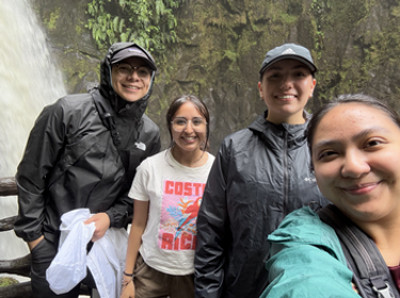
In collaboration with the Universidad de Costa Rica (UCR), this summer, four UTEP students from varied fields of study within the College of Health Sciences and College of Liberal Arts participated in a research experience hosted by the Virtual Center for Global and Border Engagement (Virtual Center).
This year's cohort included Claudia Contreras-Muro (Kinesiology major), Jenna Munoz (Anthropology major), Carlos Valle (Social Work major), and Ashley Vallecillo (Social Work major). The students were assigned as pairs to research teams at the University of Costa Rica, a longstanding partner of UTEP’s Virtual Center, where they gained hands-on experience in community-engaged research while interacting with professionals and community members from a different culture. The focus of the experience is to provide participating students with a deeper understanding of issues facing border communities in a global context.
Project 1: “Strategies for Promoting Children’s Health”
Contreras-Muro and Vallecillo worked at developing an intervention focused on increasing children’s knowledge about emotional self-regulation skills and physical activity, in line with the World Health Organization Sustainable Development Goals 3 (Good Health and Well-Being) and 4 (Quality Education). The intervention came on the heels of a needs assessment that identified key topics to enhance students’ overall well-being, and was implemented at La Lia School-Curridabat in San Jose, Costa Rica. A total of 89 children between the ages of 7 and 13 participated in two workshops, including the “My Chameleon Changes to My Emotions” activity, which used different-colored chameleons to help children correctly identify and name the emotions they were experiencing at any given time. The children also participated in a physical activity workshop that included several play and movement stations aimed at strengthening coordination, agility and body awareness. Results from the interventions were encouraging: 85% of children across all grade levels reported an increased understanding of emotions and colors from the My Chameleon activity; and 88% of first-graders and 94% of fourth-graders reported that they learned about the importance of physical activity through the play and movement stations.
Contreras-Muro said that her experience in Costa Rica has strengthened her commitment to becoming a physical therapist and deepened her awareness of including culturally sensitive approaches to care.
“I hope to continue working with diverse populations, using movement as a pathway to improve overall well-being,” she said.
Vallecillo said that her experience in the project confirmed her calling to work with migrant communities, children, youth, and at-risk adults.
“I learned that even though contexts may change, the need to be heard and understood remains the same,” she said. “I aim to become a social worker who builds bridges between communities, cultures and hearts.”
Project 2: “Digital Cognitive Biomarkers”
Munoz and Valle were part of a pilot study aimed at understanding cognitive health in older adults across various regions of Costa Rica. The pilot study was part of a larger collaborative project between the University of Costa Rica and the University of Baltimore, Maryland, and aligned with the World Health Organization Sustainable Development Goals 3 (Good Health and Well-Being), 10 (Reduced Inequalities) and 17 (Partnerships for the Goals).
The objective of the pilot study was to evaluate the performance of digital cognitive biomarkers in a subsample of 100 older adults, aged 60 to 84, that were part of a larger dataset from the Retirement Cohort of the Costa Rican Longevity and Healthy Aging Study. Munoz and Valle digitized a questionnaire, recruited participants via a flyer, and refined the questionnaire through mock interviews with a total of 10 participants. The questionnaire included a series of cognitive exercises; questions regarding health status; a frontal assessment that included tapping sequences, repeating numbers in reverse order, and completion of proverbs; and identification of participants’ emotions. Preliminary results of the study identified usability issues within the questionnaire; expected results are that the digital biomarkers will have a high validity rate in comparison to the Mini-Mental State Examination and the Montreal Cognitive Assessment.
Munoz shared that her experience while in Costa Rica strengthened her global awareness and confidence in speaking the Spanish language.
“This experience has taught me to be adaptable to different situations within the research field, and I do plan to continue research with my professors,” she said.
Valle echoed Munoz’s sentiments, saying that his experience strengthened his intercultural competence and overall confidence, as well as UTEP Edge skills such as critical thinking, social responsibility, teamwork, communication, and problem solving.
“Collaborating with a multidisciplinary team and practicing problem-solving in the face of technical and logistical challenges really impacted my professional development and allowed me to further develop my skillsets,” he said.
The Virtual Center for Global and Border Engagement, jointly led by Ms. Letty Paez and Dr. Maria Duarte in the College of Health Sciences, is a collaborative effort involving the College of Liberal Arts, UTEP Center for Community Engagement and the UTEP Office of International Programs. “The Center provides students with broad-based global and border community research experiences beyond textbook learning, while at the same time affording them opportunities to refine UTEP Edge skills,” said Paez.
“Prior to departure to UCR, the Virtual Center leadership instructed students to reflect and align different aspects of their high impact experience to the UTEP Edge. As a result, and during their final project presentations, students reflected on how this experience allowed them to further develop their leadership, problem solving, communications, confidence, teamwork, critical thinking, social responsibility, and global awareness,” commented Duarte.
###
Go Miners!
For more information about the Virtual Center for Global and Border Engagement, please contact Isabel Solis, senior coordinator, at isolis16@utep.edu.


