
Pharmacy Students Present Research at ASHP Midyear Clinical Meeting
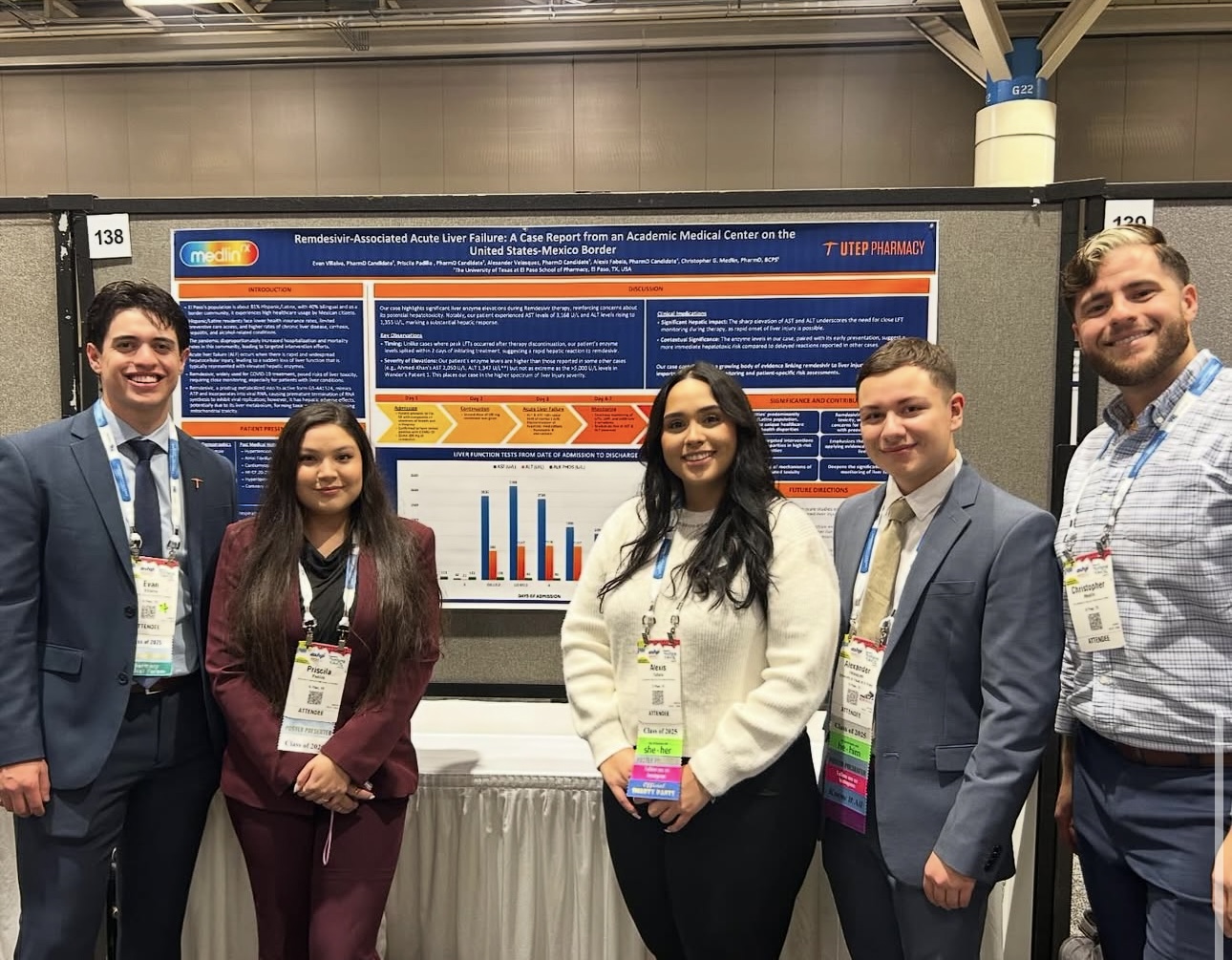
The University of Texas at El Paso continued to make its mark on the world of research at the 59th annual American Society of Health-System Pharmacists (ASHP) Midyear Clinical Meeting, held in New Orleans, Louisiana. The conference, which took place Dec. 7-12, 2024, is the largest pharmacy gathering in the world, and brought together over 25,000 pharmacists, pharmacy professionals, and students for a week of networking, professional development, and groundbreaking discussions on advancements in pharmacy practice.
Among the 20 participants from UTEP were pharmacy students Diana Lazare and Alexander Velasquez, who showcased their research to an audience of experts and industry leaders. Their work highlighted critical issues in clinical pharmacy, including medication safety, evidence-based medicine and the role of pharmacists in advancing healthcare.
From engaging educational sessions to residency showcases and research presentations, the conference offered attendees a chance to expand their knowledge, connect with industry leaders, and explore new career opportunities.
"It’s chaotic but exciting,” said UTEP professor and conference presenter Christopher Medlin, Pharm.D. “They’re making impressions, meeting residency directors, and presenting research—all while studying for finals. It’s an intense but rewarding experience.”
Fourth-year pharmacy student Velasquez, along with his mentor – Medlin – and students Alexis Fabela, Priscilla Padilla and Evan Villalva, presented research highlighting the effects of Remdesivir, an antiviral medication, on elderly patients hospitalized with COVID-19.
“Remdesivir was a major treatment during the pandemic, but we’re still learning about its safety, especially in vulnerable populations,” Velasquez said. “Our patient was from the U.S.-Mexico border, where liver disease is already a big concern in the Hispanic community, so this case raised important questions about whether we should be monitoring liver function more closely in certain populations.”
Velasquez said he has always been drawn to clinical pharmacy because of the problem-solving aspect – figuring out how to balance the benefits of a medication with its risks – and this project reinforced that for him.
“Seeing a real case of severe liver injury made me think about how we, as pharmacists, can help prevent adverse effects and make sure treatments are as safe and effective as possible,” he said.
Lazare, a fourth-year pharmacy student and conference participant, has always been passionate about mental health, which led her to her focus on psychiatric pharmacy and how pharmacists can work together with prescribers and the healthcare team to improve health outcomes for vulnerable patients.
As the granddaughter of a pharmacist, Lazare always felt drawn to the profession.
"I saw my grandfather as the person people went to for advice, support and care in our community,” she said. "I feel like I knew I wanted to be someone … that people could count on, that could care for others. Pharmacy became the way to do that."
Lazare’s research, under the guidance of Savannah McCann, Pharm.D., of Baptist Hospitals of Southeast Texas in Beaumont, Texas, retrospectively assessed the charts of patients at an inpatient behavioral health center who received an injectable antipsychotic between July 2023 and June 2024 and who were prescribed oral medications to treat their side effects, if any.
The study showed that out of 276 patients, about 29% were given medications to treat their side effects. However, upon further chart assessment, only 10% of these had the proper AIMS (abnormal involuntary movement scale) score documentation on their chart, which helps quantify the severity of side effects by assigning a number based on what symptoms they experience.
“This meant that some patients, who are already a very vulnerable population, were potentially receiving unnecessary medication if they were not actually experiencing side effects,” Lazare said.
The results of this study were then used by administration within the behavioral health center to promote medication safety and implement safer and improved prescribing practices.
Medlin said that the opportunity for students to attend and present at conferences can leave a lasting impact.
“Even if it’s a small opportunity like a case report, it helps students understand the research process and develop professionally,” he said. “[UTEP] has the mechanisms to support this work – it’s just about finding good mentors and motivation."
Velasquez said that presenting at ASHP Midyear was an amazing experience, and he enjoyed the opportunity to share work with pharmacists, researchers and students from all over the country.
“I also loved the networking aspect, talking to people from different areas of pharmacy, learning about new career paths, and just seeing how much innovation is happening in the field,” he said. “It was a reminder of how big and exciting pharmacy really is, and it made me even more motivated for the future.”
By Maggie Asfahani
UTEP Marketing and Communications


