
MinerAlert
MinerAlert

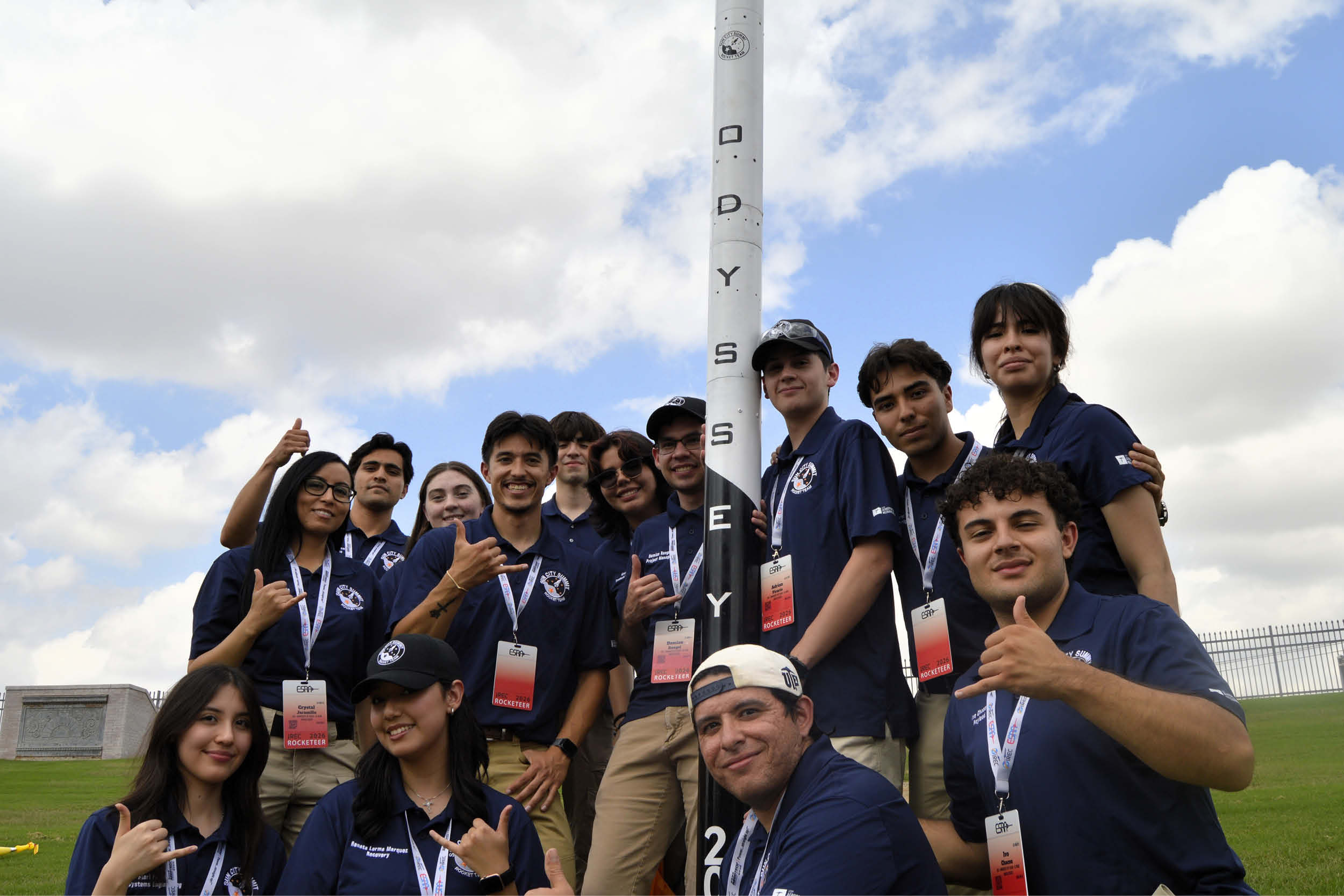


Success in collegiate rocketry is difficult to achieve. Sustaining it is even harder.
The University of Texas at El Paso's Miguel A. Loya College of Engineering Sun City Summit rocket team has done exactly that, earning second place in the 30,000-foot Commercial Off-the-Shelf (COTS) category at the 2026 International Rocket Engineering Competition (IREC). The finish marks the second consecutive year the student team has stood on the international podium, confirming that its rapid rise is no accident.
Held June 15-20 in Midland, Texas, the 19th Annual IREC brought together 143 university teams from 16 countries for what is widely recognized as the world's largest collegiate rocket competition. Hosted by the Experimental Sounding Rocket Association and the American Institute of Aeronautics and Astronautics, the competition challenges students to design, build, test and launch rockets to target altitudes of 10,000, 30,000 or 45,000 feet.
For a program founded just five years ago, repeating a second-place finish against many of the world's most established rocketry teams is a remarkable accomplishment. "This achievement reflects the dedication and perseverance of every member of the team," said Jaeyoung Cho, Ph.D. Aerospace and Mechanical Engineering Department assistant professor and faculty team lead for the Sun City Summit rocket team. "It represents months of design, manufacturing, testing and continuous improvement, along with the willingness of students from many different disciplines to work together toward a common goal."
Chasing Precision
Every competition season brings a new engineering challenge. This year, the team set out to answer one question: How accurately could they predict Odyssey's performance during supersonic flight?
To find the answer, students moved beyond traditional drag calculations and adopted full three-dimensional computational fluid dynamics (CFD) simulations, allowing them to model airflow around Odyssey with far greater accuracy.
The team then flew Odyssey, their 30,000-foot competition rocket, twice before competition, comparing simulation results with real flight data and refining their models after each launch.
The work paid off.
At IREC, Odyssey reached an apogee of 29,714 feet — within about 1% of the competition's 30,000-foot target altitude.
Appropriately named Odyssey, the rocket represented more than a destination. It embodied the yearlong journey of design, testing, setbacks and perseverance that ultimately carried the team to another international podium finish. That level of precision is the result of months of analysis, testing and countless design decisions made by students.
Engineering as a Team Sport
While the rocket may capture the spotlight, nearly 100 students helped make it fly. This year, 93 students participated in the design, manufacturing, testing and launch of the team's 10,000-foot and 30,000-foot competition rockets. Students represented Aerospace Engineering, Mechanical Engineering, Electrical Engineering, Computer Engineering, Computer Science, Systems Engineering and Business Administration.
Each discipline played a critical role.
Aerospace and Mechanical Engineering students designed the rocket's structure and aerodynamics while performing simulations to validate their designs. Electrical Engineering, Computer Engineering and Computer Science students developed the avionics, flight electronics and payload systems that collected flight data and ensured reliable operation.
Systems Engineering students coordinated documentation, system integration, risk management and requirements verification to ensure every subsystem worked together as one vehicle. Business students from UTEP's Hunt College of Business led sponsorship outreach, fundraising, budgeting and marketing, securing many of the resources that made the project possible. Their work helped build industry partnerships while ensuring the team had the financial support needed to compete on the international stage.
The collaboration between Loya Engineering and the Hunt College of Business reflects the multidisciplinary nature of today's aerospace industry, where technical innovation depends on effective project management, strategic communications and strong industry relationships.
Beyond the engineering work, the organization also operates dedicated business and media teams, giving students experience that mirrors today's aerospace industry, where engineers routinely work alongside professionals from business, communications and other disciplines to deliver complex projects.
Lessons That Can't Be Taught in a Classroom
Building a competition rocket requires much more than technical knowledge. Students organize into specialized teams, manage schedules, solve unexpected problems and coordinate hundreds of individual tasks over the course of a year. Success depends as much on communication and leadership as it does on engineering.
"The most rewarding part of leading the team has been watching more than a year of design, analysis, manufacturing and testing culminate in a successful launch," said Damian Rangel, mechanical engineering student and project management for the Sun City Summit rocket team. "Seeing the rocket leave the launch rail is unforgettable because it represents countless hours of dedication, problem-solving and teamwork."
Even more rewarding, the team leader said, has been watching students grow.
"Our students develop not only their technical abilities but also leadership, communication and collaboration skills as they apply engineering concepts in a real-world environment," Rangel said. "Watching them gain confidence, overcome challenges and contribute to something much larger than themselves has been the most fulfilling part of serving as a team lead."
Built to Last
This year's competition represented more than another successful launch.
Most of the students who founded Sun City Summit in 2021 have now graduated, making the 2026 competition the first led primarily by a new generation of student leaders.
Maintaining the team's international success through that transition demonstrates that the program has built something sustainable. Knowledge has been passed from one class to the next, creating a culture that continues to produce results.
For the students, the back-to-back international podium finishes are more than trophies. They represent hundreds of hours spent designing, manufacturing, testing and solving problems together while preparing for careers in the aerospace industry.
As Sun City Summit continues to grow, the team hopes accomplishments like this will attract additional industry and government partnerships, expanding opportunities for future students to gain hands-on experience and positioning UTEP as a destination for aspiring aerospace engineers.
Two consecutive international second-place finishes suggest that UTEP's young rocket program is no longer an emerging contender. It has established itself as one of the world's top collegiate rocketry teams, proving that innovation, collaboration and determination can propel students to extraordinary heights.