
MinerAlert
MinerAlert

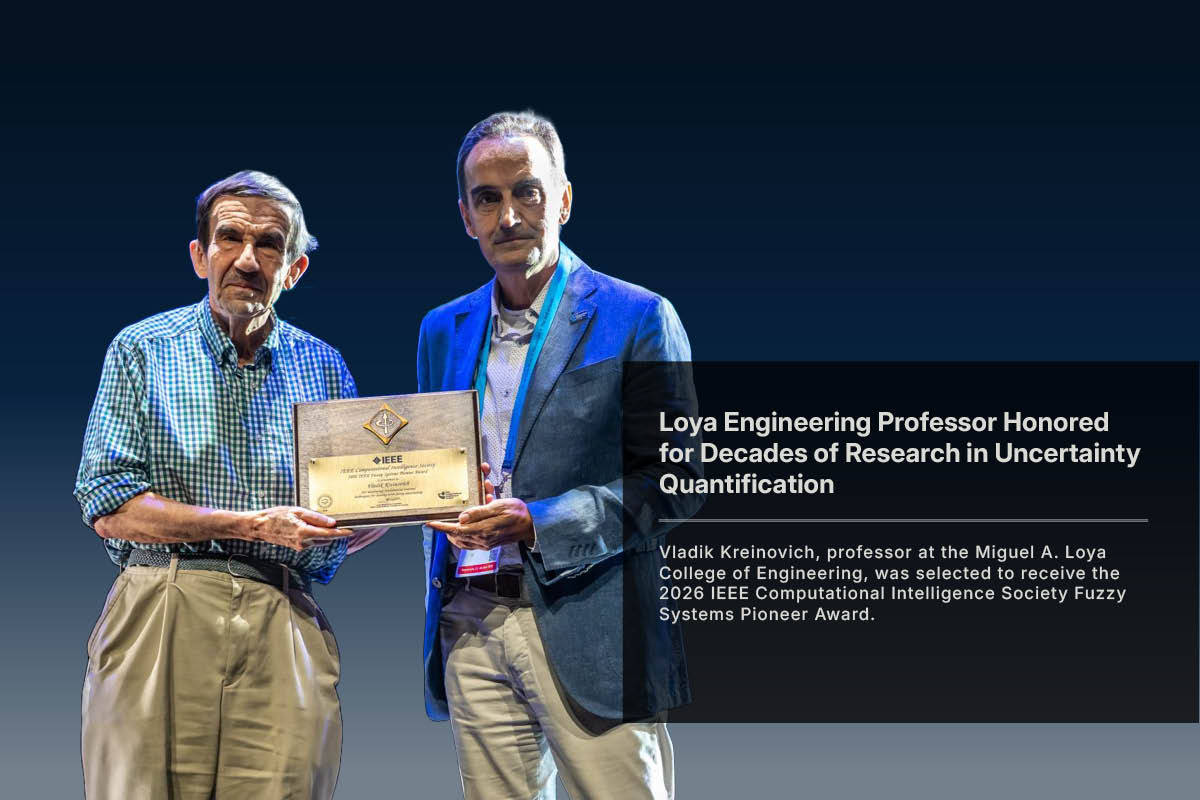


Vladik Kreinovich, Ph.D., professor of computer science in The University of Texas at El Paso's Miguel A. Loya College of Engineering, received the 2026 Institute of Electrical and Electronics Engineers (IEEE) Computational Intelligence Society Fuzzy Systems Pioneer Award in recognition of his contributions to uncertainty quantification and fuzzy systems.
The IEEE Computational Intelligence Society presents the Fuzzy Systems Pioneer Award to researchers whose work has significantly advanced fuzzy systems, which enable computers to process imprecise information and human-like concepts such as "high," "low" or "likely." These techniques are becoming increasingly relevant as researchers seek ways to make artificial intelligence systems more transparent and explainable.
"I am very happy about this award, because this award is a recognition not only of my work, but of the whole important area of uncertainty quantification," Kreinovich said.
Since beginning his research in the field in the 1980s, Kreinovich has focused on developing mathematical methods and algorithms that measure and manage uncertainty in scientific and engineering calculations. His work helps researchers determine how much confidence they can place in computational predictions, particularly when those predictions rely on incomplete or imprecise information.
For example, a computer model might estimate that an oil field contains 150 million tons of oil. However, the usefulness of that estimate depends on its margin of error. An uncertainty of plus or minus 50 million tons would provide a substantially different level of confidence than an uncertainty of plus or minus 200 million tons, which could mean the field contains little or no oil.
Kreinovich's research addresses this challenge by identifying mathematical problems for which uncertainty can be calculated efficiently and developing algorithms to solve them. His work has contributed to applications across fields including geosciences, astrophysics, medicine and engineering, where researchers often rely on expert estimates because direct measurements are difficult or impossible.
Many of these applications involve fuzzy systems, which allow computers to work with information that cannot be measured precisely and instead depends on expert judgment.
Kreinovich first recognized the practical potential of fuzzy techniques while collaborating on research involving airplane jet engines. Because extreme temperatures prevent sensors from operating inside certain engine components, researchers must rely on expert assessments to understand conditions that cannot be measured directly. Working with a colleague, Kreinovich helped develop methods to incorporate those assessments into computational models.
As AI tools become more widely used, Kreinovich is optimistic about the future of fuzzy systems in artificial intelligence. Researchers are increasingly focused on making their outputs more transparent and understandable, an area where fuzzy techniques can help bridge the gap between complex computations and human reasoning.
Kreinovich has published more than 2,000 scholarly papers and collaborated extensively with students and researchers across disciplines. He credits much of his success to those partnerships and the college’s support for interdisciplinary research.
"Students are the future of science," Kreinovich said. "I have been lucky to always have many talented students who are eager and excited to do research."
For Kreinovich, the award highlights both the progress made in understanding computational uncertainty and the continued importance of developing reliable, explainable technologies as artificial intelligence advances.