MinerAlert
MinerAlert
Research Development helps Principal Investigators (PI) prepare institutionally aligned letters that strengthen proposals, ensure sponsor compliance, and accurately represent University commitments. Early engagement allows sufficient time for coordination across colleges, departments, and University leadership.
Research Development coordinates Letters of Support, Commitment, and Collaboration requiring an institutional executive signature. When sponsor guidance permits multiple authorized signatories, Research Development will coordinate the letter for signature by the Vice President for Research & Innovation (VPRI) or Provost, as appropriate. Presidential signatures are reserved for cases in which the sponsor specifically requires the President's signature. Submit requests at least four weeks before the sponsor deadline to allow sufficient time for review, approval, and routing.
Start with an NOI. If you have not already done so, submit a Notice of Intent (NOI). The NOI captures key proposal information, including whether UTEP is the lead institution or a non-lead/subrecipient, and allows Research Development to advise on letter requirements, approvals, and institutional signatures early in the proposal development process.
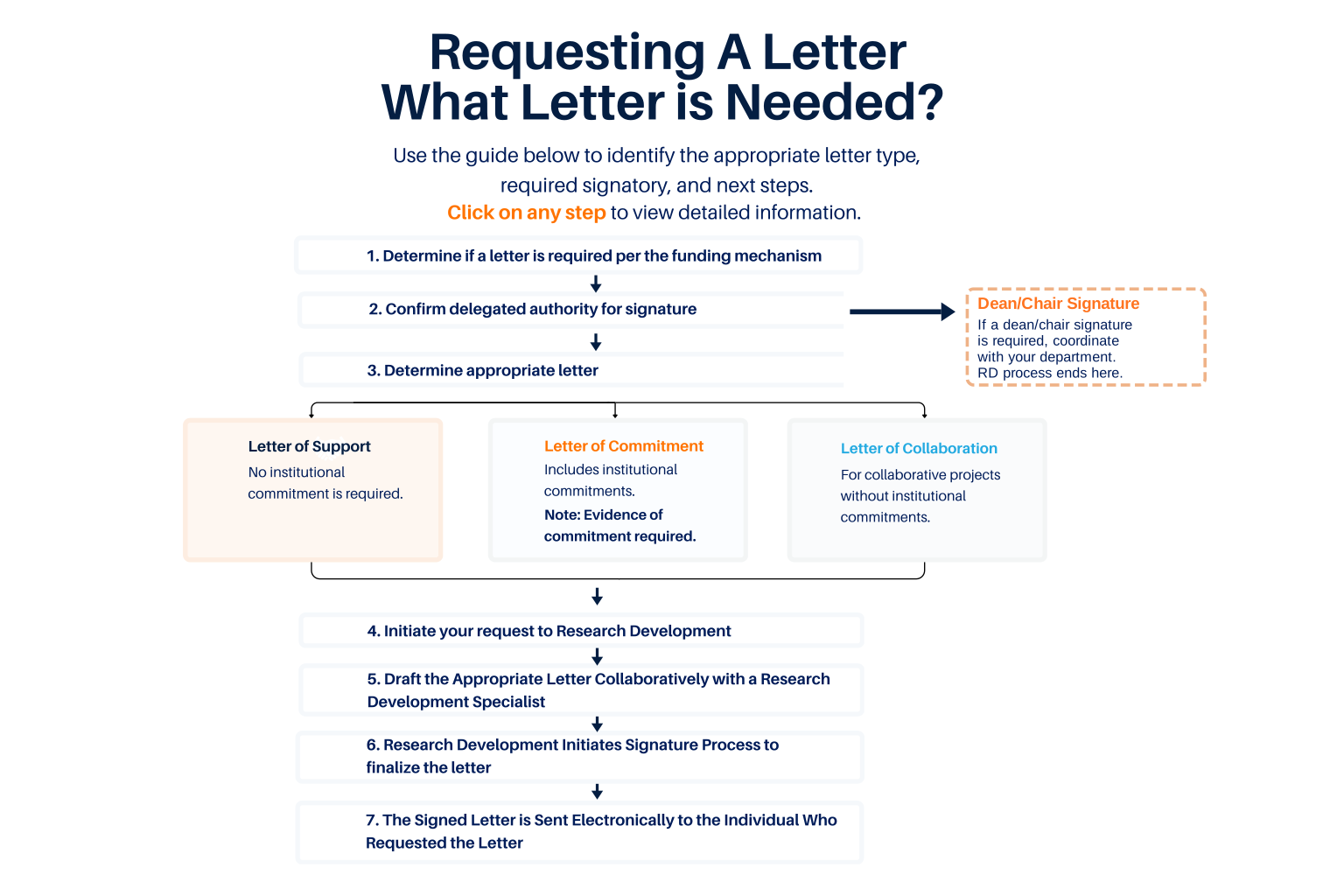
Follow the steps below to determine the appropriate letter type, identify the required signatory, and begin the approval process. Select each step for additional guidance.
Review the Notice of Funding Opportunity (NOFO) to determine whether a letter is required and whether the sponsor specifies who must sign it.
Sponsor requirements always take precedence over institutional practice. When the sponsor allows more than one institutional official to sign, Research Development will determine the appropriate routing, generally to the VPRI or Provost. A presidential signature will be pursued when the sponsor specifically requires the President's signature.
If only a Dean's or Chair's signature is required, the PI is responsible for preparing the letter and obtaining all departmental approvals. Research Development is involved when an institutional executive signature, such as the VPRI or Provost, is required, or when the sponsor specifically requires the President's signature. Institutional commitments must be approved at the appropriate organizational level before they are included in a letter.
At UTEP, the authority to sign documents that commit the University is governed by formal Delegation of Authority policies.
The level of signature should align with the scope and impact of the commitment:
|
Scenario |
Appropriate Signatory / Action |
|---|---|
|
College- or department-level commitments (e.g., faculty effort, space, standard support) |
Dean |
|
Institution-level or significant commitments |
VPRI or Provost, as appropriate |
|
Sponsor permits President, Provost, VPRI, or another institutional official |
Research Development will determine appropriate executive routing, generally to the VPRI or Provost |
|
Sponsor specifically requires the President's signature |
President; Research Development will coordinate review and routing |
|
Sponsor specifies another required signatory |
Follow sponsor requirements |
Presidential signatures are reserved for sponsor requirements that specifically call for the President. A presidential signature will not be sought solely because the sponsor permits a President or other senior institutional official to sign.
Letter of Support
A Letter of Support expresses endorsement of the proposed project and highlights its importance, anticipated impact, and alignment with organizational priorities. Unlike a Letter of Commitment, it does not obligate institutional resources.
The author’s connection to the applicant or the community.
How the project addresses a need or solves a problem.
The PI’s qualifications to execute the project successfully.
Letter of Commitment
A "Letter of Commitment" documents an institution's formal participation in a project and specifies the resources or responsibilities being committed.
Previous collaborations with the PI.
Role in the proposed project.
Specific institutional commitments, such as personnel effort, space, facilities, equipment, administrative support, or cost sharing.
Because these letters represent institutional commitments, all resources and responsibilities must be verified before signature.
Written confirmation from the responsible unit (e.g., Dean, Department Chair) is required to be submitted to Research Development for all institutional commitments. Acceptable documentation includes emails, signed memoranda, or other written authorization.
Letter of collaboration
A Letter of Collaboration confirms a limited contribution to a project, such as access to data, facilities, or specialized expertise. It does not include institutional commitments or resource obligations.
Limited to confirming access to specific resources.
Should not include commitments or endorsements.
Understanding Lead and Subrecipient Letter Requirements
The required letter depends on an organization's role in the project. Institutions serving as the lead applicant or subrecipient generally provide Letters of Commitment because they are making formal project commitments. Organizations providing limited assistance, such as access to facilities, data, or expertise, typically provide Letters of Collaboration or Access. Always follow sponsor-specific guidance.
Key Differences
|
Feature |
Letter of Commitment |
Letter of Collaboration |
Letter of Support |
|---|---|---|---|
|
Purpose |
Confirms institutional participation and commitment |
Confirms limited contribution or access |
Expresses general endorsement |
|
Use When |
Institution is part of the project team (lead or sub) |
Entity is not part of the formal team |
Sponsor allows general support letters |
|
Commitments |
Required (must specify resources or role, written confirmation must accompany letter for authorized signature) |
Not allowed |
Typically not included |
|
Length/Format |
Detailed and specific |
Often brief (e.g., 1–2 sentences, if required) |
Flexible |
|
Signatory |
Authorized institutional official |
Appropriate representative |
Appropriate representative |
|
Binding |
Yes |
No |
No |
If you haven’t already, submit a Notice of Intent (NOI).
Email researchdev@utep.edu at least four (4) weeks before the sponsor deadline.
A Proposal Development Specialist will be assigned to guide the letter through drafting, review, approval, and routing
The PI prepares the initial draft using sponsor guidance (e.g., NOFO) or a Research Development template.
The PI must obtain written confirmation of any roles, resources, or contributions described in the letter from all responsible parties and provide this documentation to the assigned Proposal Development Specialist.
Your assigned Proposal Development Specialist will review the letter, strengthen institutional messaging, and ensure alignment with sponsor and University requirements with the PI.
Once finalized, Research Development coordinates the institutional review and approval process. Letters are reviewed by the Associate Vice President for Research (AVPR) before being routed to the appropriate institutional signatory.
When sponsor guidance allows multiple institutional signatories, letters will generally be routed to the VPRI or Provost. Letters will be routed to the President when the sponsor specifically requires the President's signature.
The fully executed letter is returned electronically to the requestor for inclusion in the proposal package.
What should I do if my proposal requires cost share?
Your first point of contact should be the assigned Research Administrator, who can help determine what qualifies as cost share. If institutional commitments are needed, Research Development can submit a request to the AVP. However, these requests are more likely to be approved if you have already secured in-kind support from your Chair and/or Dean. Institutional commitments beyond the college level are rare and typically reserved for large institutional or center proposals where such commitments are a prerequisite for funding.
What is the process for getting a letter of support approved?
Once you have a strong draft of the letter, a Proposal Development Specialist will review it and present it to the Associate Vice President (AVP) for Research. The AVP will ensure the letter meets all requirements before it is sent for signature. This collaborative process helps maintain the quality and effectiveness of the letter.
How are letters reviewed and approved?
Research Development reviews each letter for sponsor compliance, institutional alignment, and clarity before coordinating executive review and signature routing.
Who has the authority to sign letters requiring a "Dean or higher" signature?
When a sponsor specifies "Dean or higher," the appropriate signatory depends on the nature of the commitment and institutional requirements. Research Development will determine the appropriate executive routing during review.
When will a letter be routed for the President's signature?
Research Development facilitates the issuance of institutional letters requiring executive signatures, including those specifically requiring the President. When sponsor guidance allows more than one institutional official to sign, the letter will generally be routed to the VPRI or Provost, as appropriate. Presidential signature is reserved for cases in which the sponsor specifically requires the President's signature.
Who is responsible for obtaining a Dean's or Chair’s signature on a Letter of Support?
If the letter requires a Dean or Chair’s signature, the PI is responsible for drafting, finalizing, and obtaining a signature. Research Development can guide formatting and content, but the PI is responsible for securing the necessary approvals.
Who signs if my dean is unavailable?
Coordinate with your department or college. Do not assume substitutions; confirm well in advance.
What should I know about Letters of Support for NSF proposals?
Many National Science Foundation (NSF) opportunities prohibit traditional Letters of Support and instead require standardized Letters of Collaboration. Always review the solicitation carefully, as NSF often provides specific language that must be followed. These letters must follow NSF’s specific formatting and content guidelines. To ensure compliance, carefully review the Notice of Funding Opportunity (NOFO) and adhere to the outlined requirements. If you need assistance, Research Development can guide you through the formatting and submission process.
What counts as an institutional commitment?
Any mention of institutional resources (e.g., funding, personnel time, space, equipment, facilities, or administrative support) is considered a commitment and requires appropriate review and approval.
Do subrecipients need letters?
In most cases, subrecipient organizations typically provide a commitment letter/form through their authorized institutional official. Always follow sponsor-specific requirements.
Kelly Hall, 7th floor, West Wing
500 W University Ave.
El Paso, TX 79968
researchdev@utep.edu