
Research Spotlight: Rethinking Decisions and Leadership
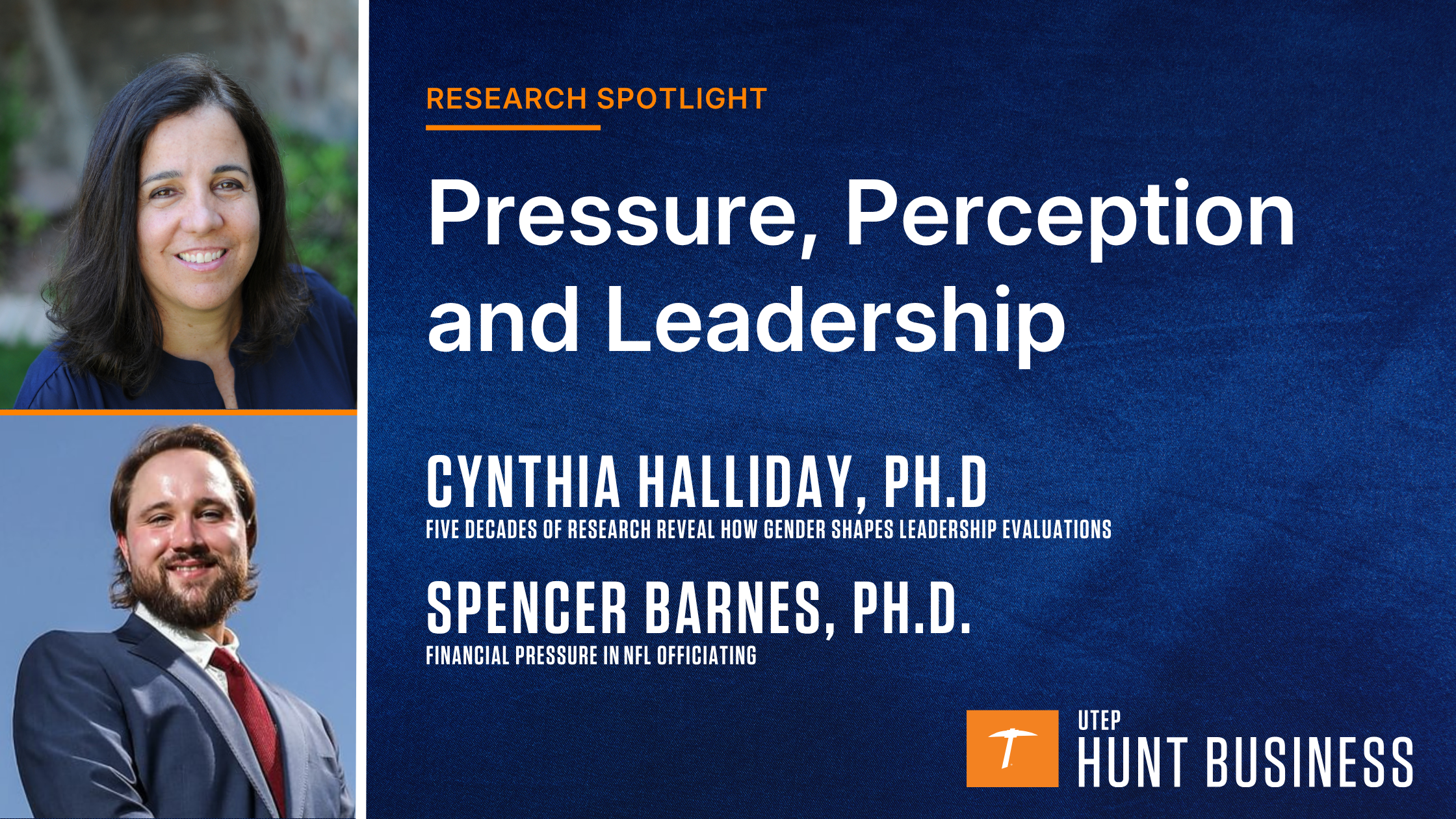
Research Spotlight: The University of Texas at El Paso Study Examines Financial Pressure in National Football League Officiating
A new study from The University of Texas at El Paso, led by Spencer Barnes, Ph.D., assistant professor of finance in the Woody L. Hunt College of Business, examines how financial incentives may subtly influence officiating decisions in the National Football League. Published in Financial Review, the research analyzed more than 13,000 penalty calls from 2015 to 2023 and found that postseason officiating disproportionately favored the Kansas City Chiefs during the Patrick Mahomes era. In particular, penalties against opposing defenses were more likely to result in first downs, significant yardage gains, and subjective calls such as roughing the passer or pass interference.
The study did not find similar patterns for other recent dynasties, including the New England Patriots during the Tom Brady era. Barnes and his team suggest the findings may reflect broader financial pressures on the league during periods of declining television ratings, framing the results within the concept of regulatory capture where institutions under economic strain may unconsciously adapt enforcement practices to protect revenue and market appeal. Beyond football, the research offers broader implications for governance, regulation and institutional decision-making under financial pressure.
Five Decades of Research Reveal How Gender Shapes Leadership Evaluations
Dr. Cynthia Halliday, associate professor of management, set out to answer a long-standing question in leadership research: Are men and women evaluated differently as leaders? Rather than relying on a single study, she and her collaborators examined 50 years of global research, analyzing hundreds of studies and thousands of leadership evaluations to understand how gender shapes perceptions across time and leadership levels. Their findings were striking across decades of data; women were consistently rated higher on effective leadership behaviors. They were seen as more supportive and ethical while also scoring just as highly on task-oriented and results-driven behaviors traditionally associated with leadership.
The implications are significant for organizations seeking to build fair and effective leadership pipelines. By synthesizing decades of mixed findings into a comprehensive analysis, Dr. Halliday’s work suggests that persistent gaps in advancement may stem less from performance differences than from bias in evaluation systems. Her research encourages businesses and HR professionals to reassess how leaders are assessed, developed, and promoted, while offering research-backed validation to women navigating leadership roles. For Dr. Halliday, the work reflects a broader commitment to rigorous, impactful scholarship that challenges outdated assumptions, strengthens institutional fairness, and mentors the next generation of researchers to ask bold questions that drive meaningful change.


