
BSN vs RN: Key Differences, Salaries and Career Benefits
Nursing is one of the most rewarding and in-demand careers in healthcare.
The U.S. Bureau of Labor Statistics projects more than 193,000 annual job openings for registered nurses through 2033 due to workforce turnover and growing healthcare needs, especially with aging populations.
For that reason, nurses enjoy strong job security, flexible work environments, and the satisfaction of helping people every day. But if you’re researching nursing career paths, you’ve likely seen terms like RN and BSN, and maybe wondered about the difference.
In short:
- RN (Registered Nurse) is a professional license you earn after passing the NCLEX-RN exam.
- BSN (Bachelor of Science in Nursing) is a four-year degree that is one pathway to becoming an RN, and often leads to higher pay and more opportunities.
This article breaks down BSN vs RN, including education requirements, salary comparisons, and why the BSN is becoming the preferred standard in nursing.

RN vs BSN: What’s the Difference?
A Registered Nurse (RN) is a licensed healthcare professional authorized to provide patient care across a variety of settings such as hospitals, clinics, nursing homes, and community health organizations.
To become an RN, you must complete an accredited nursing program and pass the National Council Licensure Examination (NCLEX-RN). The RN license represents the professional credential that allows nurses to practice.
Educational Pathways to RN Licensure:
- ADN (Associate Degree in Nursing): A two-year degree focused on foundational nursing knowledge and clinical skills.
- ASN (Associate of Science in Nursing): Similar to an ADN, typically emphasizing hands-on clinical training over theory.
- BSN (Bachelor of Science in Nursing): A four-year degree that integrates nursing science, leadership, research, and population health along with clinical experience.
How a BSN Fits into the RN Career Path
While all BSN graduates earn RN licensure after passing the NCLEX, not all RNs hold a BSN degree. The BSN is increasingly becoming the preferred educational pathway because it prepares nurses for a broader scope of practice, leadership roles, and graduate education opportunities.
Why Employers Prefer BSN Nurses
Improved Patient Outcomes with BSNs
According to the American Association of Colleges of Nursing (AACN), hospitals with more BSN-prepared nurses see better patient outcomes, including lower mortality rates. BSN programs provide comprehensive training in leadership, research translation, and population health, skills that are less emphasized in ADN and ASN programs.
As a result, many healthcare employers now:
- Require a BSN for new hires.
- Offer tuition reimbursement for RNs earning a BSN.
- Prefer BSN nurses for promotions and management roles.
Janise Tinsman, UTEP Director of the RN to BSN program, emphasizes this trend: “The American Nurses Association has long advocated that the entry-level requirement for nursing should be a BSN. Magnet-designated facilities, for example, only hire BSNs, and they often provide a more supportive work environment because they view nurses as valuable assets.”
BSN Advantages in Leadership and Communication Skills
BSN programs provide training beyond clinical skills, including leadership development, evidence-based practice, and advanced communication techniques. These skills enhance teamwork, patient education, and the ability to implement quality improvements in healthcare settings.
RN vs BSN Salary Comparison
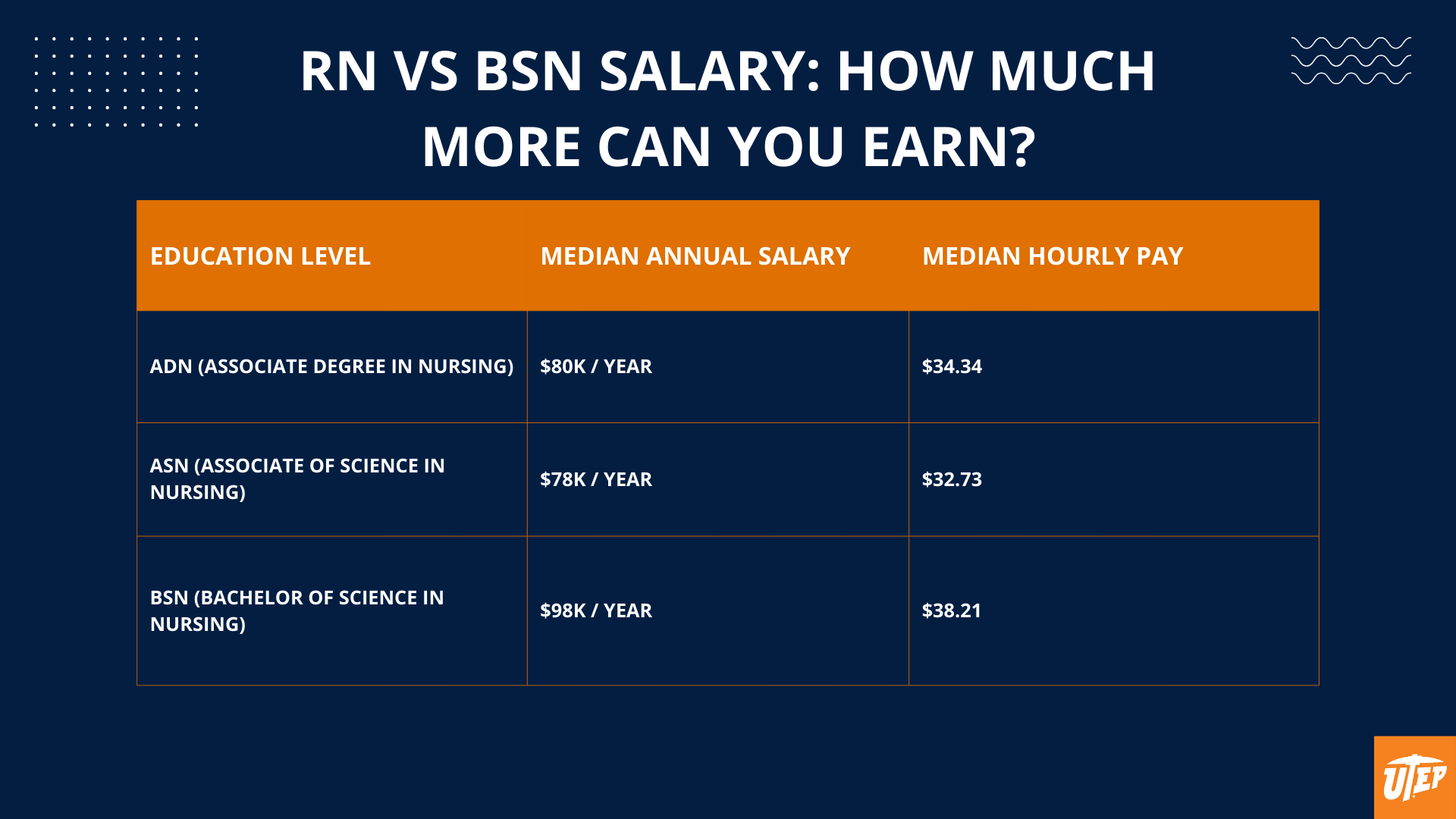
When comparing RN vs BSN salary, it’s clear that BSN-prepared nurses often earn more than RNs with an ADN or ASN. In addition to higher hourly pay, BSN nurses are more likely to qualify for leadership positions, specialty units, and management roles that boost total compensation. Employers also offer incentives like shift differentials, bonuses, and tuition reimbursement, making the RN pay vs BSN pay gap even more significant over time. Choosing a BSN can therefore enhance your career growth and long-term earnings.
RN vs BSN Hourly Pay
Nurses with a BSN typically earn higher hourly wages compared to those with an ADN or ASN. According to Payscale data, the average hourly pay for ADN-educated RNs is around $34.34, while BSN-prepared nurses earn about $38.21 per hour.
Additional Benefits of a BSN Degree
Career Advancement Opportunities
Holding a BSN opens doors to leadership roles, specialty nursing positions, and higher clinical ladder placements. Many employers also tie salary increases and promotions to BSN attainment.
Graduate School Readiness
BSN graduates can directly enter Master of Science in Nursing (MSN) programs without additional prerequisites, facilitating advancement into nursing education, administration, or advanced practice roles.
Job Security and Flexibility
With healthcare evolving rapidly, BSN-prepared nurses are more adaptable and qualified for diverse roles across settings, from clinical to administrative and community health, enhancing job security and flexibility.
Learn more about the benefits in our guide to the reasons to become a Nurse with a BSN.
RN to BSN at UTEP: Flexible, 100% Online
Already an RN? UTEP’s online RN to BSN program is designed for working nurses who want to upgrade their credentials without putting their career on hold.
Program Highlights:
- One course every 7 weeks—manageable alongside full-time work.
- Finish nursing-specific courses in as few as 2.5 semesters (after core requirements).
- Non-clinical mentorship projects that directly benefit your workplace.
- Pathway to UTEP’s MSN programs in education or administration.
With tuition reimbursement options and competitive salaries for BSN-prepared nurses, advancing your education can be both affordable and rewarding.


